What’s in a name?

In a previous post I discussed the importance of naming your book, product or company in such a way as to optimize it for search engines on the Internet. You do this by infusing the name or title with keywords.  Case in point: While I was in a grocery store the other day, I decided to test this hypothesis by examining the names of products.  The majority of packaging demonstrate this tendency.  I started to look a little ridiculous texting product names into my iPhone standing in the personal hygiene aisle, but here’s just one example of a product that has a keyword-infused name:

Right Guard Xtreme Fresh Blast Ultra Gel Anti-Perspirant Deodorant

That’s a mouth full, but I bet it comes up on an Internet search. Hey, if it works for Gillette, it can work for you…

Optimize your book or company for search

As we continue discussing how book marketing is similar in many ways to marketing a company, one consideration to always keep in mind is “search engine optimization.” This may seem a more appropriate topic when it comes to marketing a company, specifically as it relates to optimizing a company website, but the same considerations — and therefore the same tactics — hold true with regard to book promotion as well.

Optimizing your book for Internet sales starts with the title.  I discuss this subject in my book Sell Your Book on Amazon in regard to how Amazon’s search engine indexes books, but the same can be said for Internet search engines in general (Google, Yahoo, etc).  When “content” is indexed by computers, the “title” of that content is weighted quite heavily. For books, the title is… well, the title. For web pages, the title is the “title page” in the HTML.

This is so important for authors that Outskirts Press offers an optional service whereby we offer title suggestions to our authors.  This begins with seeing the author’s initial title and/or sub-title. We analyze that against the content of the book and against other books that may either share that title or be “too similar” to that title.   Next, we suggest 3 alternate titles and sub-titles that are geared toward maximizing the applicable “keywords” that define the book’s subject matter or content. 

Sub-titles for books are one of the most powerful, and one of the most overlooked, marketing opportunities for books in the Internet age.  One need look no further than five of the top 10 bestselling books published through Outskirts Press in 2009 for perfect examples. I’ll highlight the keywords that are helping these books get seen by more potential customers who conduct searches on the Internet.

  • The Complete Guide to Day Trading: A Practical Manual From a Professional Day Trading Coach, by Markus Heitkoetter
  • LEED AP Exam Guide: Study Materials, Sample Questions, Mock Exam, Building LEED Certification (LEED-NC) and Going Green, by Gang Chen
  • Meat Smoking and Smokehouse Design, by Stanley Marianski, Adam Marianski, Robert Marianski
  • Sell Your Book on Amazon: Top-Secret Tips Guaranteed to Increase Sales for Print-on-Demand and Self-Publishing Writers, by Brent Sampson
  • What To Do When You Become The Boss: How New Managers Become Successful Managers, by Bob Selden

If sub-titles are so successful for books, ask yourself…. should your company have one?  Are the names/titles for the products or services you launch optimized for search? These are important things to consider.

Establishing your expertise

Whether you are promoting a book or promoting a company, one integral step is establishing your expertise in your field.   If you are a novelist, your “field” is your genre. If you write non-fiction, your “field” is your topic or subject matter. If you own a clothing store, your “field” includes the clothing lines you carry. 

The question is not whether you are an expert in your field, since, presumably, you are if you have either written a book or started a business.   The question is, how do you establish that expertise publicly by sharing it with others, either your potential readers or your potential customers?

There are a number of ways to establish your expertise, and they are the same regardless of whether you have written a book or started a company.  One way is to write a blog. Another method is to write articles and distribute them through “article banks” on the Internet.  These are not mutually exclusive.  In fact, once you are doing one of these things, you can easily do the other. The writer’s maxim is the opposite of the old carpenter’s maxim: you should write it once, and use it twice — or even more!

Interestingly, if you own a business, one of the best ways to establish your expertise in your field is to write a book and publish it.

How book promotion is like company marketing

Marketing is marketing. There are some basic steps one must take to promote either a product or a service. As both an author with a book to promote and a business owner with a company to market, it becomes easier to see the similarities in the necessary steps:

1. Establish your expertise
2. Optimize your (new) product/service for Internet searching
3. Make it easy for people to buy your product/service
4. Give incentive for people to buy your product/service
5. Seek awards or other forms of recognition
6. Distribute press releases that announce your (new) award/product, and that…
7. Establish your expertise
8. Repeat

In the coming days and weeks I will discuss each of these steps specifically as they apply both to book promotion and company promotion…

Navigating the Amazon Sales Ranking

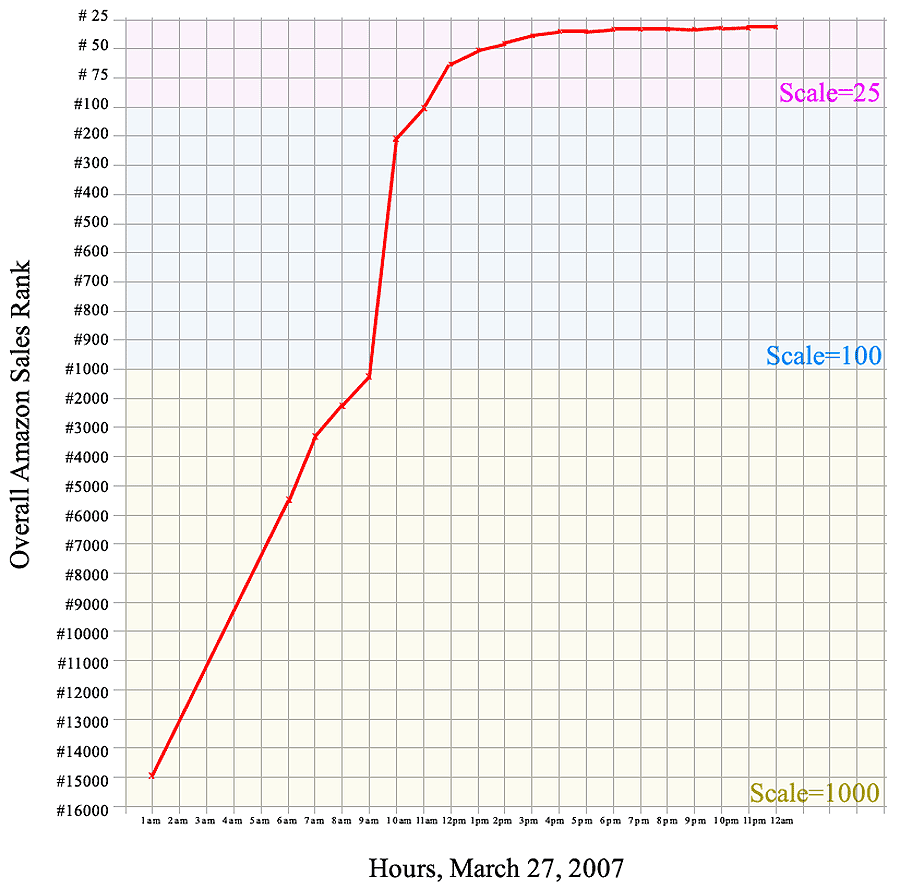
In a previous post I discussed my book SELL YOUR BOOK ON AMAZON’s climb up the Amazon Sales Chart as a result of specific marketing tactics. I included the following graph, which we charted on the day of the campaign:

There are some interesting things to notice about this cart.  For instance, you will notice how rapidly the ranking climbs from 15,000 to 3,000.  And then, again, you will notice how quickly it climbs from 1000 to 200 (the difference in scale notwithstanding, of course).  But also notice how slowly it climbs from 50 to 29.  This is probably obvious, but I’ll say it anyway: The closer you get to a #1 ranking, the more books you need to sell. 

One section of my book discusses the Amazon Sales Rank in detail, and the information may be helpful when looking at the above chart, so I’ll include it below:

First, the disclaimers: Since the algorithm Amazon uses to generate its sales ranking is proprietary, the details contained herein are extrapolated from research and field tests. The resulting consensus finds Amazon’s system to provide marginal sales data at best.

To whit, read Amazon’s own definition of its system, slightly paraphrased from their FAQ: “The Sales Ranking system exhibits how books are selling. The lower the number, the higher the sales. The calculation is based on sales and is updated each hour to reflect recent and historical sales of every item sold. We hope you find the Amazon.com Sales Rank interesting!” This last sentence seems to indicate Amazon’s own perspective on the importance with which the sales rankings should be viewed.

You’re not supposed to find the sales rankings informative or helpful. You’re supposed to find them interesting.

In actuality, the process is somewhat more convoluted than they let on. The ranking does not depend solely upon the actual number of books sold, but rather, on a comparison against the sales figures of the other books in their database (all 5 million+ of them) within that same hour. Simultaneously, a trending calculation is applied to arrive at a sales trajectory. So, hypothetically, a book that held a ranking of 2,000 at 2pm and 3,000 at 3pm, might hold a 4,000 ranking at 4pm, even if it actually sold MORE books between 3-4 than it did between 2-3.

Current projections and historic sales information also play a key role in these calculations. In fact, the predictive nature of the Amazon ranking system is what makes it possible for a newly-released book to outrank an older established title, even though the actual sales figures for the latter far exceed the former.

That said, sales history takes a back seat to current sales rankings. Sales projections and trending take an active role here, which is why a book’s ranking can leap from 900,000 to 200,000 in the span of 24 hours or less. Does this mean the book has sold 700,000 copies in 24 hours? Absolutely not! What it does mean is that recent activity (i.e. purchases) for that book is trending higher than those 700,000 books it just surpassed. But, don’t get excited just yet; since the activity of those 700,000 other books range from slow to stagnant, one or two orders are sufficient to catapult a ranking.

If a book’s ranking breaks into the top 100,000, the sales history calculation starts to rear its head, which is why a “phenomenon” book has a hard time maintaining a high, legitimate ranking. A phenomenon is defined by a book that leaps from the high hundred-thousands into the lower thousands (or better) in the span of 24 hours or less, usually due to some concentrated marketing initiatives. Since Amazon’s sales history for that title doesn’t support the leap, the spike occurs and then quickly drops again.

HOW DOES ALL THIS TRANSLATE TO ACTUAL SALES FIGURES?

Since the data is recalculated all the time, it’s impossible to arrive at accurate, cumulative sales figures, although those figures are applied to the algorithm during the calculation. No, to get a very rough idea of the actual number of books being sold, the sales ranking has to be dissected dynamically, with the same immediacy as the ranking being calculated. In other words, chart the ranking of the book at the same time every hour for 24 hours and then divide by 24 to arrive at its average daily ranking. Do that for seven straight days to arrive at its average weekly ranking.  You can do it all month long to arrive at its average monthly ranking. The longer your average timeframe, the more accurately your sales ranking will reflect “reality” (as opposed to a spike or dip in sales).

Are you a best-selling author? Part 2

A common question is, “How many books do you have to sell to become  a best seller?”

Well, it depends upon the list.  Another way of saying that is, it depends upon what you’re “comparing” your sales against.  While my Sell Your Book on Amazon is “officially” an “Amazon Best Seller” I will say that Outskirts Press has published many books that have sold more copies than Sell Your Book on Amazon in any given month, and many of them don’t refer to themselves as “best sellers.”   In fact, today on our Self Publishing News blog, our top 10 best sellers from 2009 are announced.

I will also say that a “best-selling” book doesn’t always translate to high revenue or high sales. In fact, those two criteria do not have to be connected at all.  We have other “official” Amazon Best Sellers who sold enough books to reach #1 in their category on Amazon for a period of time, but didn’t sell enough books to become one of our top 10 best-selling authors in that month.   We have other books where authors earn $20, $30, $50 or more for each copy of their books that Amazon sells, but the content is very niche.  As a result, their quantity of sales are never statistically “high” enough for them to be considered “best sellers” but we still send them impressive royalty checks. If their goal was to receive impressive royalty checks, mission accomplished. And then we have other authors who receive impressive royalty checks AND are best sellers in their category.

Authors have different goals when publishing a book. Some want to be famous; others want to make a lot of money; others want to share a message with the world; and still others want to attract the attention of an agent or New York publisher and get “picked up.”  We have helped authors reach all these goals, and that is part of our goal at Outskirts Press. Most authors’ goals fall into one of these four major categories, and being a “best selling” author is simply a by-product of, or a catalyst to, reaching one of those other goals.

Are you a best-selling author? Part 1

Some of my previous posts have already touched upon the caveat that should exist with the term “best-selling author” since different lists from different retailers have different values and different processes for creating the list.  An argument could be made that the only true way to define a “best-selling” book is based upon the number of copies it has sold.

As both the president of a self-publishing company and an author, I am in a fairly unique position of being able to see my own book sales, compare it with my Amazon Sales Rank, and then do the same for the 5,000+ other books that have been published through Outskirts Press.   I talk about this a little bit in Sell Your Book on Amazon, because I feel it’s a unique perspective.   And since I have an opportunity to share a unique perspective, I feel obligated to do so.

And here’s my perspective: If you have an “Amazon Best-Selling” book, you should be proud.  All things taken into consideration, that’s an amazingly hard feat to accomplish.   With the proliferation of books being published nowadays (500,000+ a year), it’s been said that publishing a book isn’t all that impressive anymore. Excuse me? There are over 6 billion people on the planet.  If you’ve written and published a book, no matter how you’ve done it, you’re in the minority. 

With the “best-selling Amazon campaign” it’s been said that being an “Amazon best seller” isn’t all that impressive anymore. Excuse me?  There are 500,000+ books published every year.  If your book was/is an Amazon best seller, no matter how you’ve done it, you’re in the minority.  And books that are Amazon best sellers still attract attention and kudos from publishing traditionalists like editors, agents, and conventional publishers.  These people are scanning the self-publishing ranks looking for their next authors/clients, but maybe no longer due to the strength of the book and the promise of its sales potential. Now I believe it is because an author that can “become an Amazon best seller” themselves has successfully demonstrated his or her ability to leverage/monetize their platform.  And that’s what is valuable to all publishers and agents — an author who not only has a platform, but can turn that platform into book exposure and book sales. Just having a list of 500,000 to million people to conduct the “campaign”  is impressive to publishers and agents, not to mention composing a “pitch” compelling enough to get a large number of those people (most of them strangers) to purchase something.  Like I said before, it’s all easier said than done, and that’s why being an Amazon best seller is a hard-earned, noteworthy status. We have many authors at Outskirts Press who have accomplished this, and it is a milestone in their continuing book promotion efforts.

How to add a graphic to your Twitter background

1. Go to twitter.com and sign-in to your account if you’re not already signed in. You do this along the upper-right hand corner.

2. Once you are signed-in, you will see your menu choices along the top and these include: Home, Profile, Find People, Settings, Help, and Sign out. Click on “Settings.”

3. You now get a sub-menu of choices under the “Settings” section, including: Account, Password, Mobile, Notices, Picture, Design, and Connections. Click on “Design.”

4. At this point, your computer may ask you whether you want to only view the “secure” elements of this page.  Click “No.”

5. You will see a collection of  “themes” you can select from.  Below the thumbnail choices representing your theme choices are two links: Change background image and Change design colors.  Click “Change background image.”

6. You will see a “Browse” button to the right of an empty box. This is how you select the graphic from your computer. If you already have your graphic, click the “Browse” button to upload it now and then skip to Step 10.

7. If you don’t have a graphic you will need to create one.  Depending upon your monitor’s resolution, it may appear that you have a “lot” of space for your background graphic. Or, it may appear that you have almost no space at all.  The “lower” your resolution, the less space you will have.  The graphic you use should be optimal for the maximum number of monitor resolutions, so it is best to keep your graphic no wider than 100 pixels wide.  For example, our logo is 76 pixels wide on our Twitter page, but there’s still some “room to spare” even on lower monitor resolutions.  So, if you’re thinking of uploading the cover to  your latest book (which would be a good idea if you’re an author), you may want to consider a graphic size of 100 pixels wide by 150 pixels high.

8. Depending upon the graphic, you may need to “color match” the background color setting from Twitter. Twitter claims to accept .gif images, too, so you may also be able to use a .gif image with a transparent background if necessary. Fortunately, if you’re putting up a square or rectangular image, like a book cover, you won’t have to worry about this.

9. Save your image to your computer and then use the “Browse” button on your Twitter settings page referred to above to upload your image.

10. Once you have uploaded your image, be sure to select it from the thumbnail choices that appear below the “Browse” button.  Note: If your image doesn’t appear, it means you indicated that you did NOT want to see non-secure images when you were asked. In that case, you’ll need to leave the “Design” page and then come back, answering the pop-up question properly.

11. Once you have selected your image thumbnail by clicking on it, click on the “Save Changes” button and your graphic will be added to your Twitter page’s background.

12. Congratulations! You’re done, and your branding on Twitter has officially started.

Branding your Twitter page

Let’s first take a look at the NFL’s Twitter page so you can see an example of what I discussed previously.  Depending upon your monitor’s resolution, you will either see the NFL logo clearly visible and non-obstructed along the left-hand side of the “conversation” box.  Or, if your monitor has a lower resolution, you may see part of the NFL logo “covered up” by portions of the Twitter page itself.  Or, I guess a 3rd alternative is, now that the Super Bowl is over, the NFL people may remove or alter the logo entirely, and naturally, I don’t have any control over that.

Now that you’re looking at an example, the goal is to put something of YOURS on your Twitter page that will help you brand yourself on Twitter.  With the example of the NFL fresh in our mind, we added our company’s name to our Twitter page on its side.  Obviously, we would prefer for it to be “right-side-up” but then one runs into the issue the NFL experienced, with the graphic being obstructed or partly-obstructed by the Twitter box and/or Twitter logo.  We have two versions of our “company graphic treatment” — a horizontal version and a “stacked vertical” version — but after experimenting with different lay-outs and sizes, this was what we settled on because it was the only one that looked consistently the same, regardless of monitor resolution.

And now this opens up a number of different topics for me to blog about in upcoming posts… 1) the creation and considerations involved in creating a graphic treatment for your company name by using ours as an example and 2) the details of adding a non-scrolling graphic to the background of your Twitter page.

I could cover some of that now, but I read in a recent Entrepreneur article — about “ghost blogging,” interestingly enough — that business/corporate blog postings are ideally supposed to be under 300 words in length. So, with that sage advice in mind, until next time….

Twitter, the Super Bowl, and branding

Before the Super Bowl this past weekend I went to the  NFL’s Twitter page to see what a media phenomenon like “the big game” was having on the social media site. Yes, lots of tweets and yes, lots of followers (over 1 million – wow!).  I also liked the way they had “branded” their page with an NFL logo.  On my monitor — which is set at a resolution of 1600 x 1200 — it looked fantastic. Almost too good actually.   So I looked at the same NFL Twitter page on a monitor set at a more common resolution, and the NFL logo was obstructed in a not-very-visually-pleasing manner by the “conversation box.”  You could see that the NFL logo was “behind” the content box on Twitter, and the left-most portion of the logo was clearly visible in the “border” of the frame, but on a whole, it looked more like a mistake than it should have, especially since over 1 million people were probably looking at it.

So I guess one could take away two morals from that story.  1) It’s hard to take “things” like that too seriously on the Internet — if the Super Bowl people can miss a concept like accounting for all common resolution types in front of 1 million people, you’re certainly forgiven if you do, too.  And, 2) branding your Twitter page is one of the quickest ways to give it a little panache in a land full of redundancy and duplicity. And we’ll discuss how in a future post…