
Am I a best-selling author? Part 3

I’ve said in the past that I use my own books as “guinea pigs” for the self publishing services we offer to authors.  If I am successful doing something, it is reasonable to think that someone else can be successful, also. If something I do doesn’t have the positive impact I was hoping for, I adjust and try again.  And if something fails, well then we know to either avoid suggesting it or to make an effort to advise our authors against it.

Such was one of the blog postings I made in 2005 on my old blog about Kirkus Discoveries, and it was one of the blog postings that led to an interview with the New York Times.   At the time I believe Kirkus Discoveries was charging $350 for a “review” of self-published books. Recently they charged $400 or more, and very recently, I hear the future of Kirkus Discoveries seems to be in jeopardy entirely.

However, at the time in 2005,  I had seen several of these Kirkus Discoveries reviews, courtesy of our authors, and came away with the feeling that this was not serving the best interests of self-publishing authors, in general.  So I said in my blog this was something I wouldn’t recommend to our authors. And our Marketing COACH suggested our authors think twice about doing it.

Anyway, back to the story — another experiment I tried with one of my books was the so-called “Amazon Bestseller Campaign.” There are people out there charging thousands of dollars for this concept, but here it is for free: Contact as many people as you can (suggestions range from 500,000 to one million people) via email.  Get as many people as you can to buy your book on Amazon all on the same day. Provide them with incentive to buy your book by offering them other products or services that have a value much greater than the cost of your book itself. 

Conducting this campaign has its pros and cons. It also has its share of people firmly entrenched in the “this is good” camp and others firmly entrenched in the “this is evil” camp.   All the “downsides” to this campaign contribute to the reasons we don’t currently offer it as a “service” for our authors — because a lot of our authors inquire about it.

Furthermore, pulling this off is easier said than done. Who knows 500,000 people they can email? Nowadays there are companies that charge thousands of dollars to implement this sort of campaign on behalf of the author. 

Personally, I didn’t need to pay anyone to do it for me because I had access to lists, and I knew other industry professionals who would support my campaign. But it did take a lot of my time orchestrating, and in retrospect, it may have actually been more cost-effective and efficient — and perhaps even effective — for me to just buy it as a “package” from someone else.  But, nevertheless, when Sell Your Book on Amazon was published, I conducted by own “bestseller” campaign as a test.

And it worked.  My book reached #29 on the overall Amazon Sales Rank on March 27th, 2007. Below is a chart of my book’s Amazon sales rank that day. Notice that I have to change the SCALE of the chart 3 times in order to keep the chart from being 10 feet tall. Also notice that the ranking starts at 15,000.  It would have done the same exact thing if it had started at 150,000 or 1,500,000.  The initial ranking is important though, because it implies Amazon’s “true” valuation of the book. Which means after the “campaign” is over, your book will mostly likely return to roughly the level it started at. But in the meantime, you may have acquired a few more reviews, a few more tags, and a little more activity around your book — and that helps support your longer term marketing tactics on Amazon.
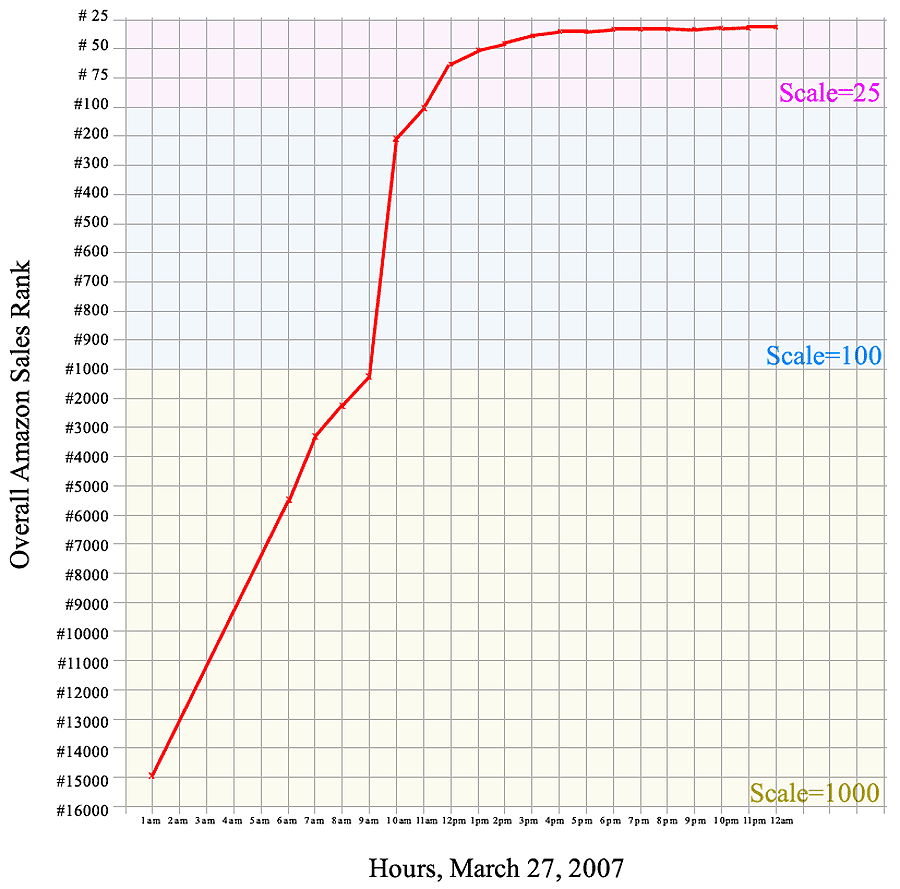
Click for a larger view (opens in a new window)

Was that an exciting day? You bet. Did I become a millionaire overnight? Of course not. I didn’t even reach #1. In fact, I didn’t even reach #1 in my category, which is the whole point of the campaign. I reached #2 in my category, because some HUGE best seller was #1, and I couldn’t knock it off.

As I mentioned in a previous post, best sellers are more a product of marketing than sales, just like Oscar winners are often more a product of marketing than quality.

Am I a best-selling author? Part 2

Let’s all conduct an experiment together. Go find a copy of Stephanie Meyer’s Eclipse paperback and look at the back cover. If you cannot find at least one copy lying around the house you either a) are not a woman or b) don’t know any women. This book is amazingly pervasive. Every woman I know has either read the Twilight Saga or is reading it (again).

On the back of the paperback edition of Eclipse it says:

The #1 New York Times Bestseller
The #1 USA Today Bestseller
The #1 Wall Street Journal Bestseller

Hmm, I guess Little, Brown — the publisher of Eclipse — prefers the single-word lexicon “bestseller” rather than the two-worded version preferred by Webster. But that’s not the point. The point is that there are multiple “best seller” lists. Eclipse promotes being the #1 best seller on 3 different lists from 3 different newspapers. Granted, in this case, these are highly respected lists.

But the fact is, nearly every major metropolitan newspaper has a “best seller” list, and most major booksellers or chains have their own best seller lists, too. The cynic inside me assumes that when a book promotes itself as being the “#1 bestseller” without specifying a list, it is because the best-selling list on which the book appeared #1 is NOT the New York Times, USA Today, or the Wall St. Journal.   But book marketing is book marketing and those publicists and marketers are doing whatever they can to draw attention to that book and that author in a very competitive environment. And the fact is, that book DID appear on some best-selling list, somewhere.

“Best-selling” status becomes even more questionable when you realize how the lists are compiled.  Are booksellers really pouring over weeks and months of data, comparing sales receipts against sales returns, and arriving upon a list of books that truly reflect higher sales compared against all other books?  Or, is a sales manager hastily completing a survey every week/month that rewards top-of-mind recall more than actual data?  This would make marketing and promotion the true factor involved, rather than actual sales, just as marketing and promotion is the true factor involved in the Oscar race, rather than performance/quality.

Am I questioning whether Eclipse is a #1 bestseller? Absolutely not!  I’m sure it is. As I mentioned, every woman I know owns a copy (and bought two more as gifts for other people last Christmas).   But I am saying that acquiring “best-selling” status is easier than it might appear and in many cases, might not even relate to actual sales volume.   And, there’s the rub; the moment something becomes “easier” to do, it receives less respect.  That’s one of the issues we face today with self-publishing.

But everything has a range of difficulty.  It’s easier to not write a book than it is to write one. So, right there, people who write a book deserve some level of respect.  Of course it’s easier to self-publish a book than it is to get a book traditionally accepted and published. But it’s even easier to not publish a book at all. Doing nothing is always easier than doing something.

And so it goes: writing a bad book is easier than writing a good one.  Writing a book that does not appear on any best seller lists is easier than writing a book that does appear on one or more best selling lists. Writing a book that does not earn a million dollar advance is easier than writing a book that does.   But are these black and white classifications?  Is a book only respectable IF it earns a million dollar advance, earns best seller status on the New York Times, and is published traditionally?

Certainly those accomplishments are worthy of admiration, but so are other accomplishments. Does someone choose not to respect Eli Manning because he’s not Peyton Manning? Even though publishing a book is becoming “easier” and becoming a “best selling” author is becoming “easier,” accomplishing these feats is still “hard” in the overall scheme of things. Any published book and any bestselling status is worthy of some level of kudos. 

If you are thinking about writing a book, don’t let anyone stop you. And if you are thinking about publishing a book, don’t let anyone stop you.

And with that prelude, the question remains: Am I a best-selling — or is it bestselling, or best selling– author?  Let’s examine that question further in an upcoming post…

Am I a best-selling author? Part One

I’ll start this topic by referencing a previous posting where I was considering adding “best-selling author” to the name of my blog.  The purpose is to add another applicable keyword phrase that people who may have interest in this blog could conceivably type into a search engine. I’ve already discussed in the past how blog names and individual blog post titles are important to consider for SEO purposes.

But, as I mentioned, adding “best-selling author” brings up a host of considerations, the first of which I’ll dissect now.

1. Keyword optimization is already complicated, and is made even MORE annoying by words and phrases that are – or could be – hyphenated.  At Outskirts Press, we run into this issue all the time within our marketing and IT departments regarding “self publishing” because you see it hyphenated just as often as not, and when considering topics like SEO, you are wise to support what people might do, and not necessarily what is correct.  That’s why pay-per-click bidding on common misspellings of popular keywords is almost as competitive as bidding on the correctly spelled words.

At any rate, adding “best-selling author” to my blog name raises one issue solely based upon the hyphen.  Without any other considerations, would it be better to say “best-selling” or “best selling” or “bestselling?” 

Hyphenation is often subjective, and everyone has an opinion. Other writers and editors are particularly apt to point out your foibles if you do something they don’t agree personally with — so there’s one can of words, right there,  raising the ire of my target audience. What can you say about a language where there are multiple manuals of styles — Strunk & White, A.P., Chicago– all equally credible, but often different in their approaches?  Officially — which means, in my humble opinion — “best-selling” should be hyphenated because you are linking a modifying adverb that doesn’t end in “ly.”  Other examples of this include “ill-favored” and “well-known” and… yes … “self-publishing.”

So, if one believes that little dose of English 201, one agrees that “best-selling” with the hyphen is the way to go.

But here’s the problem. The whole point of adding “best-selling” to the blog name is to optimize this blog for search engines, not to toot my horn!  Well, okay, maybe it is to add a small amount of additional credibility — but we’ll address that later, too…

The fact is, the majority of people don’t type hyphens into search engines. In fact, a surprising number of people often don’t type spaces into search engines, particularly in the case of potentially hyphenated or compound words like “self-publishing” or ‘best-selling.”

So, that logic would suggest that “bestselling” is the way to go.   But you know what? “Bestselling” isn’t a single word according to either of the dictionaries I use as a resource –where, often, compound words will be spelled differently depending upon the dictionary.  To add further complexity, of course Bill Gates and Word thinks “bestselling” is just fine; so who do you believe? Webster, who has been dead forever, or the richest guy in the world? It’s a tough choice, and Word for Windows has let me down before… I think we’ve all become too reliant upon its “spell check” and “grammar check” functionality that we sometimes eschew true copyediting due to time constraints or resources. Word is fairly competent when it comes to correcting misspellings, but less capable when it comes to correcting incorrect word usage. For that reason, when submitting a book for publication, I would recommend utilizing the services of a human copyeditor and not relying solely on a computer’s functionality.

Back to the story of what to do with this “best-selling” quagmire.   All decisions should be made by weighing all the pros and cons. And that requires understanding more of the issues.  Am I a best-selling author?  There’s more to that answer than just a hyphen, so more on that in the near future…

Outskirts Press, Colorado Humanities, and TIE

I’ve been trying to avoid blogging about the “day-to-day” details because, frankly, that’s not very interesting. Strategic topics are great to discuss here, but when I find myself composing a blog about the minutiae of running a company, I usually end up erasing it. Why? Because the minutiae here is probably the same as the minutiae everywhere else.   Once companies reach a certain size, there’s a certain similarity to what is involved, and while the “big picture” might be different, many of the steps are often the same. 

But last week had a few exceptions. I met with the nice folks at Colorado Humanities to discuss what they were going to do with the donation Outskirts Press made to their non-profit organization last year.  We are sponsoring their Colorado Book Awards and Student Literary Awards and also discussed some other potential collaborations.

Last Thursday evening I also attended a TIE Association meeting. TIE stands for The Internet Entrepreneur and Thursday’s speaker was Steve Knopper, who was discussing his book, Appetite for Self-Destruction: The Spectacular Crash of the Record Industry in the Digital Age.

I don’t think I’m saying anything surprising when I say it has some similarities with what is happening now with the traditional publishing industry…