Incorporating a small business on Legal Zoom – Pt 3

… continuing on with the step-by-step process of incorporating a small business on Legal Zoom…

11. After you enter your state of incorporation and your proposed business name and hit the CONTINUE button, it asks: Would you like us to help you obtain S corporation status?  It offers 3 options:

  • Yes, obtain my S-Corp status with the IRS
  • Yes, prepare my S-Corp form only
  • No (which means you want a C-Corp)

Here’s the help that Legal Zoom supplies in regard to this question: “An S corporation is treated as a pass-through entity for tax purposes. This avoids double taxation and may simplify your taxes. LegalZoom can obtain S corporation status for you, or we can prepare IRS Form 2553 so that you can more easily obtain it on your own. Please note that we can only help if the corporation has a fiscal year ending December 31.  Please note that one of the restrictions that apply to an S corporation is that it cannot have any preferred stock. You may only have common stock.  Preparation of IRS Form 2553 is included with the Gold Incorporation Package — otherwise, a $45 charge will apply. To have LegalZoom obtain S corporation status for you, an $80 charge will apply ($35 with the Gold Incorporation Package). If you would rather be a C corporation, select no. Which is better? There is no right answer to this question. The majority of our users form S corporations. You may wish to consult with an accountant to see which type of corporation is best for you.”

I’m going to obtain S-Corp status for my business, and I’m going to have LegalZoom obtain it for me for $80. I have better things to do.

12. Same thing with the next question: Would you like us to help the corporation apply for a federal tax identification number?

  • Yes, please obtain my tax ID for me.
  • No, prepare the form only
  • No

I’m going to have them obtain my tax ID for me.  That’s why I’m using  a service. It’s going to cost me $79.  When I look at my normal hourly rate, I have to ask myself how long it would take me to figure out how to do it on my own, then to actually do it, and then to deal with the anguish afterwards if I did it wrong.  Probably more than $79.

As I continue to draw parallels between this process and our online process of helping authors publish and market books at Outskirts Press, this is another similarity. We offer similar services/upgrades through the process. For instance, our authors are presented with the option early in the pre-production process to have us officially register their copyright for them with the U.S. Copyright Office. They can do this on their own, just like I could obtain my S-Corp status on my own, but it’s just easier to let someone else do it all for you. At least, that’s how I feel…

13. Then it asks: Are you a doctor, dentist, lawyer or other licensed professional seeking to form a Professional Corporation? If so, please check this box.

Personally, I’m saying No to that one, which means I leave the box blank.

14. Click SAVE AND CONTINUE

… to be continued…


Comparing Online Services for Incorporating a Small Business

Over the past several posts I’ve been blogging about incorporating a small business and have detailed the benefits of doing so followed by the general steps.  Not surprisingly, as the CEO of Outskirts Press, I believe using a professional online service to help you do something conveniently and easily is better than absorbing the learning curve of trying to figure out how to do it yourself.  It’s easier to go to a site and click  “ADD TO CART”  than it is trying to figure out how to register an ISBN, register a Copyright,  apply for a Library of Congress Number,  calculate the spine width of a book cover,  resample images to 300 dpi,  incorporate bleeds into a cover design,  format an interior in InDesign, and…..   Well, you get the idea. Sure, a writer could do all that herself, I suppose.    Why on earth would she want to?  Does she want to be a publisher, or does she want to be a published author?

I don’t want to incorporate businesses for a living. I just want one. So I’m going to find a service to help me, and to that end, I’ve found two comparison sites:

Compare Legal Forms

… and Top Consumer Reviews

Let’s look at only the services evaluated by both:

Compare Legal Forms also lists Incorporate, BizFilings, CorpNet, and Rocket Lawyer, while Top Consumer Reviews also lists The Company Corporation, My Corporation, My Law Daddy, and Corporate Creations.  If I were giving legal advice (which of course, I’m not, since I’m not a lawyer), I might recommend looking into all those alternatives, but for the sake of brevity, we’ll just compare the two options that are represented on both sites.

Compare Legal Forms doesn’t review the services, but rather lists their features. Top Consumer Reviews offers a review and a rating for each service it lists, and in their case, they consider Legal Zoom to be superior to My New Company.   I also happened to ask a CPA his opinion and he also recommended Legal Zoom, at least for me — your specific needs may vary. But that just goes to show, when possible, it’s always nice to hear or read what other people have to say, too.  For instance, we make our authors’ comments and testimonials readily available on the Internet (and we add 3 new ones each week) so anyone can review them by clicking here.

So… Legal Zoom it is… Stay tuned next week as I incorporate a business on Legal Zoom, step by step…


Which online service should you use to incorporate a small business?

Over the past couple posts I’ve discussed the advantages of incorporating and a brief outline of the steps involved in incorporating a small business. Now let’s do some research to determine the online service to use.  I’m going to incorporate a new company, so I’m going to research online services to help me.  But how to choose the “best” one?

It’s not unlike the process I recommend to authors or professionals when they are researching a self publishing company:  Locate a number of comparison or review sites and allocate a point system to come up with a combined value for all the firms you are researching.   This prevents any one opinion from carrying undue weight.  Do enough research on any large company on the internet and you will find unhappy campers and ecstatic customers. Who do you believe?  You believe yourself, but conducting research and common sense. So when you look at a number of sources and take a combined average score from all of them, you usually come away with a good, fair idea of the service or company. 

I performed this process for self-publishing firms to demonstrate what I mean. You can see the results of that effort by clicking here.

So now we get to compare online incorporation services. I’m going to use two comparison sites: CompareLegalForms.com and TopConsumerReviews.com.    Stay tuned tomorrow to see what happens next…

How to incorporate a small business

Yesterday we discussed the reasons someone might want to incorporate a small business. Today, we’ll outline the process.

How to incorporate a small business in 5 easy steps:

1. Determine the state of incorporation. Usually this is the state in which you reside and in which you plan to conduct your business. Sure, there are some long-term tax advantages to incorporating in states that have more advantageous tax laws, but unless you live in those states (Delaware is a favorite) then you have to qualify to conduct business in your state of residence anyway, which is kind of like incorporating twice.  Should it ever become valuable to consider the tax benefits, you can always incorporate in another state later, so right out of the gate, it’s easiest to incorporate in the state you live in.

2. Determine who will own stock. It’s easiest if that answer is “Me and my immediate family.” 

3. Check with your Secretary of State or Corporations Commissioner and the federal and state trademark registers to settle upon an available business name. You can find these sources via a Google search.

3. Prepare your Articles of Incorporation – These forms are state specific, but fortunately, the Internet has made it easier than ever to find the correct form. Here’s a handy-dandy map that allows you to click on your state and be taken to the appropriate form.

4. Complete your Corporate Bylaws – This online form service can help.

5. Files these documents with your state and pay the registration fee.

Not easy enough yet? No problem. There are incorporating services available on-line that promise to make the process of incorporating a business a snap (and affordable, to boot!)  Do they work? Stay tuned tomorrow as I compare some of the major players in Online Incorporations side-by-side and pick the one I’ll use to incorporate an actual business.

Certainly there is a correlation between this series of posts and our services at Outskirts Press.  Yes, I could incorporate my business by going to each government website individually and finding the proper forms and filling them out and doing everything manually.  But, instead, I’m going to opt to use an online service to make all that work faster and easier for me.  Am I going to have to pay for that convenience? Of course, but given the amount of time it would take me to learn how to do it all on my own, the convenience and knowledge that it is being done correctly is worth the cost to me.  The same can be said for self-publishing a book

Brent Sampson interview – part 4

… continued from yesterday…

JR: What is your favorite book and why?

Brent:  The Catcher in the Rye.  I find portions of it hilarious. That’s probably a little odd to admit, but there you have it.

JR: What is your ultimate goal for Outskirts Press? How do you intend to get there?

Brent: Ultimately, Outskirts Press will be a destination for writers who are seeking assistance with more than just publishing. We already offer ghostwriting, copyediting, and other a la carte services for authors who may not even know how they’re going to publish their book. And we are starting to add more and more book marketing services for authors who may have published elsewhere before realizing, by gosh, their publisher doesn’t offer any marketing support after publication.  These additional services to all authors are already starting to become available and we will continue to offer more.

JR: If I have dinner with any author, dead or alive, it would be…

Brent: …Bret Easton Ellis

JR: My biggest pet peeve about writers is…

Brent: …Is the same as my biggest joy about them: their artistic, passionate spirit.

JR: Other then running a publishing company and writing, I really enjoy…

Brent: …Spending time with my wife and son.

JR: One thing people would be surprised to know about me is…

Brent: …I’m an artist and used to sell a lot of artwork over the internet, complete with original poems on the back of original works.

JR: I wish I had more time to…

Brent: …Spend time with my wife and son.

 JR: Any final words or comments?

Brent: As the publishing industry is continuing to evolve, more writers are exploring ebook publishing first, through the Kindle, Nook, and iPad. Outskirts Press offers services to conveniently facilitate those publishing goals, regardless of where (or if) you published hard copy versions. And unlike most other platforms, we don’t take any of the royalties for ebook sales. Learn more at http://outskirtspress.com/p/kindle and http://outskirtspress.com/p/nook and http://outskirtspress.com/ipad respectively.

Brent Sampson interview – Part 3

Over the past several days I’ve been posting the transcription of an interview I conducted with Jairus Reddy of Hobbes End Publishers. I’m at a lot of conferences, seminars, and workshops and I conduct a lot of interviews, but I rarely mention most of that stuff on my blog because I’m not sure any of those “updates” are very helpful for visitors to this blog, who are primarily writers and entrepreneurs. How exciting or interesting or informative is it for them to hear that I was at a book expo in NY or attended workshops in Anaheim? Not very.

But sometimes when I converse with other industry professionals, I feel that the dialogue sometimes hold value, so, for what it’s worth, here’s the continuation of that interview. Parts 1 and 2 “aired” yesterday and the day before…

JR: What advice would you give an author who has a finished manuscript, but no idea where to go from there?

Brent:  Get it edited.  Publishing has become so “easy” that authors often jump straight to production when their manuscript needs a bit of work first. We offer editing services even for authors who don’t know where or how they’re going to publish at http://outskirtspress.com/p/editing and that’s the first thing I would recommend to any writer who just finished their book. Even if you plan on submitting your book to an agent or a traditional publisher for consideration, it needs to be edited first.  Some authors think that since traditional publishers edit manuscripts as a part of their production process, the book doesn’t have to be edited before submission. Nothing could be further from the truth; that misconception is one of the reasons the publisher or agent is going to turn you down.  Yes, editing is an investment, but so is publishing a book. If you publish a book for “free” guess what you’re going to have — a book that looks like it didn’t cost anything to make.  Even if you have no intention of paying to have your book published, you should plan on paying to have it professionally edited.

JR: I have had changing views on self-publishing over the last couple of years. All the authors I have interviewed or talked to, published by Outskirts, have always been satisfied. What separates your company from other “vanity” presses?

Brent: There are true “vanity” presses that blow wind up your skirt about how great your book is and then ask you to pay $10,000 dollars or more to publish it. They’re in a different category than us, so a comparison is non-applicable.  There are also do-it-yourself author mills that push out thousands of “books” a day without any human intervention, and those presses are in a different category, too.  But when comparing Outskirts Press with other quality, full-service self-publishing firms, there are a few benefits: 1) Outskirts Press authors keep 100% of their net profit for book sales. Our competitors pay around 50% and traditional publishers pay 5%-10%. 2) Our books win statistically more awards so authors know that quality and service is of utmost importance to us. 3) I’m a writer first and a CEO second. Writing a book might be an art form, but publishing one is a business, so our authors benefit from having the CEO walking that line right along with them. As the Hair Club for Men guy used to say, “I’m not only the president, I’m also a client.”

JR: How have you seen the industry change over the past ten years? Where do you think it will go from here?

Brent: The self-publishing industry is growing exponentially! Our growth has been phenomenal, as demonstrated by our three-year run on the Inc. 5000.  All of this increased growth has happened just in the past 10 years, but even so, a statistically small number of writers are aware of self-publishing as an option.  I still run into authors all the time at events who look at me like some sort of magician when I show them how easy and fast it is to get their book published and listed for sale on Amazon. As more writers become aware of their true publishing choices, self-publishing will continue to grow and evolve to meet their needs.

JR: I am always interested to why people have chosen their career path. Why did you decide to publish books?

Brent: It’s incredibly fulfilling.  We received written testimonials from authors holding their books, or videos from authors seeing their books for the first time, that will literally bring tears to your eyes — they’re so touching.  I know what the feeling is like, and I can’t possible write 7500 books, but I’ve enjoyed the experience of publishing 7500 books by living vicariously through our authors. It’s so rewarding.

… read the conclusion to this interview tomorrow…

Brent Sampson interview – part 2

… continued from yesterday’s post…

JR: As an author, what are your views on the publishing industry as a whole? How do these views differ from that as your role as CEO of Outskirts Press?

Brent:  I was always frustrated by the traditional publishing industry, and I still am. Even now, I rarely even get acknowledgement from literary agents when I submit anything to them. That’s rude. The traditional industry is kind of like the US Postal Service; the world has changed and their business model isn’t changing with it.   As the CEO of Outskirts Press, I can see both sides. Authors are artistic, creative, and passionate. Often that comes with a fervor that is hard to contain, and sometimes that fervor is joined by a type of “blindness” or “deafness” to suggestions, recommendations, or even business realities.

JR: Many authors, and even publishers, struggle to sell books. Why do you think these struggles persist and what advice would you give an author to sell more?

Brent:  Many authors have a misconception about what constitutes a financially successful book because they watch JK Rowling and Stephenie Meyer on the news and project themselves into that reality.  Well, there is a reason JK Rowling and Stephenie Meyer are on the news — they’re news! Which means, they’re exceptions.  In the business sense, a financially successful book is one that earns more than it cost to produce and market.  For self-publishing firms, it is much easier for an author to have a “successful” book because a successful self-publishing author is not subsidizing the publisher’s losses on their other books (well, unless you’re using a “free” service and then yes, your success is obviously subsidizing other authors’ failures).

 JR: You have a book called Sell Your Book on Amazon which has been well-reviewed. It seems to have helped many authors. If you could tell a new author how to reach their marketing and ultimately, sales potential, what would you tell them to do?

Brent:  Read as many books or articles about marketing that you can. Sell Your Book on Amazon is just one, and I would recommend it, but there are so many others, all filled with great suggestions and tactics, from Kremer’s 1001 Ways to Market Your Book to Weber’s Plug Your Book.  Read them all, and then, most importantly, act upon what you read. It doesn’t do any good if you don’t follow through on the advice.

JR: This book really came out at a prime time for internet sales to increase, as the economy really started it’s downturn around 2007. How has internet marketing revolutionized the industry? It seems like selling to “brick and mortar” retailers is not as imperative as it once was.

Brent: You’re right, as brick and mortar retail sales stagnate or even decline, online book sales have been growing consistently for a decade.  The “book math” is much more in the author’s favor and with social networking opportunities like blogs, Facebook, Twitter, and author websites, the marketing playing field has really leveled for a tenacious online marketer.

JR: You have another book called Self-Publishing Simplified that came out in 2005 when self-publishing was starting its rise in the industry. How do you think self-publishing has changed an industry that used to be dominated byNew York conglomerates? Where do you think it will go from here?

Brent:  The music analogy has been mentioned before in association with this question, and it’s very applicable.  Music conglomerates went out of business when music moved online, and no one seemed to realize (or care) that Apple wasn’t making their money selling music — they were making their money selling the hardware that played the music.  The same thing is happening now with Amazon and the Kindle, Apple and the iPad, and other up-and-comers.  And the publishing industry, even knowing what happened with music, is just passively allowing the same thing to happen to them.  That’s great news for Amazon and Apple, and for the content creators (writers) who use companies like Outskirts Press to manage the production and digital distribution side; but not such great news for traditional elements of the industry like New York publishers, literary agencies, or brick and mortar bookstores, all of whom are banging their heads on the wall instead of reading the writing on it.

… to be continued tomorrow…

Brent Sampson interview – Part 1

I’m at a lot of conferences, seminars, and workshops. I conduct a lot of interviews. I rarely mention most of that stuff on my blog because I’m not sure any of those kind of “updates” are very “helpful” for my readers, who are primarily writers and entrepreneurs.   How exciting or interesting or informative is it for them to hear that I was at a book expo in NY or attended workshops in Anaheim? Not very.

But sometimes when I converse with other industry professionals, I feel that the dialogue sometimes hold value, such as the recent interview I had with Jairus Reddy of Hobbes End Publishers.  For what it’s worth, here’s the transcript of that recent interview below:

JR: I am here today with Brent Sampson, CEO of Outskirts Press and author of Sell Your Book on Amazon and Self-Publishing Simplified. Hey Brent. Tell us a little about yourself, your company and your books.

Brent: I’m a writer and I have been ever since I was six, clanking out stories on an old Remington typewriter speckled in White-Out.  In 2002 I founded Outskirts Press with the purpose of publishing my own books but quickly discovered how fulfilling it was to help other writers overcome the same publishing and marketing obstacles I was encountering. We incorporated in 2003 and it’s been an exhilarating ride ever since!

JR: How many titles has Outskirts Press published?

Brent:  This number grows on a daily basis, but if you look at Amazon right now, today, we have 7,735 titles listed.

JR: Why should an author choose Outskirts Press over other publishers?

Brent:  It depends upon your goals. If your goal is to become an award-winning author with an award-winning book, Outskirts Press is your best choice. We offer the most economic packages and helpful pre-production, production, and post-publication options.  Our authors use their books to further establish their expertise in their professional fields, attract the attention of traditional literary agents and publishers, or leave their legacy.  Of course our authors keep all their rights, and one of the main benefits is that Outskirts Press authors also keep 100% of the profits of the book, too.

JR: Give us a little hint of what a typical day in your office is like. Most people don’t understand what publishers actually do on a day-to-day basis and the time these tasks take.

Brent:  You’re right, publishing a high-quality book takes some time and effort. Unfortunately, some self-service publishing firms out there have given authors the misconception that writers can self-publish their book without any assistance.  While they can, that doesn’t necessarily mean they should. The majority of the books being pushed out by those do-it-yourself places are supporting the stigma that self-published books are bad, ugly, and unprofessional.  The fact is that in almost all cases, a professionally published book needs the support and service of professionals who publish many books and can call upon that expertise.

JR: How do you manage the time to run a company and write? I have written a couple short stories for The Endlands anthology, but they only took 3 hours each to write. It must be completely different when you are working on a project where you are the primary author and trying to maintain your business routine.

Brent:  Fortunately, it’s not just me at Outskirts Press. We have an army of consultants, editors, illustrators, cover designers, interior book designers, production supervisors, and project managers.  Our Operations Officer oversees the production, our Financial Officer oversees all the accounting and royalty departments, and our Vice President runs things from day to day.  Even so, you’re right, as Outskirts Press has gotten bigger and more complicated, the time I have to devote to writing has decreased substantially. It’s a constant struggle to find time. Writers NEED to write, and I’m no exception.

… interview to be continued tomorrow…

Why didn’t Amazon buy Borders.com?

On September 26, 2011 the federal bankruptcy court approved the sale of  Borders’ brand trademarks, domain names, and customer lists to Barnes & Noble for approximately $14 million. The true value of the sale was just shy of $16 million but a bookseller — in Malaysia! — bought the remaining assets totaling approximately $2 million.  As a result, Barnes & Noble received customer information, mailing lists, and all the traffic resulting from www.borders.com – it now forwards directly to barnesandnoble.com.

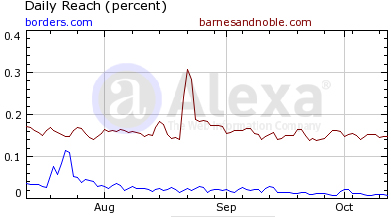
These assets were offered in an auction. So one has to ask, why didn’t Amazon buy them?   Here are some thoughts:  Amazon probably already has all the customer information Borders.com was offering.  But wouldn’t the domain names redirecting to Amazon.com be something Jeff Bezos & Co. would value?  Perhaps. Perhaps not.  Here’s a comparison of the website traffic for borders.com, barnesandnoble.com, and amazon.com, courtesy of our friends at Alexa:

Perhaps Amazon felt the Borders.com domain name was not very valuable. And this chart below can demonstrate perhaps why Barnes & Noble did … their traffic is at least in the same ball park, once you remove Amazon from the scale:

What do you think? Should Amazon have bought Borders’ assests rather than allowing Barnes & Noble to take ownership of them? I’ll open up a public poll tomorrow…

Borders.com forwards to Barnes & Noble’s website

So have you tried to buy anything from Borders.com lately? As you probably know, Borders declared bankruptcy over the summer and began liquidating their stores shortly thereafter, but their website presence remained unchanged, at least at the time.

No longer. Type in www.borders.com and you’re taken to a landing page on the Barnes & Noble website.

This isn’t a page on borders.com referring to a redirect. The redirect is happening at the domain level, taking the user to barnesandnoble.com.  Wow. 

As a part of their bankruptcy, Borders opened their customer information and domain names to bidders in an auction.  ( Hmm, I wonder why they didn’t use e-bay…)  The auction involved 50 rounds of bidding and included both booksellers and online retailers.   Apparently Barnes & Noble paid $13.9 million.  

Which makes you wonder whether or not Amazon was a part of the bidding.  And I’ll look into why Amazon perhaps didn’t care too much about the borders.com domain name next time…