Brent Sampson interview – Part 3

Over the past several days I’ve been posting the transcription of an interview I conducted with Jairus Reddy of Hobbes End Publishers. I’m at a lot of conferences, seminars, and workshops and I conduct a lot of interviews, but I rarely mention most of that stuff on my blog because I’m not sure any of those “updates” are very helpful for visitors to this blog, who are primarily writers and entrepreneurs. How exciting or interesting or informative is it for them to hear that I was at a book expo in NY or attended workshops in Anaheim? Not very.

But sometimes when I converse with other industry professionals, I feel that the dialogue sometimes hold value, so, for what it’s worth, here’s the continuation of that interview. Parts 1 and 2 “aired” yesterday and the day before…

JR: What advice would you give an author who has a finished manuscript, but no idea where to go from there?

Brent:  Get it edited.  Publishing has become so “easy” that authors often jump straight to production when their manuscript needs a bit of work first. We offer editing services even for authors who don’t know where or how they’re going to publish at http://outskirtspress.com/p/editing and that’s the first thing I would recommend to any writer who just finished their book. Even if you plan on submitting your book to an agent or a traditional publisher for consideration, it needs to be edited first.  Some authors think that since traditional publishers edit manuscripts as a part of their production process, the book doesn’t have to be edited before submission. Nothing could be further from the truth; that misconception is one of the reasons the publisher or agent is going to turn you down.  Yes, editing is an investment, but so is publishing a book. If you publish a book for “free” guess what you’re going to have — a book that looks like it didn’t cost anything to make.  Even if you have no intention of paying to have your book published, you should plan on paying to have it professionally edited.

JR: I have had changing views on self-publishing over the last couple of years. All the authors I have interviewed or talked to, published by Outskirts, have always been satisfied. What separates your company from other “vanity” presses?

Brent: There are true “vanity” presses that blow wind up your skirt about how great your book is and then ask you to pay $10,000 dollars or more to publish it. They’re in a different category than us, so a comparison is non-applicable.  There are also do-it-yourself author mills that push out thousands of “books” a day without any human intervention, and those presses are in a different category, too.  But when comparing Outskirts Press with other quality, full-service self-publishing firms, there are a few benefits: 1) Outskirts Press authors keep 100% of their net profit for book sales. Our competitors pay around 50% and traditional publishers pay 5%-10%. 2) Our books win statistically more awards so authors know that quality and service is of utmost importance to us. 3) I’m a writer first and a CEO second. Writing a book might be an art form, but publishing one is a business, so our authors benefit from having the CEO walking that line right along with them. As the Hair Club for Men guy used to say, “I’m not only the president, I’m also a client.”

JR: How have you seen the industry change over the past ten years? Where do you think it will go from here?

Brent: The self-publishing industry is growing exponentially! Our growth has been phenomenal, as demonstrated by our three-year run on the Inc. 5000.  All of this increased growth has happened just in the past 10 years, but even so, a statistically small number of writers are aware of self-publishing as an option.  I still run into authors all the time at events who look at me like some sort of magician when I show them how easy and fast it is to get their book published and listed for sale on Amazon. As more writers become aware of their true publishing choices, self-publishing will continue to grow and evolve to meet their needs.

JR: I am always interested to why people have chosen their career path. Why did you decide to publish books?

Brent: It’s incredibly fulfilling.  We received written testimonials from authors holding their books, or videos from authors seeing their books for the first time, that will literally bring tears to your eyes — they’re so touching.  I know what the feeling is like, and I can’t possible write 7500 books, but I’ve enjoyed the experience of publishing 7500 books by living vicariously through our authors. It’s so rewarding.

… read the conclusion to this interview tomorrow…

Brent Sampson interview – part 2

… continued from yesterday’s post…

JR: As an author, what are your views on the publishing industry as a whole? How do these views differ from that as your role as CEO of Outskirts Press?

Brent:  I was always frustrated by the traditional publishing industry, and I still am. Even now, I rarely even get acknowledgement from literary agents when I submit anything to them. That’s rude. The traditional industry is kind of like the US Postal Service; the world has changed and their business model isn’t changing with it.   As the CEO of Outskirts Press, I can see both sides. Authors are artistic, creative, and passionate. Often that comes with a fervor that is hard to contain, and sometimes that fervor is joined by a type of “blindness” or “deafness” to suggestions, recommendations, or even business realities.

JR: Many authors, and even publishers, struggle to sell books. Why do you think these struggles persist and what advice would you give an author to sell more?

Brent:  Many authors have a misconception about what constitutes a financially successful book because they watch JK Rowling and Stephenie Meyer on the news and project themselves into that reality.  Well, there is a reason JK Rowling and Stephenie Meyer are on the news — they’re news! Which means, they’re exceptions.  In the business sense, a financially successful book is one that earns more than it cost to produce and market.  For self-publishing firms, it is much easier for an author to have a “successful” book because a successful self-publishing author is not subsidizing the publisher’s losses on their other books (well, unless you’re using a “free” service and then yes, your success is obviously subsidizing other authors’ failures).

 JR: You have a book called Sell Your Book on Amazon which has been well-reviewed. It seems to have helped many authors. If you could tell a new author how to reach their marketing and ultimately, sales potential, what would you tell them to do?

Brent:  Read as many books or articles about marketing that you can. Sell Your Book on Amazon is just one, and I would recommend it, but there are so many others, all filled with great suggestions and tactics, from Kremer’s 1001 Ways to Market Your Book to Weber’s Plug Your Book.  Read them all, and then, most importantly, act upon what you read. It doesn’t do any good if you don’t follow through on the advice.

JR: This book really came out at a prime time for internet sales to increase, as the economy really started it’s downturn around 2007. How has internet marketing revolutionized the industry? It seems like selling to “brick and mortar” retailers is not as imperative as it once was.

Brent: You’re right, as brick and mortar retail sales stagnate or even decline, online book sales have been growing consistently for a decade.  The “book math” is much more in the author’s favor and with social networking opportunities like blogs, Facebook, Twitter, and author websites, the marketing playing field has really leveled for a tenacious online marketer.

JR: You have another book called Self-Publishing Simplified that came out in 2005 when self-publishing was starting its rise in the industry. How do you think self-publishing has changed an industry that used to be dominated byNew York conglomerates? Where do you think it will go from here?

Brent:  The music analogy has been mentioned before in association with this question, and it’s very applicable.  Music conglomerates went out of business when music moved online, and no one seemed to realize (or care) that Apple wasn’t making their money selling music — they were making their money selling the hardware that played the music.  The same thing is happening now with Amazon and the Kindle, Apple and the iPad, and other up-and-comers.  And the publishing industry, even knowing what happened with music, is just passively allowing the same thing to happen to them.  That’s great news for Amazon and Apple, and for the content creators (writers) who use companies like Outskirts Press to manage the production and digital distribution side; but not such great news for traditional elements of the industry like New York publishers, literary agencies, or brick and mortar bookstores, all of whom are banging their heads on the wall instead of reading the writing on it.

… to be continued tomorrow…

Brent Sampson interview – Part 1

I’m at a lot of conferences, seminars, and workshops. I conduct a lot of interviews. I rarely mention most of that stuff on my blog because I’m not sure any of those kind of “updates” are very “helpful” for my readers, who are primarily writers and entrepreneurs.   How exciting or interesting or informative is it for them to hear that I was at a book expo in NY or attended workshops in Anaheim? Not very.

But sometimes when I converse with other industry professionals, I feel that the dialogue sometimes hold value, such as the recent interview I had with Jairus Reddy of Hobbes End Publishers.  For what it’s worth, here’s the transcript of that recent interview below:

JR: I am here today with Brent Sampson, CEO of Outskirts Press and author of Sell Your Book on Amazon and Self-Publishing Simplified. Hey Brent. Tell us a little about yourself, your company and your books.

Brent: I’m a writer and I have been ever since I was six, clanking out stories on an old Remington typewriter speckled in White-Out.  In 2002 I founded Outskirts Press with the purpose of publishing my own books but quickly discovered how fulfilling it was to help other writers overcome the same publishing and marketing obstacles I was encountering. We incorporated in 2003 and it’s been an exhilarating ride ever since!

JR: How many titles has Outskirts Press published?

Brent:  This number grows on a daily basis, but if you look at Amazon right now, today, we have 7,735 titles listed.

JR: Why should an author choose Outskirts Press over other publishers?

Brent:  It depends upon your goals. If your goal is to become an award-winning author with an award-winning book, Outskirts Press is your best choice. We offer the most economic packages and helpful pre-production, production, and post-publication options.  Our authors use their books to further establish their expertise in their professional fields, attract the attention of traditional literary agents and publishers, or leave their legacy.  Of course our authors keep all their rights, and one of the main benefits is that Outskirts Press authors also keep 100% of the profits of the book, too.

JR: Give us a little hint of what a typical day in your office is like. Most people don’t understand what publishers actually do on a day-to-day basis and the time these tasks take.

Brent:  You’re right, publishing a high-quality book takes some time and effort. Unfortunately, some self-service publishing firms out there have given authors the misconception that writers can self-publish their book without any assistance.  While they can, that doesn’t necessarily mean they should. The majority of the books being pushed out by those do-it-yourself places are supporting the stigma that self-published books are bad, ugly, and unprofessional.  The fact is that in almost all cases, a professionally published book needs the support and service of professionals who publish many books and can call upon that expertise.

JR: How do you manage the time to run a company and write? I have written a couple short stories for The Endlands anthology, but they only took 3 hours each to write. It must be completely different when you are working on a project where you are the primary author and trying to maintain your business routine.

Brent:  Fortunately, it’s not just me at Outskirts Press. We have an army of consultants, editors, illustrators, cover designers, interior book designers, production supervisors, and project managers.  Our Operations Officer oversees the production, our Financial Officer oversees all the accounting and royalty departments, and our Vice President runs things from day to day.  Even so, you’re right, as Outskirts Press has gotten bigger and more complicated, the time I have to devote to writing has decreased substantially. It’s a constant struggle to find time. Writers NEED to write, and I’m no exception.

… interview to be continued tomorrow…

Should Amazon have bought Borders.com?

On September 26, 2011 the federal bankruptcy court approved the sale of Borders’ brand trademarks, domain names, and customer lists to Barnes & Noble for approximately $14 million, sold through an action involving 50 rounds of bidding.

Where was Amazon?

Should Amazon have bought Borders’ assets, including its trademarks, domain names (including Waldenbooks), and its customer information, including mailing addresses and emails? What do you think?

Why didn’t Amazon buy Borders.com?

On September 26, 2011 the federal bankruptcy court approved the sale of  Borders’ brand trademarks, domain names, and customer lists to Barnes & Noble for approximately $14 million. The true value of the sale was just shy of $16 million but a bookseller — in Malaysia! — bought the remaining assets totaling approximately $2 million.  As a result, Barnes & Noble received customer information, mailing lists, and all the traffic resulting from www.borders.com – it now forwards directly to barnesandnoble.com.

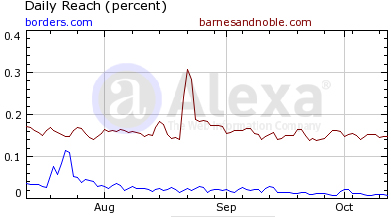
These assets were offered in an auction. So one has to ask, why didn’t Amazon buy them?   Here are some thoughts:  Amazon probably already has all the customer information Borders.com was offering.  But wouldn’t the domain names redirecting to Amazon.com be something Jeff Bezos & Co. would value?  Perhaps. Perhaps not.  Here’s a comparison of the website traffic for borders.com, barnesandnoble.com, and amazon.com, courtesy of our friends at Alexa:

Perhaps Amazon felt the Borders.com domain name was not very valuable. And this chart below can demonstrate perhaps why Barnes & Noble did … their traffic is at least in the same ball park, once you remove Amazon from the scale:

What do you think? Should Amazon have bought Borders’ assests rather than allowing Barnes & Noble to take ownership of them? I’ll open up a public poll tomorrow…

Borders.com forwards to Barnes & Noble’s website

So have you tried to buy anything from Borders.com lately? As you probably know, Borders declared bankruptcy over the summer and began liquidating their stores shortly thereafter, but their website presence remained unchanged, at least at the time.

No longer. Type in www.borders.com and you’re taken to a landing page on the Barnes & Noble website.

This isn’t a page on borders.com referring to a redirect. The redirect is happening at the domain level, taking the user to barnesandnoble.com.  Wow. 

As a part of their bankruptcy, Borders opened their customer information and domain names to bidders in an auction.  ( Hmm, I wonder why they didn’t use e-bay…)  The auction involved 50 rounds of bidding and included both booksellers and online retailers.   Apparently Barnes & Noble paid $13.9 million.  

Which makes you wonder whether or not Amazon was a part of the bidding.  And I’ll look into why Amazon perhaps didn’t care too much about the borders.com domain name next time…

How to get venture capital

 Every year when Outskirts Press appears on the Inc 5000 of fastest growing private companies we get a deluge of calls, letters, and proposals from investment bankers, venture capitalists, and the like. It’s easy to become flattered by all this attention from companies offering to give you lots of money, but the reality is that most of these companies are simply using the Inc 5000 as a source for approaching possible companies of interest. I used to take it more seriously than I do now, because in some cases I’ve had follow-up conversations with firms who have expressed an interest in Outskirts Press only to discover that they really don’t know anything about us – other than the fact that we are profitable and growing quickly and consistently.  True, in this day and age, those characteristics alone are worth the phone call. But you would think, since those corporate characteristics are so rare, that those firms would take a moment to learn at least some talking points about the firms they are pursuing in advance of sending out letters.

It reminds me of that old axiom, when you need a credit card you can’t get one. The same holds true for investment capital. You can’t get money when you need it, but once you don’ t need it, everyone is offering it to you. That’s why I prefer the bootstrapping method of starting a company rather than the investment method.  If you bootstrap a successful company venture capitalists will literally come out of the woodwork to find you.  Why? Because you’ve already demonstrated you have what it takes to be successful.  A venture capitalist would prefer to work with an established, profitable company than with an unknown because venture capitalists are gamblers, and gamblers like to hedge their bets.

How hard is it to find an analogy in the above paragraph fo today’s authors and publishers?  A publisher would prefer to work with an established, profitable author than with an unknown, because traditional publishers are gamblers, and gamblers like to hedge their bets.  Self-publishing is the “bootstrapping” equivalent to starting your own business.  You aren’t having something given to you. You’re so confident in your own offering (whether it be a book or a business) that you do it yourself.  It’s a viable key to success.

What is a “gazelle” in the business world?

I received a letter in the mail from a company that identified Outskirts Press as a “gazelle.”  Apparently, gazelles, by definition, are companies that are growing at least 20% annually for at least four consecutive years.   According to the Financial Times Lexicon gazelle corporations  are quite scarce in most economies, comprising about 5% – and at the most 10% – of all new entrants in a given cohort entry. They are of major political and economic interest because they are seen as potential large employers and wealth creators of the future.

By definition, almost any successful small company is bound to be a gazelle at the start (from a tiny base) and are therefore usually excluded from discussions of gazelles. And this is the same economic reality that makes it difficult to appear on the Inc 5000 list multiple years in a row.  The majority of companies do it by getting investors to give them money, rather than by getting customers to pay them for their services or products. I’ll talk about that more next time…

Book Marketing Online

Yesterday when I posted the recent webinar I conducted about using Amazon to market your business or your book I mentioned that it would stream from MetaCafe because it exceeded YouTube’s length maximums.  That didn’t prevent me from uploading it to YouTube; I just didn’t expect it to work.  But, surprise, surprise.  It appears to have loaded just fine onto YouTube, even though it’s over an hour long.  Just goes to show: you can’t believe everything you read on the Internet. Sometimes, you have to experience things yourself. 

Here’s the stream of the webinar again, embedded into this blog, for your convenience:  Book Marketing Online Through Amazon. Enjoy…


How to market your book (or your business) on Amazon

I recently conducted a webinar for the Internet Marketing Club on the topic of using Amazon to market your book or your business. Rather than getting into the nitty-gritty or summarizing it, I’ll just provide the entire webinar here in its entirety. I hope you all find it helpful. It’s long — 60 minutes — but filled with content about how to establish your presence, your content, and your expertise on Amazon in order to promote your book or business.

Just click on the image below to watch. You’ll be taken from WordPress to MetaCafe’s website, since WordPress doesn’t support embedded MetaCafe videos and YouTube’s maximum video length is 15 minutes… 

Here’s also a convenient way to purchase the two products mentioned in the video.  You can save 10% on my book, Sell Your Book on Amazon, by clicking here.

And you can save 25% off a la carte pricing on three specific Amazon Marketing options (Kindle, Search Inside, Keyword Tagging) we offer with the Amazon Extreme package by clicking here (and in that case, we’ll include a free copy of Sell Your Book on Amazon).

Enjoy…