Scheduling social media blasts in advance

So if you’re not as famous as Ashton and Britney (and let’s face it, most of us aren’t), then automation and strategic scheduling are tactics you can employ to maximize your social networking strategy. I discussed automation previously. 

Scheduling it just what it sounds like — plotting the release schedule of blog postings, ping updates, and social comments, etc.  The idea behind scheduling is to spread out the content you are distributing so that something “new” is posted every couple of hours.  This is relatively easy if you’re the only one doing the posting. It becomes harder if you have to coordinate these efforts with other people or other departments.   

The automatic aggregation makes it even more difficult still. TweetDeck, Hoot Suite, Feed Burner, Ping.fm, and the like don’t all operate instantaneously.  They update in batches.  So for example,  Feed Burner distributes this blog via RSS to our Twitter feed, but there is a discrepancy between when this blog is posted “live” and when Feed Burner syndicates the feed to Twitter.   Normally, this discrepancy isn’t that big of a deal, but when you’re trying to schedule postings in advance, such a delay complicates matters even further.

While I realize strategically what would be optimal, actually accomplishing such a lofty goal as strategically scheduling social content is still mostly a pipe dream I have.  For example, if one watches our own Twitter feed, one often sees 3-4 tweets come in quick succession (within a matter of seconds or minutes) when it would be best to spread those out across several hours.  In fact the only true tactic I’ve successfully accomplished is by scheduling my own blog posts to go “live” in the afternoons.  This is because I know our other blogs and social activities often (though not always) take place in the morning.    In other words, it is important enough to me to play a role in what keeps me up at night, but not really important enough for me to mandate some schedule with other people/departments at Outskirts Press.

Even Ashton Kutcher and Britney Spears can’t believe everything that is on the Internet

As I mentioned in the last post, Ashton Kutcher and Britney Spears have almost 6 million Twitter followers each.  That is mostly due to their celebrity status. While they have both been passionate “tweeters” in the past, it’s not ONLY due to their consistency that they have so many followers. In fact, according to celebritytweet.com, Ashton Kutcher averages .6 tweets per day and Britney Spears averages 0 (yes, zero) tweets per day.  How accurate is this information?  Well, let’s see:  Celebritytweet.com also reports that Ashton has only 4.6 million followers (not the 5.8 million reported by Twitter) and Britney only has 75,000 followers (instead of the 5.9 million fans reported by Twitter).  Which source is more accurate?   

And that just goes to show, you can’t believe everything you read on the Internet.  Hmm… where have I mentioned that before?

How do Ashton Kutcher and Britney Spears do it?

Ashton Kutcher has 5.8 million Twitter followers and appears to “tweet” a 140 character (or less) message 4-5 times a day at least.  Britney Spears has 5.9 Twitter followers even though she “tweets” what appears to be just about 4-5 times a week on average; and she even has help doing that.

Certainly being a big name celebrity doesn’t hurt, but what these two Twitter aficionados have demonstrated is that consistency with Twitter updates is one of the cornerstones to attracting followers.  That’s all well and good if you don’t already have a full-time job; but as most mere mortals soon discover– Twittering consistently and frequently can be a lot of work.

How do they do it?

Well, I can’t speak for them (having an entourage probably helps), but for the rest of us, it helps to rely on a little bit of automation and a little bit of strategy.  At least, that’s what we do at Outskirts Press to find the time to manage a somewhat realized “social networking footprint” while still devoting the majority of our time and resources toward efforts that benefit our clients the most (ie., producing award-winning books).

First let’s discuss the automation. We use three aggregators frequently: Ping.fm, Feed Burner, and Tweet Deck.   The first two are among the “tips” I discuss in detail in my upcoming book “0-60: Accelerating Your Online Marketing Efforts” and they also play a role in my upcoming presentation on the same topic at the Self Publishing Book Expo in New York on the first Saturday in October.

Ping.fm allows you to broadcast a single message simultaneously to about 50 different social networking sites. It requires an up-front time investment to set-up those sites initially with a profile, password, username, etc.  But once those sites are set-up, Ping.fm allows you to “participate” on all of them relatively efficiently.   Of course, part of the advantage of Web 2.0 is that it is a “two way conversation” and that is where Ping.fm has its drawbacks. Sure, it is very efficient at initiating one way correspondence, perhaps too efficient, because those messages then require some manual participation to moderate and respond to the “two way conversation” that results.  Managing 50 social networking sites is beyond our company’s resources; perhaps your company is in a different place. So we pick and choose the channels we invest time and energy in.  Not coincidentally, they are the most “popular” channels like Twitter and Facebook, etc.

Feed Burner and TweetDeck offer similar time-saving social networking tools, albeit in a different capacity than Ping.fm.  And that’s why we use all of them, rather than being able to rely on just one.

Automation and aggregation are only half the battle.  Strategizing and scheduling the composition and distribution of social networking messages is equally important and we will discuss that next time.

You can’t believe everything you read on the Internet

In the category of “You can’t believe everything you read on the Internet” have been my past several postings about what I call the Google Scam, or more officially, the “Google Suggestions” functionality. In previous postings I displayed some screen shots that indicate that, according to Google’s new functionality, everything on the Internet is a scam. Regardless of whether your Google search involves Inc. 500 #1 company Ambit Energy, bottled water, chiropractors, Google, Zappos, or even Outskirts Press, scam display results in Google are misleading.

No need to describe it yet again (this posting does a good job of it), but my previous several postings about apparent “scams” on the Internet caused me to mention a recent correspondence I had with one of our new authors.  Even with our 99% satisfaction rate at Outskirts Press,  I touch base with all of our new authors to see if things are going smoothly with their self-publishing process and if I can do anything to assist them.

One of our recent authors mentioned “negative stuff” on the Internet when I reached out to her:

So I replied:

Hi Catherine,

You’re right, the Internet is a double-edged sword. It is filled with valuable and useful information.  It is also so unregulated that anyone, with any opinion, can post anything they want without repercussion, no matter how inaccurate it is. If it would help comfort you, I would be happy to provide my perspective on the “negative stuff,” if you feel like sharing the exact location of what you are referring to.

I’m happy to hear things are going smoothly. Thank you for saying “hello.” We look forward to working with you.

Sincerely,

Brent

Her response in turn:

Hi Brent –
 
And you are exactly right – it’s our responsibility to sift through the unedited information, weigh what may be behind it and make our own decisions, listening to our inner feelings. If we don’t, we’re just sheep being led.   I look forward to working with you, also.

Catherine

Hi Catherine,

 I couldn’t have said it better myself. Say, with your permission, would you mind if I posted this email exchange on my blog?

 Sincerely,

Brent

Brent –  No problem….permission granted.    Catherine

And there you have it. The system works.   In spite of Google’s attempt to display controversial, irrelevant information, most people are knowledgeable enough to know that there are two sides to every story; one does not simply believe everything one reads on the Internet without thinking for one’s self.     And for those who do…. Well, maybe you don’t want them for clients anyway.

How big of a scam is it? 3 tips to tell

As I continue this discussion of the new Google Suggestions and “Google Instant” functionality, particularly as it relates to its rubber-necking tendency to reward controversial searches like “scam”  (see the previous  post for a refresher), it presents an opportunity to remind new customers investigating online business that all too often, the perception is worse than the reality.  A high number of “scam” results in Google  may not mean what it implies.  For instance, in many cases, the Google Search results may simply be locating questions from consumers about whether or not a business is a scam.   The answers may be to the contrary, and yet Google still displays the page, which in turn causes an undeserved negative perception. 

Along the same lines, in the case of Outskirts Press, for instance,  some of the books we have published have various scams as their subject matter; so those books appear in the results, yet it takes additional investigation on the part of the Google searcher to separate those realities from the perceptions.

So a customer/consumer/client must first determine, really… how big of a “scam” is it, based upon the Google results.

That said, here are 3 things a consumer/customer/client can do when investigating an online business to truly determine the relevancy/accuracy of any such “scam” claims that they may run across thanks to Google’s new search functionality.

1)  Determine the source of the controversial or negative websites/blogs.

More often than not, the source is not reliable. Outskirts Press, for instance, is a part of a fiercely competitive industry without much regulation or policies.  As a result, the competitive environment is ruthless, savvy, sometimes unethical, and even downright nasty.   The same can be said for many other industries.  So if you, as a potential customer are looking up a business on the Internet and  run into a blog posting or a website claiming Business XYZ is a “scam” or in some other way not on the up-and-up, then it is up to you to determine if the source of that information is truly impartial, or whether they have ulterior motives.   You’d be surprised how many businesses post inaccurate, unsavory, or maliciously libelous statements about their competitors behind the anonymity of  blogs or in the name of journalism.  Due diligence is essential.

2) Look at the date of the information

Information posted on the Internet is available for a loooong time… and yet it is easy to assume everything you read on the Internet is timely. Don’t be fooled. You may be looking at information that is 3, 4, 5 or more years old.  It may no longer be relevant or even accurate (if it ever was).  Always look at the date information was initially posted to make a better assessment of its relevancy to your search.  

And speaking of being fooled, be extra cautious of information posted on April 1.  “April Fool’s Day” has earned its namesake in the Internet age, with desperate marketers using the date as justification for posting false, fraudulent, and libelous claims.  A competitor of Outskirts Press, for example, once distributed a press release on April Fool’s Day claiming that the Library of Congress needed to add another wing to accommodate the vast quantity of books being published by said competitor.  Another company in our industry (this one not so much a competitor of Outskirts Press) claimed to have reached a deal with J.K. Rowling for the ebook rights to Harry Potter.   Were both these press releases clever?  Of course they were.  But they muddy the waters in an already misunderstood industry and ultimately confuse the end customer/consumer/client (or author in this case), who may not realize that such a press release is a “joke.”     Separating the facts from the falsities is hard enough on the Internet; companies don’t have to make it even harder one day out of the year.

3) Don’t believe everything you read on the Internet

With a 99% satisfaction rate,  all of us at Outskirts Press take great pride in our services and our books.  But when you publish 150 books a month, that leaves 1.5 authors, on average, who are less than satisfied.   That’s incredible in an industry with so much emotion and “artistic fervor” at stake, yet we constantly add additional procedures to improve our satisfaction rate even further. For instance, I am now personally touching base with every new Outskirts Press author who starts publishing with us, just to see how things are going and if there is anything I need to do to make their publishing process more enjoyable.  One such correspondence I had recently with an author touched specifically on the subject of not believing everything you read on the Internet, and it seems appropriate to share that correspondence in its entirety, and I’ll do that next time…

The Scam You Didn’t Even Know Existed

In my last posting I discussed the self-defeating Google Suggestion functionality and the manner it which it feeds on people’s fear and uncertainty by validating–even rewarding–irrelevant, unscrupulous, inaccurate content on Google.

Google does this disservice to its users by misinterpreting terms like “scam” as relevant rather than morbid curiosity.  According to Google, it’s Suggestion functionality uses “a wide range of information to anticipate the queries users are most likely to want to see. As the user types into the search box, we provide suggestions to help them formulate the query, reduce spelling errors, and save keystrokes.”

What this logic doesn’t anticipate is that many human beings like looking at car accidents, like reading the Enquirer, often feed on negativity, and seek controversy.  Especially on the internet, where anonymity removes all accountability.  So when Google takes into account the popularity of a suggested phrase based upon the number of times it is clicked from the suggestion box, is it any surprise that the controversial ones find their way to the top? 

This isn’t rewarding relevant content; it is rewarding rubber-necking.

Just to see how ridiculous Google had become, I did another search, this one for “chiropractor salaries” and even before I could say “back pain” Google suggested this:

chiropractor scam outskirts press scam

So then I did a search for “bottled water.”  Yes, bottled water… should be safe right?

Even clean, fresh,  bottled water isn’t safe.

Do you recognize a theme here?

Everything is a scam according to the Internet, because every Tom, Dick, and Harry (usually the middle one) can post anything about anyone on the Internet, no matter how inaccurate,  inane, ludicrous, or irrelevant it is to your inquiry. And yet, Google, in their infinite wisdom, has decided, in essence, to authorize and validate this inaccurate, ambulance-chasing content by making it even easier to find.

Is anyone safe? Nope.  Try searching for scarves on Zappos, the #1 All-Mighty Customer Service-Centered Company According to Everyone (especially CEO Tony Hsieh):

Heck, even Google is a scam according to Google:

Thank you, Google. You’ve just proved my point.


The Google Search Scam

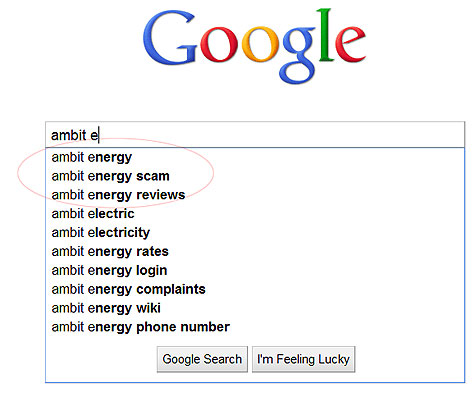
In yesterday’s post about Outskirts Press on the Inc. Magazine Fast 5000, I listed “scam” in the tags and categories since that posting discussed #1 Inc 500 company Ambit Energy; and I wanted to refer to my posting today about Ambit Energy and, more specifically, what I refer to as the Google Search Engine Scam (officially called “Google Suggest”).

Certainly you’ve seen this relatively new functionality of Google, whereby Google tries to anticipate a search term and offers suggestions even before you finish typing.  Convenient, yes?  Well, no. The reality is that Google now ends up penalizing real content (and, ironically, “real content” is Google’s whole M.O.) by pairing logical, relevant results with the car-accident-gawking illogical results derived from human curiosity. 

For example, since I wanted to compose a blog about Ambit Energy in my last posting, I searched for Ambit Energy on Google. And here’s what Google Suggest offered to me even before I finished typing:

ambit scam outskirts press scam

The #1 fastest-growing, cover-story-leading company featured in Inc. Magazine and probably hundreds of other magazine and newspaper articles receives a slap in the face by having “ambit energy scam” appear on the list of Google Suggestions immediately below the actual term I was searching for.   Well, gosh, thank you Google.  I didn’t even know I was looking for a scam until you told me I was.  And gosh, thank you so much, Google; you list it #2 in the suggestion drop down, so it MUST be important.

How silly did I feel believing any of this? Was the Outskirts Press CEO really susceptible to Google voodoo logic to believe a “scam” just because Google suggested it?   It felt like a visit to the carnival side show hypnotist, who whispers suggestions into your sub-conscious. Snap out of it.  

Let’s consider this: Is “ambit energy scam” more relevant, valuable (or impartial) than the 3rd suggestion “ambit energy reviews?”  Of course not.   Is it more relevant than “ambit energy rates” or “ambit energy phone number?”  Absolutely not.

Here’s the unfortunate, Big Brother-esque reality: Google now rewards the human being’s natural inclination toward controversy by improving the Suggestion Rank of suggested terms based upon nothing more than the illogical number of times someone clicks on it. And, like it or loathe it, human beings are fascinated with negative, controversial things.   That means Google’s suggestion algorithm flies in the very face of Google’s mission, which is to display the most relevant results first.   Instead, what Google now displays are results people didn’t actually search for OR care about (or even have in their mind) but which appeal to our basic, morbid curiosity.   

And therefore, instead of valuable, relevant content, Google delivers the rantings of a few kooks and/or the carefully crafted blogs of unscrupulous competitors.    Neither is what the Google user was searching for.

And that, as Spock would say, is very illogical, Captain. More on this next time…

Inc. Magazine ranks Outskirts Press #1266 on Fast 5000

Every year Inc. Magazine recognizes the 5000 fastest growing private companies in America.  Last month they published their findings. Outskirts Press was ranked #1266. Getting on the list once is hard enough — the majority of companies don’t appear on the list twice.  Well, actually, most companies don’t appear on the list even once, but that’s a different story.

Lists such as these average a company’s growth percentage across a number of years. What makes this interesting is that a company’s  annual revenue can actually increase year after year and at the same time, their overall average growth percentage will naturally decline.  This is what happened at my company, Outskirts Press.   2009 revenue was the highest it has ever been but the exponential leap in revenue over previous years was smaller. Not surprising really when an average company is considered successful if it increases revenue by 10% year over year and companies appearing on the Inc 500 in 2010 have average revenue increases between 20,000% (#1 Ambit Energy) and 600% (#500 AtTask). 

20,000% ?!? How is that even possible, you may ask.  Well, a growth percentage like this is usually the combination of 2 things:

1) A new company that barely qualifies for the Inc 5000’s minimum revenue threshold in the first year, and
2) Receives an infusion of cash from investor(s), bank(s), or venture capitalist(s) in the remaining years.

This is what happened for Ambit, which earned $1.6 million in 2006 (their first year in business) and then received substantial investments which brought their 2009 annual revenue to $325 million. In fact, their whole business model is based upon finding rich people to invest in their company.  Whether or not that is a sustainable business model is a topic for a later day.

But this is what makes repeating an appearance on the Inc 5000 list so difficult.  It’s difficult to continue inticing investors into giving you money. Eventually those investors are going to expect companies to earn it.   A company must continue growing at exponential rates either by receiving money or earning it.

In fact, if you look at this year’s Inc. 500 list in the September 2010 issue of Inc. Magazine, you have to scan all the way down to #18 to find a company that was on the list previously.  Of the 500 companies listed, only 101 appeared on the list previously — 20%.  These are probably the companies that are actually making money from customers, rather than having money handed to them by investors.   I wonder what the Inc. 500 would look like if these companies were ranked according to the actual amount of money they earned from their customers, and not from their investors…

But that’s a topic I’ve spoken about in the past, so I won’t dwell on it much here, although I might dwell on it more next time.

Inc. 5000 Self Publishing Company

Recently I made a change to this blog’s main title. For those of you reading since the beginning, you may realize how much thought I put into the title of the blog to begin with, since the subject of “titling your blog” was one that stretched across a number of postings at the beginning of this year.  In short, blog titles (not to be confused with posting titles) are extremely important for search engine optimization purposes.

Up until very recently, the “title” of my blog for the past year or so has been:  Brent Sampson: CEO of Inc. 500 Self Publishing Company OutskirtsPress.com. This accomplished a couple of things: It introduced me and my role/position; it identified the name and URL of our company; and it provided some promotion of its own, using other recognized keywords (Inc. 500, for instance). 

Two things occurred that led to the change. For one, Outskirts Press broadened its scope and its customer base with the launch of the Version 4 website, which is a subject I’ve been blogging about quite a bit recently, so I won’t cover it much here. But the long and short of it is that we are now offering book marketing services to writers on an a la carte basis regardless of where they publish. As a result, the new name became “Brent Sampson: CEO of Self Publishing & Book Marketing Company OutskirtsPress.com” to define this wider vision and incorporate perhaps a more applicable keyword phrase into the title (book marketing).

Secondly, came the change to our Inc Magazine listing. August was an exciting month because Outskirts Press won two different honors for fastest-growing private company, one from the Denver Business Journal indentifying us as the #10 fastest growing private company in the small-to-medium category; and the other from Inc. Magazine, which identified us as a Fast 5000 company–not that the Inc. Fast 5000 is anything to sneeze at, as 4999 other honorees will attest. 

 The “fastest growing” lists are interesting because, due to the way they are calculated, your company can actually increase its revenue year after year and still decrease its growth percentage.  But that is a subject for a future post.

Outskirts Press Direct Bookstore

The solution to the wholesale/retail bookstore issue I discussed in the last posting was to combine both bookstores into one single store, and that is what we did with the launch of Version 4.0 of the Outskirts Press website.  We retained both URL links to the store but focus mostly on just promoting a single one: outskirtspress.com/bookstore

For example, this is the URL that appears at the end of most of our book videos, driving potential customers to the online store where they can get the book from the video they just watched on YouTube.

Now the retail store and wholesale store act in concert with one another seamlessly, by offering a tiered discount structure to the customer depending upon the quantity of books he/she buys.   In fact, even retail orders of just 1 book receive a discount. After all, we save money by not having to sell that book through Ingram & Amazon; why not pass that savings on to the book buyer?  The author still receives their full royalty in any case.

Retail orders are defined by quantity purchases of 1-9 copies of a single book.  For those purchases, the bookstore automatically applies a 10% discount to the retail price.  I discussed a bit about this and the reasoning behind it in some of my June posts.

Wholesale orders are defined by quantity purchases of 10 copies or more.  For those purchases, the bookstore automatically applies whatever trade discount the author set during their publishing process.  The majority of our discounts range between 25% – 50%, but in some cases authors elect to set a 55% trade discount on their book. Whatever price plan the author selected is the discount available to retailers, wholesalers, or customers who purchase those books direct from Outskirts Press at outskirtspress.com/bookstore in quantities of 10 or more.   

This is advantageous to everyone involved. The retailer gets a better margin than if they ordered from Ingram and the author still gets their full royalty.   In fact, at industry-standard 55% trade discounts, retailers are accustomed to just 40% margins, since Ingram often takes 15%.  But by removing Ingram from the equation, our authors can offer retailers a better deal, which incentivizes more retailers into ordering our authors’ books.

These discounts are reflected dynamically on the bookstore detail pages for every book in an effort to incentivize customers to order more quantities, too. In fact, we’ve had authors order OTHER authors’ books at wholesale prices when they knew they were going to be attending a major book event, because anytime you buy low and sell high you have a profit-generating opportunity.

The changes worked. Both retail and wholesale bookstore orders increased substantially with the introduction of the new Outskirts Press direct bookstore.

In fact, the downside is that some of our authors became a little confused.  Getting up to a 55% discount on books ordered through the Outskirts Press bookstore sounds so good, some of our authors have purchased their own copies from the store when, in fact, they get an even better discount within their own publishing center.  As a result, our IT department added an “alert” that triggers if the bookstore recognizes an author purchasing their own book from the bookstore instead of from their Publishing Center. 

We’re using similar alerts to notify authors and potential authors of the discounts they can receive on our a la carte writing and marketing services if they elect to publish with Outskirts Press. But that’s a topic for a future post.