
Sell Your Book on Amazon – cover image

Take a look over to the right and see the cover of the second edition of SELL YOUR BOOK ON AMAZON (it’s right below Self-Publishing Simplified).

That’s how the cover looks of the actual book. But, strangely, that’s not how I want the cover image to look on Amazon.  And this has to do with online marketing in the new millennium, combined with the aspect ratio of books in relationship to the aspect ratio of the graphic footprint Amazon uses on its sales pages.  In other words, a 6×9 rectangular book cover is not OPTIMAL for use within a 260 x 260 square space, which is the graphic footprint Amazon allocates for product images on its detail pages.   Showcasing portrait-shaped books results in a graphic that is 260 pixels HIGH, but only uses 50% of the available WIDTH.  In other words, most book covers on Amazon sacrifice some of the space Amazon is giving to them.  And let me tell you, with the number of shoppers on Amazon, that is some expensive square-footage going to waste.

So, the solution is to provide Amazon with a different graphic other than the “actual” graphic of the book cover — one that is square rather than rectangular.  Of course, most books are rectangular (portrait) so this means you must “change” the appearance of the cover.  You can either “squash it” so that the entire cover fits in a space that is 33% shorter. Or you crop off a portion of the cover in preference of greater online sales.  I opted for choice number 2.   So when SELL YOUR BOOK ON AMAZON was first published in its first edition, I manually uploaded an alternate cover image (doing anything “different” through Ingram or Amazon requires some manual intervention). 

The cover at that time was slightly different.  The “a” in Amazon was lower-case and I had their little orange “curve” under the word. It wasn’t an arrow, but they apparently thought it was too close to their mark nonetheless and requested that I change the cover of my book.     Of course, I’ve seen other book covers that infringe upon that same exact mark in a manner much more obtrusively than I did, so why Amazon singled ME out is a subject I’ll leave for the conspiracy theorists. 

But in the past 2-3 months the original “trademarked, lower-case-‘a'” version of the book cover ended up on on Amazon again.  I know none of us at Outskirts Press made that change… so how did it get changed back to the version that was rejected by Amazon to begin with?  Another question for conspiracy theorists, perhaps….?

So anyway, that’s the cover anomaly I referred to in my previous post as something I wanted to fix with the Second Edition. Since I knew we had to update the image anyway, might as well make it the image for the Second Edition book, too.  

So below is the new image we’re uploading to Amazon specifically to re-address their trademark concern, which I already corrected but apparently need to correct again and also to re-introduce the square version of the graphic instead of the real-estate-wasting portrait version that 99.9% of all books on Amazon use.  (Hint: differentiating your book from 99.9% of the books on Amazon is a good thing).


Of course, the more observant readers may also notice another difference between the Amazon version of the graphic above and the “real” version to the right — other than the shape.  Yes, the Amazon version is a nice garish YELLOW.  And this brings me to one of the most wonderful things about marketing on the Internet — you can have your cake and eat it, too.

What do I mean by that?  I would never design an actual cover of a book to look like the image above. It’s too… well, “ugly” for lack of a better word.  I don’t want ugly babies, because I submit my babies to contests and awards and I want them to have a chance to win.  And win they do. Below is a run down of the awards Sell Your Book on Amazon has won:

  • Finalist – 2007 USA Book News Best Book Awards
  • Book of the Year – 2007 Royal Palm Literary Awards
  • First Place, How To – 2008 Readers Views Awards
  • First Place, Informational – 2007 Royal Palms
  • Finalist, How To – 2008 Indie Book Awards
  • Winner, Sales – 2008 Indie Book Awards
  •  So cover design is pretty important to me. But sadly, what makes an effective cover “in person” is not always the same as what makes an effective cover online.  That yellow sure is ugly, but when you’re scrolling through 25 books about self-publishing on Amazon’s search page, guess which image your eye is going to see first?  The big ugly yellow one…  So I can have a great actual cover that wins lots of awards (which Sell Your Book on Amazon has), and I can have an image on Amazon that attracts lots of attention. Having my cake and eating it, too.

    I’ve suggested this Amazon cover tactic to writers at seminars and during some of my presentations, and the concept of “altering” their book cover on Amazon doesn’t sit well with many of them.  They think it’s… I don’t know… breaking some unwritten rule or something.   They’re right! It’s breaking the unwritten rule that self-published authors don’t sell many books. And we’ll talk more about this tactic next time.
    Sell Your Book on Amazon – Second Edition

    The second edition of SELL YOUR BOOK ON AMAZON is now available through Ingram and on Amazon and Barnes & Noble’s websites. It has been available for a number of weeks, but I’m just getting around to announcing it, mostly because it’s not all that exciting. For people who already purchased the first edition, I wouldn’t necessarily recommend they buy this one (it’s not THAT different).   Yes, that flies in the face of the whole “annual revisions to get people to buy the same content over and over again” concept because, well… I don’t really believe in that as an author business model.  I’m not saying it doesn’t work (because it does); I’m just saying it’s a little lowbrow to ask the same retail price every year for something that only changes by 10%.

    And for new people coming to the book for the first time, they don’t really care that it is the first edition or the second — they just care that it will help them market their book(s) more successfully on Amazon, which it will.

    I had a couple of goals with the second edition. The first, obviously, was to update it according to the changes Amazon has made to its guidelines, functionality and offerings in the 3 years since the first edition was published. And I’ll detail those changes in a future post.

    The second goal was to create a newer version of the book in-house so we could create a “better” Kindle edition and a Search Inside the Book edition that was more productive.   Since the interior formatting for my book is somewhat atypical, this caused some problems with the Kindle edition. The Kindle edition for Sell Your Book on Amazon was also our first Kindle edition for Outskirts Press (because, as I’ve said, we guinea pig my books first before launching any new options for our authors – to work out all the bugs). Yes, for you writers out there, I just turned “guinea pig” into a verb.   So, my first edition on the Kindle didn’t “look” so great.  This second edition allowed us to iron out some of those formatting bugs, too, which are mostly associated with how Amazon’s DTP conversion tool processes HTML or PRC files.  So the second edition on the Kindle will look much better.  I say “will” instead of “does” because we haven’t uploaded it yet. There’s an issue remaining with the Table of Contents. This use to work with our process and now it doesn’t, which leads me to assume Amazon’s conversion software was adjusted slightly. But we’ll figure it out quickly.

    Speaking of Table of Contents, I also made an adjustment to the table of contents with the second edition. In the first edition, my TOC was 1 page long. It mentioned the specific chapter names and provided each chapter’s starting page number. Sufficient, right?  But I’ve since discovered that “sufficient” isn’t always the same as “successful.”   A more productive Table of Contents for a non-fiction book is one that not only identifies each chapter and its correlating page number, but also identifies each section and/or sub-section of those chapters.  Why? Because Search Inside the Book displays the TOC and you want your table of contents to look LONG, so that it communicates how substantial and informative your book is.   Does this actually affect the content?  No.  But an aesthetic consideration like this goes a long way toward turning a browser into a buyer, especially if they actively use Search Inside the Book to make their purchase decisions.  So with the Second Edition, my TOC is 3 pages long, so it can display all the sub-sections of each chapter. It really does make a large difference in communicating the value of the book, even if it’s merely cosmetic.

    With this edition we also wanted to create the subject index in a different way to explore methods for lowering our indexing costs so we could offer the indexing option at a more affordable price point for our authors.  I’m happy to say the test was successful so now we’re just working on the logistics involved in modifying that option in our system. (Please see “How long everything takes…”

    Lastly, this second edition publication was an opportunity to correct a cover anomaly on Amazon that happened for my book several months ago… and more on that next time.

    How long everything takes

    I’m sure other entrepreneurs can relate to this. Doesn’t it seem like everything takes a really long time? And the “bigger” you get — I’m not talking about weight — the more time everything takes.  A previous post talked about the complexities of creating a logo, for example.  So here I am officially recognizing that my re-write of Sell Your Book on Amazon is taking longer than I expected. I’m partly to blame, of course. But we also wanted to use my book to test a new indexing process.

    I believe that all non-fiction books should include an index.  Of course, indexing a book is a time consuming process and, unfortunately, our price for this option has reflected that effort.  As a result, not as many of our self-publishing authors have added an index to their books as we would like, due to the additional cost.    

    My first edition of Sell Your Book on Amazon had an index so of course we needed to index it again with the second edition.  Once the new edition was done and edited, we decided to explore alternate methods of indexing it in order to bring the price down for our authors.  I’m happy to report that I think we succeeded.   So in the coming days — or more likely weeks, since, as I mentioned above, everything takes longer than it should — we’ll be able to lower our indexing price.    In a day and age when it seems like all other self-publishing companies are increasing their pricing, it’s a pleasure to be able to lower ours for our authors.

    So, to make a long story short, that is why the second edition is taking so long.

    Amazon Kindle demos

    Speaking of Amazon, sales statistics of their Kindle device indicate that “boomers” represent the largest group of Kindle purchasers.  Theories for this range from “disposable income on the slightly expensive device” to “weakening eyesight that benefits from the flexibility Kindle affords in terms of font-size.”

    While creating a Kindle edition of a hardcopy book represents a growing segment in the publishing and self-publishing industries, this second theory represents an equally appealing opportunity that, thus far, has not proven as popular — large print editions.

    The median age of America (in fact, the world) is increasing. And with an increase in age often comes a decrease in one’s ability to read small print. Large print editions represent a great opportunity for already-published authors to “write it once, use it twice,” which is a motto I repeat during my speeches and presentations.   One manuscript, two books, two different target markets….

    Amazon and affiliates

    Amazon recently announced that it is no longer going to compensate Colorado-based affiliates due to tax complications. An Amazon affiliate is an individual or business that refers book buyers to Amazon in exchange for a small percentage of the sale if that referred customer buys anything during that “session.”  

    Unlike other affiliate programs that support longer term affiliate cookies, Amazon’s affiliate code is pretty stingy – last I checked it only rewards “same-session” purchases. In other words, if you send a customer to Amazon through your affiliate code on a Tuesday, and they buy a product from Amazon right then, you earn your commission. However, if the customer follows your affiliate link to Amazon on a Tuesday but decides instead to buy the book on Wednesday, and browses several other websites in the meantime, you do not receive that affiliate commission at all.

    As if you needed another reason not to be an Amazon affiliate, Amazon is now starting to bow to the government’s taxation whims by abandoning certain state-based affiliates.

    It seems that anything Amazon does nowadays causes undo concern for many authors, so I’d like to take this moment to clarify for all authors reading this who are thinking about self-publishing, or already have:  

    This Affiliate situation has nothing whatsoever to do with the publication, distribution and availability of POD or self-published books on Amazon. 

    Specifically, Outskirts Press books with ISBNs are distributed via Amazon.com and always have been, the majority featuring much more author-advantageous discounting than can be achieved with many other publishers. But those publishers are not being affected either, at least not as it relates to books being listed and sold from Amazon’s sites.  The only way a publisher or company might be affected by this would be if that publisher was directly referring readers (not writers) to Amazon for the purposes of buying something.  Affiliates advertise Amazon’s services  and in exchange for that advertising, Amazon pays affiliates a commission of session-based sales.    This is not related to the practice of distributing books at all, which for most self-publishing companies, including Outskirts Press, occurs through Ingram.

    The fact that Amazon is having to adjust part of its affiliate business model just goes to show that taxes represent one of the largest complications of running a growing business. The larger you get, the more complicated the taxes become — just look at Amazon. Rather than dealing with the extra complication imposed by the new state law, Amazon decided to opt-out of that complication altogether. In fact, if one were to read between the lines of the letter Amazon sent to all its Colorado-based affiliates, they are clearly trying to ‘strong-arm’ Colorado legislature into repealing this.

    Give incentive for people to buy your product or service

    Whether you are promoting a book or promoting a company, you need to give people incentive to buy.  Just making it easy isn’t quite enough (although it is an important component).  Not only must the purchase process be easy, it must be urgent.  You create urgency through the use of promotions, discounts, or other incentives.

    One of our competitors does this very well. They inflate their prices to $13,000 so they can offer a $7000 discount.  Do authors fall for this? Of course.  It looks great on a Flash banner; and it is a savvy person who can look past the flash — pun intended — and identify the true value, or lack thereof.

    Books sell better with incentive, too. The most typical incentive is a discount or a “sales price” and in the majority of the cases, this type of promotion is handled by the retailer rather than the author herself.  Amazon does discounting very well.  They discount books in a variety of ways.   Not only will they often discount a single book by eating into their own margin, but they also pair similar books together and then offer discounts if the customer orders BOTH books.   My book Sell Your Book on Amazon discusses how authors can use this functionality of Amazon to their advantage.

    Navigating the Amazon Sales Ranking

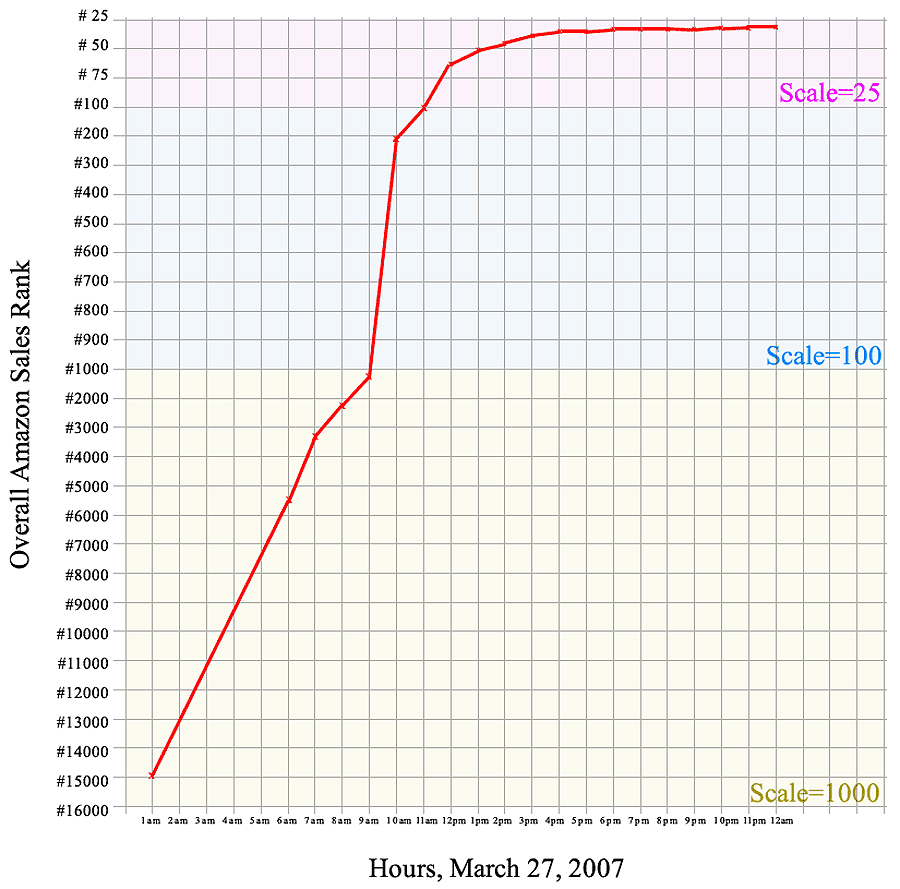
    In a previous post I discussed my book SELL YOUR BOOK ON AMAZON’s climb up the Amazon Sales Chart as a result of specific marketing tactics. I included the following graph, which we charted on the day of the campaign:

    There are some interesting things to notice about this cart.  For instance, you will notice how rapidly the ranking climbs from 15,000 to 3,000.  And then, again, you will notice how quickly it climbs from 1000 to 200 (the difference in scale notwithstanding, of course).  But also notice how slowly it climbs from 50 to 29.  This is probably obvious, but I’ll say it anyway: The closer you get to a #1 ranking, the more books you need to sell. 

    One section of my book discusses the Amazon Sales Rank in detail, and the information may be helpful when looking at the above chart, so I’ll include it below:

    First, the disclaimers: Since the algorithm Amazon uses to generate its sales ranking is proprietary, the details contained herein are extrapolated from research and field tests. The resulting consensus finds Amazon’s system to provide marginal sales data at best.

    To whit, read Amazon’s own definition of its system, slightly paraphrased from their FAQ: “The Sales Ranking system exhibits how books are selling. The lower the number, the higher the sales. The calculation is based on sales and is updated each hour to reflect recent and historical sales of every item sold. We hope you find the Amazon.com Sales Rank interesting!” This last sentence seems to indicate Amazon’s own perspective on the importance with which the sales rankings should be viewed.

    You’re not supposed to find the sales rankings informative or helpful. You’re supposed to find them interesting.

    In actuality, the process is somewhat more convoluted than they let on. The ranking does not depend solely upon the actual number of books sold, but rather, on a comparison against the sales figures of the other books in their database (all 5 million+ of them) within that same hour. Simultaneously, a trending calculation is applied to arrive at a sales trajectory. So, hypothetically, a book that held a ranking of 2,000 at 2pm and 3,000 at 3pm, might hold a 4,000 ranking at 4pm, even if it actually sold MORE books between 3-4 than it did between 2-3.

    Current projections and historic sales information also play a key role in these calculations. In fact, the predictive nature of the Amazon ranking system is what makes it possible for a newly-released book to outrank an older established title, even though the actual sales figures for the latter far exceed the former.

    That said, sales history takes a back seat to current sales rankings. Sales projections and trending take an active role here, which is why a book’s ranking can leap from 900,000 to 200,000 in the span of 24 hours or less. Does this mean the book has sold 700,000 copies in 24 hours? Absolutely not! What it does mean is that recent activity (i.e. purchases) for that book is trending higher than those 700,000 books it just surpassed. But, don’t get excited just yet; since the activity of those 700,000 other books range from slow to stagnant, one or two orders are sufficient to catapult a ranking.

    If a book’s ranking breaks into the top 100,000, the sales history calculation starts to rear its head, which is why a “phenomenon” book has a hard time maintaining a high, legitimate ranking. A phenomenon is defined by a book that leaps from the high hundred-thousands into the lower thousands (or better) in the span of 24 hours or less, usually due to some concentrated marketing initiatives. Since Amazon’s sales history for that title doesn’t support the leap, the spike occurs and then quickly drops again.

    HOW DOES ALL THIS TRANSLATE TO ACTUAL SALES FIGURES?

    Since the data is recalculated all the time, it’s impossible to arrive at accurate, cumulative sales figures, although those figures are applied to the algorithm during the calculation. No, to get a very rough idea of the actual number of books being sold, the sales ranking has to be dissected dynamically, with the same immediacy as the ranking being calculated. In other words, chart the ranking of the book at the same time every hour for 24 hours and then divide by 24 to arrive at its average daily ranking. Do that for seven straight days to arrive at its average weekly ranking.  You can do it all month long to arrive at its average monthly ranking. The longer your average timeframe, the more accurately your sales ranking will reflect “reality” (as opposed to a spike or dip in sales).

    Am I a best-selling author? Part 3

    I’ve said in the past that I use my own books as “guinea pigs” for the self publishing services we offer to authors.  If I am successful doing something, it is reasonable to think that someone else can be successful, also. If something I do doesn’t have the positive impact I was hoping for, I adjust and try again.  And if something fails, well then we know to either avoid suggesting it or to make an effort to advise our authors against it.

    Such was one of the blog postings I made in 2005 on my old blog about Kirkus Discoveries, and it was one of the blog postings that led to an interview with the New York Times.   At the time I believe Kirkus Discoveries was charging $350 for a “review” of self-published books. Recently they charged $400 or more, and very recently, I hear the future of Kirkus Discoveries seems to be in jeopardy entirely.

    However, at the time in 2005,  I had seen several of these Kirkus Discoveries reviews, courtesy of our authors, and came away with the feeling that this was not serving the best interests of self-publishing authors, in general.  So I said in my blog this was something I wouldn’t recommend to our authors. And our Marketing COACH suggested our authors think twice about doing it.

    Anyway, back to the story — another experiment I tried with one of my books was the so-called “Amazon Bestseller Campaign.” There are people out there charging thousands of dollars for this concept, but here it is for free: Contact as many people as you can (suggestions range from 500,000 to one million people) via email.  Get as many people as you can to buy your book on Amazon all on the same day. Provide them with incentive to buy your book by offering them other products or services that have a value much greater than the cost of your book itself. 

    Conducting this campaign has its pros and cons. It also has its share of people firmly entrenched in the “this is good” camp and others firmly entrenched in the “this is evil” camp.   All the “downsides” to this campaign contribute to the reasons we don’t currently offer it as a “service” for our authors — because a lot of our authors inquire about it.

    Furthermore, pulling this off is easier said than done. Who knows 500,000 people they can email? Nowadays there are companies that charge thousands of dollars to implement this sort of campaign on behalf of the author. 

    Personally, I didn’t need to pay anyone to do it for me because I had access to lists, and I knew other industry professionals who would support my campaign. But it did take a lot of my time orchestrating, and in retrospect, it may have actually been more cost-effective and efficient — and perhaps even effective — for me to just buy it as a “package” from someone else.  But, nevertheless, when Sell Your Book on Amazon was published, I conducted by own “bestseller” campaign as a test.

    And it worked.  My book reached #29 on the overall Amazon Sales Rank on March 27th, 2007. Below is a chart of my book’s Amazon sales rank that day. Notice that I have to change the SCALE of the chart 3 times in order to keep the chart from being 10 feet tall. Also notice that the ranking starts at 15,000.  It would have done the same exact thing if it had started at 150,000 or 1,500,000.  The initial ranking is important though, because it implies Amazon’s “true” valuation of the book. Which means after the “campaign” is over, your book will mostly likely return to roughly the level it started at. But in the meantime, you may have acquired a few more reviews, a few more tags, and a little more activity around your book — and that helps support your longer term marketing tactics on Amazon.

    Click for a larger view (opens in a new window)

    Was that an exciting day? You bet. Did I become a millionaire overnight? Of course not. I didn’t even reach #1. In fact, I didn’t even reach #1 in my category, which is the whole point of the campaign. I reached #2 in my category, because some HUGE best seller was #1, and I couldn’t knock it off.

    As I mentioned in a previous post, best sellers are more a product of marketing than sales, just like Oscar winners are often more a product of marketing than quality.

    Self Publishing Simplified – Kindle Edition

    We are relaunching our Kindle Edition option this month. Actually, we are “relaunching” a number of our author services options this month, because we’ve added more benefits to each of them while retaining the same retail price.  The CD Media Kit and Enhanced Audio Excerpt each come with an included 30 minute phone consultation with a Marketing Assistant, while the relaunched Book Video Trailers are now cooler than ever, and feature improved social distribution, including links on twitter and Facebook.

    One of these relaunched options is the Kindle, and this is a perfect time to announce it, with the release of the new Amazon Kindle app version 1.3  for the Iphone and Ipod Touch.  This new app makes all Kindle books available for download and reading on the iPhone! This is big news for self-publishing authors, so while we announce this new benefit (and incentive to create a Kindle edition) we will also emphasize our improvements in formatting Kindle editions that actually look — you know — good.  Forums and blogs are filled to the brim with this topic — the complexity and “pain” associated with converting a heavily formatted document — particularly one designed in inDesign, as nearly all Outskirts Press books are– into a Kindle edition that is aesthetically pleasing.

    And to kick it all off, the Kindle edition of Self-Publishing Simplified was made available this week, at the lowest price I could set it, 99 cents.   The whole point of this book (both the paperback and now the Kindle) is to demonstrate the pricing flexibility available to Outskirts Press authors.  I would have sold the paperback edition on Amazon for less than $5.95 if I could, but that price represents not only the true power of the pricing we offer — where else can you find a 108 page paperback on Amazon, new, for $5.95?– but also an accurate representation of what IS possible. There’s no wizard behind the curtain — that price IS the price listed on Amazon for a 108 page book.   Our authors have the exact same pricing flexibility I do. Granted, I’m only making 7 cents each time it sells, but that’s not the point. My goal was to demonstrate that POD books don’t have to have astronomical retail prices — at least, not if you publish with us. <smile>

    The 99 cent Kindle edition doesn’t exhibit that pricing flexibility to the same degree, because it appears that Amazon allows authors to set a 99 cent price whenever they want. I couldn’t set a price lower than 99 cents, though — I tried to make it free, but Amazon wouldn’t let me.

    Sell Your Book on Amazon – Second Edition

    In March of 2007 I published Sell Your Book on Amazon, which reached #29 on Amazon.com in its debut month.  In a strategically-planned effort, I first recorded a series of podcasts on the same subject matter, and distributed them through RSS and Podcast feeds (including iTunes) in the late fall of 2006. I then transcribed those podcasts into a first draft (an exercise which resulted in a rapid writing process–a process I highly recommend).

    In the nearly-three years since that book’s publication, Amazon has changed a lot!  Some of the tactics I recommended in the book have changed or have been removed entirely.  Some of the reviews (175 at last count, with an average of 4.5 stars — nothing to sneeze at!)  even started to imply these were short-comings in my book, rather than recognizing that Amazon’s policies, offerings, or guidelines had changed.  What was a short-coming is that a second edition was long overdue!  I admit it. Sorry — I’m kinda busy.

     Nevertheless, over the past few weeks I’ve been working on the Second Edition of Sell Your Book on Amazon, and I’m pleased to report it is done.  The “newly revised for 2010” edition is being proof-read one last time and a new subject index is being created (one of the services we offer for authors of non-fiction books). Once these steps are completed, the revised edition will be sent to Ingram, for distribution via EDI to all the locations Sell Your Book on Amazon is available, like Amazon.com and Barnes & Noble, etc.  

    We will also update the Kindle edition with the Second Edition at the same time, and that will drastically improve the Kindle edition, too. You see, Sell Your Book on Amazon was the first Kindle edition Outskirts Press released — I use my books as “guinea pigs” for all our author services, because if our services work for me, they can work for our authors, too — and it’s no small secret that Kindle isn’t the best when it comes to converting  specially-formatted books.  But our Kindle option now excels at providing Kindle with versions that compensate for that platform’s formatting short-comings.

    I will also upload the Second Edition to Amazon’s  Search Inside, and I’m looking forward to that change, because I’m making what basically amounts to an aesthetic change to the Table of Contents which actually should improve the overall sales of the book by giving the impression of a greater degree of content.  Let me explain:

    With the first edition, I was purposefully sparse with the Table of Contents, forcing it entirely on one page, even though each chapter of the book was divided into sections defined by sections on the various Amazon pages I was describing.

    When looking at the book via Search Inside, the table of contents makes the book appear to be lacking information because the Table of Contents is so short.

    So, when writing the Second Edition, I’ve changed my philosophy with the Table of Contents to include all the various sub-sections included within each chapter.  This didn’t take any additional skill, or even much more time, but it makes the book appear to be filled with way more content.

    The presentation of information is often just as important as the information itself. These are the kinds of things it is important for self-publishing authors to consider…