Start marketing your book as you are writing it

For the last month and a half, my posts have focused on my participation in National Novel Writing Month, which tasks writers to compose 50,000 words to a book within the 30 days of November.  During the month, as WriMo’s (as they are called) write their books, they also converse with “buddies” online, commiserate in forums,  and some even attend local “Write-Ins” in person, where they can write alongside other NaNoWriMo participants. And all of this helps them do something that ALL writers should do — market their book AS they are writing it.

This is good advice regardless of whether you are writing a book in a month, or in a year; and Outskirts Press has recently published a book by one of the best social media marketing authors, Mirtha Michelle Castro Marmol, who uses multiple social media platforms to engage her audience for both her acting career and her writing career.

Author and actress Mirtha Michelle Castro Marmol is perhaps best known for her roles in the “Fast & Furious” franchise and the upcoming film, “AWOL-72.” Her first book of poetry, Letters, To The Men I Have Loved, was released by Outskirts Press in June of 2014 and quickly climbed through the bestseller ranks. In a recent interview with us, Mirtha Michelle credits much of her success to a quality relationship with what she calls her “social media family.” In her own words, here are four simple tips she offers to the newly published author:

  1. Diversify your platform. Mirtha Michelle keeps readers up-to-date on her activities and poetry through Facebook, Twitter, Tumblr, and Instagram-a rigorous and diverse digital platform that ensures her words reach as many people as possible. “Social media has helped me get to know my readers and my audience,” she says, and it is important that she reach her readers wherever they are to be found.
  2. Create original content, and regularly. “Two years ago,” Mirtha Michelle tells us, “I just posted about my life a little bit-my outfits, if I went out somewhere exciting, and so on. But after a while, I started posting quotes I liked, and I started to see that social media was an outlet to express myself and show what I was working on.” She began posting more intentionally about her ongoing projects, with the intent of bringing her followers alongside as her work continues to evolve: “I see it as a job, to be honest. I pay close attention to my social media.” She makes a point of posting new and original content several times a week, including artistically and professionally shot photographs of her poetry.
  3. Positivity helps. Mirtha Michelle’s initials make up a personalized hashtag, #MMCM. This hashtag helps her readers connect across social media platforms, and has become a bastion for positivity and healthy relationships. In their comments on her blog, fans often cite her work as instrumental in helping them through difficult times. “I wish I could reply to every single person who writes a comment,” she says, “and I wish I could thank every person.” It can be challenging to keep up with every follower, but Mirtha Michelle goes to great lengths to ensure they know she’s listening: “I try to respond to everyone on Tumblr, because I really, really care.” Readers return to Mirtha Michelle’s blog, and her poetry, again and again-in large part because of her optimism and her genuine interest in their lives.
  4. Be authentic. “Write your heart,” Mirtha Michelle advises. “Imagine you’re meditating with your computer, with words. Really listen to your soul, so you can express what it wants to say.” Even on social media, she tells us, “I don’t try to be anything I’m not.”

Mirtha Michelle’s book, Letters, To The Men I Have Loved, is available through iTunes, Amazon, Barnes & Noble, and the Outskirts Press Direct bookstore.

My NaNoWriMo stats for yesterday, November 5, 2014:

Average Per Day 1833
Words Written Today 2371
Target Word Count 50,000
Target ~ Words/Day 1,667
Total Words Written 9165
Words Remaining 40,835
Current Day 5
Days Remaining 26
At this rate, you’ll finish November 28
Words/Day to finish on time 1,571

How to Plot a Novel

award

In 2007 I attended the annual Florida Writer’s Association conference to accept the “Book of the Year” award from the Royal Palms Literary Awards for my book, Sell Your Book on Amazon.

While I was there, I gave a seminar titled “How to Plot a Novel” and it proved to be so popular that I’ve since given that same presentation many times to writing groups and conferences around the country. And I am using the basis of that presentation to plot the novel I will be writing in 30 days during National Novel Writing Month.

So, for those of you that I am mentoring from NaNoWriMo, or those of you in general who are writing a novel (that means you’re writing a fiction book since non-fiction books are not called novels, although, confusingly enough, you ARE allowed to write non-fiction even during National Novel Writing Month), I’ve condensed the content of that hour-long presentation into one easily digestible blog posting.

I will use my novel, Idle Hands, as the example for this posting and you will get an inside, behind-the-scenes glimpse of how I’m preparing my book. Sorry for the horrible penmanship.  Then, tomorrow we will discuss the mathematical logistics required to actually, physically WRITE 50,000 words within 30 days.  Don’t worry, it’s not as boring (or as scary) as it sounds. But first, the plot!

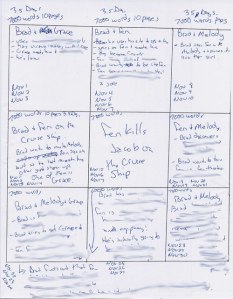
The basic concept of my How To Plot a Novel presentation is creating a visual outline comprised of 9 “blocks” which is my own personal continuation of a standard “three-act structure.”  So if you wish to play along, get an 8.5 x 11 piece of paper and fill it with a Tic-Tac-Toe grid (or pound sign symbol, if you prefer).  Then enclose the lines with an outside box and you are left with 9 blank squares (see below if you want to see the boxes, although in my example, there’s lots of notes).

For the purposes of sharing this information in an orderly fashion, number the boxes from 1 – to 9 starting at the top left corner and going from left-to-right on each row.

Here’s mine, along with copious (barely legible) notes, some of which have been obscured and all of which are difficult to read, since I don’t want to reveal too much of the twists and turns of my plot. But for the purposes of this blog/presentation, I’ve left in the important elements to discuss below:
plot

The easiest box to read is right smack in the middle in box #5: Fen kills Jacob on the cruise ship

Novels are about characters and relationships, but plots are about something that happens. When using my 9-block visual plotting device, you put the single major incident that happens in the center square, box number 5.  And since everything that occurs in a novel should somehow be connected to that one major event, this blocking scheme will help you place (and pace) appropriate characters, events, and twists in the appropriate parts of the story.  Boxes 1 -4 (the beginning portions of the novel) all must lead up to that major event.  Boxes 6-9 (the ending portions of the novel) involve the fall-0ut, climax, and resolution from that event.

Box #1 in the upper left hand corner is titled “Brad & Grace” for my book, Idle Hands.  This is where the protagonist (Brad) is introduced, along with auxiliary characters.  Each box doesn’t necessarily HAVE to involve a separate chapter, but it could.   Above Box #1 I have written “3 Days, 7000 words, 10 pages” and in the bottom of box #1 I have written “November 1, November 2, November 3.”  Those involve my personal milestone goals for WRITING the story in 30 days, and I will discuss those logistic notes in tomorrow’s blog posting, so ignore them for the time being.

Box #2 in the middle of the top row is titled “Brad & Fen”. This is were the antagonist (Fenderson, aka Fender or Fen) is introduced, along with other auxiliary characters.  You will also notice that since Block #2 is directly touching Block #5 directly below it (in the center, where the major plot event takes place), that Fenderson takes a lead role in both Blocks 2 and Blocks 5. In fact, he also takes a lead role in Block 8, directly below 5, although I neglected to title that block and should have. It would have also been titled “Brad & Fen”.

Box # 3 in the upper right is titled “Brad & Melody”. This is where the third major character and major love interest in this love triangle is introduced.  And speaking of plot connections, you will notice that Melody is also a key character in Blocks #6 and 9 directly below Block 3 in a column.

In fact, let’s discuss the columns and rows as a whole for a moment before moving on to the second row.

Idle Hands is a character study disguised as a dark comedy/thriller within the conventions of a love triangle.   The three major characters are Brad, Fenderson, and Melody, and you will notice, not coincidentally, that each major character “owns” their own column.  Brad owns the left-most column (Blocks 1, 4, and 7) with squares titled “Brad & Grace”, “Brad & Fen”, and “Brad & Melody & Grace”, respectively.  Fenderson “owns” the middle column (Blocks 2, 5, and 8) with squares titled “Brad & Fen”, “Fen kills Jacob” (the major event), and “Brad & Fen”, respectively.  And finally, Melody “owns” the right-most column (Blocks 3, 6, and 9) with squares titled “Brad & Melody”, “Fen & Melody”, and “Brad & Melody” respectively. Block 3 is also where the first major turning point of a novel should take place. For Idle Hands, this is where Brad meets Melody.

Okay, okay, Brad plays major roles in the majority of all these blocks, but that stands to reason since he is the protagonist.

It could be argued that the center column (Fen’s column) is actually the most important, because that is the column where the major event takes place in Block #5.  Part of the point of this 9-block device is to ensure a book is properly paced, with sufficient build-up (ie, motivation), and sufficient fall-out, and all the emotional highs and lows that result.   But it would be a mistake to assume that just because the major event is in Block 5 that nothing happens until half way through the book.  The opposite is true.  Something notable must happen in EVERY single square (otherwise, why write about it?).  I’ve happened to title my squares around characters, but you could just as easily title your squares around events that occur, all of them connected to their adjacent squares, and all leading toward (or coming from) the Major Event in Block 5.  In fact, more traditional, plot-oriented novels would probably do exactly that.

Now let’s discuss the rows. The top row involves the beginning of the novel, and if you’re a 3-act structure traditionalist, you would say Row 1 is Act 1 (and Row 2 is Act 2 and Row 3 is Act 3). In row 1 you introduce your characters (Brad, Fen, and Melody, in my case), and lay the ground work and emotional motivations for everything that takes place in Row 2.  The plot-outline-blocks of this 9-Block device can help you determine where in the story each character should be introduced based upon that specific character’s involvement with the plot.  The middle row is arguably the most important (for the same reason column 2 is the most important) because it involves the major event of the story.  This is different from a turning point or “twist” (which I will discuss below).  Block 5 is really the answer to the question, “What happens in your book?”  You wouldn’t reveal the plot twists or turns when answering that question would you?  And finally, the bottom row (Act 3) involves the character’s lowest point, the turning point, and the dénouement (the final resolution), respectively.

Now back to the individual blocks…

Block #4 in the middle-left square is titled “Brad & Fen on the cruise ship”.  Since Block #5 tells us that “Fen kills Jacob on the cruise ship”, we can see that Block 4 involves specific build-up and motivations to that Major plot event.

Block #5 is the centerpiece of your plot. For Idle Hands, that is when the antagonist, Fenderson Quinn kills Jacob Hardy.  Block 5 is also the one square among all of them that is connected to the most adjacent squares, so important characters or events leading up to this plot must be present in Block #2 and Block #4, while important consequences must be present in Blocks #6 and #8.

Block #6 in the middle-right is titled “Fen & Melody”. This is where another major turning point of your novel should take place, which is further complicated (and motivated/caused) by the major event that just took place in Block 5. In the case of Idle Hands, this major turning point is when Brad discovers that Melody and Fen are actually husband & wife.

That turning point in Block 6 should lead to the “emotional low” of your novel, when everything is at their darkest in Block #7, which I have titled “Brad & Melody & Grace” for Idle Hands. A character driven to his (or her) lowest point is sometimes driven to drastic measures and this is where events and characters introduced in Blocks 1 and Blocks 4 make another appearance, thus fulfilling requirements of foreshadowing, and demonstrating you are well in control of your craft as a novelist.

Typically a major twist leads to an epiphany and is what motivates the final climax (often some sort of emotional or physical confrontation), and this all occurs in Block 8. Given its direct proximity below Block 5, it’s probably no surprise that the epiphany or twist, as well as the climax, are all directly related to the event that takes place in Block 5.

The final block #9  in the lower right hand corner is where the dénouement begins and all the plot points are resolved, not out of the blue, but by connecting dots left in adjoining Blocks 6 (the second major turning point) and 8 (the results of the climax). Characters and/or events introduced in Block 3 must also play a major role in this resolution as well.  Resolutions cannot occur without the proper foundation.

Now that we’ve discussed pacing and plotting a novel, tomorrow we will discuss the pacing of writing a novel… in 30 days.

More details about the Outskirts Press 2012 Best Book of the Year Awards

Today on the Self Publishing News blog, we announced the first finalist for the 2012 Outskirts Press Best Book of the Year Awards.

Congratulations to Sharon Rhodes, author of It’s a Family Affair, which is the second novel she has written and published with Outskirts Press.   We will be announcing Finalist #2 and #3 in the coming days and then public voting will commence to determine the winner this coming Friday.

Winning a CIPA EVVY Award is a pre-requisite to winning our own Outskirts Press Best Book of the Year award, now in its 4th year. In 2010 we published a book called The Beads of Lapis Lazuli, by Doris Kenney Marcotte, which went on to win a 2011 EVVY Award for Fiction and become a finalist for our contest.   Doris was up against The Key to Job Success in Any Career, by Frank B. Leibold, Ph.D and Psych Consults by Robert J. Mignone, M.D. In the weeks following the finalist announcements, Doris engaged in some aggressive “author platform” leveraging and social media marketing efforts, which paid off — her book was named the 2010 Outskirts Press Best Book of the Year, recognizing the best book we published in 2010, written by the author who demonstrated the best marketing muscle. Her interview is here.

In 2011 we published a book called Pathway to Math Proficiency:Mastering Equivalent Fractions, Decimals and Percents…with Ease, by Susan Mercer, which won a 2012 EVVY Award for Workbooks. She went on to win the 2011 Outskirts Press Best Book of the Year award, after competing head-to-head with the other two finalists: Angelic Warfare, by Bolko Zimmer and The Keya Quests: The Battle for Shivenridge, by Glenn Skinner.  And like the 2010 contest, the 2011 public poll was a close call, going right up to the wire.

I summarized my thoughts about how the public polling panned out here. In that posting, I shed some light on the aggressive marketing efforts the winners must make to secure the award.  It may also help to know what process determines the three finalists in the first place.  Logistic and creative elements  have already been taken into consideration and recognized (given the fact that all finalists are already EVVY Award-winning books), so determining the three finalists are admittedly a more subjective decision making process.  While the “order” of the EVVY Awards (first, second, third, merit) play a role in determining our finalists, there are other considerations we take into account that EVVY judges do not.  We know the authors. We are more familiar with their writing career and talents and aspirations. We know if they have published previous books and, if so, how THOSE books have performed in various contests.  The CIPA judges take none of these factors into account when judging individual EVVY Awards (nor should they) but we do when choosing finalists from among all the EVVY winners.

That said, Finalist #2 will be announced on Wednesday and Finalist #3 will be announced on Thursday.   But, readers of this blog know they sometimes receive some news early, so allow me to say this:  This upcoming poll does give us an opportunity to witness a little social experiment first hand.  You may have noticed from the paragraphs above that our previous two Best Book of the Year winners have been female, even though they were each competing against two other men in the Finalist rounds.

Without revealing TOO much about the next two finalists, I will give a hint and say that we have that same situation again.  Sharon Rhodes will find herself head-to-head-to-head against two male finalists when the voting begins on the Outskirts Press blog this coming Friday.  Let’s see if she continues the trend started by Doris and Susan before her, proving that in this digital day and age of social media marketing and online book promotion, female authors are not to be trifled with.   Or will our first male Best Book of the Year author finally take a crown.  We’ll find out this week!

How to write and self publish your memoirs

Last time I posted a video submitted by one of our authors. Now here’s another video. This is one we created using a third party “video template” in an experiment to see if it was sufficient for the purposes of creating a new “Explainer” video about our self-publishing services at Outskirts Press. We decided it wasn’t sufficient for those purposes, but it does accomplish what it sets out to do here — introduce our new Memoir Writing Kit and its benefits.

Give a look:

Self Publishing Love

For the second year in a row, Outskirts Press held a “Share the Love” video promotion around Valentine’s Day where we invited our authors to submit a “Video Valentine” showing off their books. We received a lot of great submissions, tabulated the Facebook “Likes” of many of them on our Facebook page, and from those “likes” arrived upon three finalists to participate in a public poll at the SelfPublishingNews.com blog.  The author of the video receiving the most votes in the public poll would win a free laptop computer.

When the votes were counted, the finalist was announced on March 1, and Tommy Baker, author of Santa Clause The Fourth Wise Man, walked away with a free computer with this video. Congratulations, Tommy!


Best Self Publishing Companies

Top Consumer Reviews is an independent consumer services ranking website located at TopConsumerReviews.com. Along with ranking services in the health, beauty, and family categories, it also ranks the “top self publishing companies”. Top Consumer Reviews ranks Outskirts Press #1 among the “best self publishing companies” reviewed. Each of the seven companies is given a 1-to-5 star ranking.

Outskirts Press is the only self publishing company receiving a five star ranking and their first place blue ribbon designation.

Here are a couple of excerpts from the Top Consumer Reviews website regarding Outskirts Press self publishing:

“Outskirts Press is the best self-publishing company you’ll find to publish your work. They offer a variety of exceptional value programs that start as low as $199. You can choose the services that you want and still keep 100% of the royalties from the books you sell.”

“Outskirts Press is a self publishing company built for authors. With superior services, upfront pricing, and honest business practices, they are dedicated to ensuring the success of their authors.”

“Outskirts Press allows authors to keep 100% of the royalties from the sale of their books. This incredible feature sets this program above the rest of the self-publishing services.”

“Outskirts Press is an excellent self-publishing service. They offer a range of resources tailored for the budget-minded author, and allow you the flexibility to pick and choose those features that you’re most interested in. Their focus is to provide you with the services you need while allowing you to maximize your profit without any hidden fees. Outskirts Press sets the standard by which all self publishing companies should be judged and clearly earns our highest rating.”

Thank you, Top Consumer Reviews.


Self Publishing 2013

Every January we update our “About Us” information with milestones we reached in the previous year and an update to our “Total Titles Published” chart.  Now that 2012 has come to a close and 2013 is underway, here’s our updated information about Outskirts Press:

Over ten years ago, Outskirts Press was founded as a better way for authors to write, publish, and market their books. Outskirts Press incorporated in Colorado in 2003, and through strategic partnerships, exemplary customer service, and unmatched quality, Outskirts Press quickly became the fastest-growing full-service book publishing and book marketing firm.

The years between 2004 and 2006 marked a growth rate in excess of 1,500%, an accomplishment that was recognized in July 2007 by The Denver Business Journal when Outskirts Press was honored to be the 3rd fastest-growing privately held company (in any industry) in Colorado.  By the end of 2006, Outskirts Press already had nearly 1,000 books in print,  all of them available worldwide through Ingram, Baker & Taylor, Amazon, and Barnes & Noble online, among others. And by the end of 2007, Outskirts Press more than doubled its title totals again.

In 2008 The Denver Business Journal once again recognized Outskirts Press as the fastest-growing publisher, and in fact, the fastest-growing privately held small-to-medium sized company in Colorado (in any industry), boasting growth of over 500% for the years between 2005-2007.

2009 and 2010 marked more new milestones, as well. In 2009 Outskirts Press published its 5,000th title and became the only self-publishing company to appear on the Inc. 500 list of fastest-growing privately held companies.

In 2010, 2011, and 2012, Outskirts Press repeated its appearance on the Inc. 5000 list three more times, and became the only self-publishing company to appear on the list of top 5,000 fastest growing businesses in America for four straight years.

2012 also marked the 10-year anniversary of the company’s founding and the year it passed the milestone of 10,000 published books.

So how does Outskirts Press remain the fastest-growing full-service self publishing provider?

  • It begins with our Mission Statement: To exceed the expectations of every author we help publish.
  • It continues with our commitment to conservationism and recycling. Our most popular book sizes offer a recycled paper-stock option, featuring 30% post-consumer.
  • It grows with our authors.  Just ask Gang Chen, who earned over $100,000 in 180 days; or Sally Shields, the stay-at-home mom-turned-2-time Amazon.com bestseller; or Ronnie Lee, who has become one of the most prolific published authors of our generation with the assistance of Outskirts Press.

As we look toward the future, our commitment to produce high-quality books and offer high levels of support to our authors in all three phases of their journey (writing, publishing, marketing), only grows stronger.

For instance, we have embraced digital e-books with three a la carte digital publishing options:

 We have embraced social media to help our authors further promote their books:

And, we practice what we preach, publishing our own series of books to help authors navigate the sometimes tricky waters of book publishing and offering free publication in various anthologies through the year to showcase how easy, fast, and fun it can be to publish with Outskirts Press.

Through it all, Outskirts Press authors have remained our main focal point. With over 10,000 published titles, Outskirts Press continues to pour development dollars and resources into further improvements to the Outskirts Press website and its growing list of writing, publishing, and marketing services/products to further support our authors’ goals and dreams.

What does success mean to you? By any measure, you will find it here with Outskirts Press and we look forward to helping you on that journey.

Many of us, and some of our family members, took a moment during a summer picnic to pose…

A Self-Publishing Holiday Retrospective 2009-2012

All this week leading into the new year I am comparing the annual Outskirts Press holiday luncheon pictures of year’s past as a sort of short-form retrospective of the folks at Outskirts Press who make thousands upon thousands of authors’ dreams come true every year.  Of course, it should be noted that these pictures never offer a comprehensive glance of ALL the talented editors, illustrators, formatters, cover designers, and other folks involved with Outskirts Press year in and year out; if it did, these photographs would feature more than 100 people each year.  With what many authors would call “round the clock” support, and with a production pipeline containing between 300-500 titles at any given time, you can imagine the difficulty inherent in even getting 20 people together during a work day all at once.  Plus, we have people who work across the country, which makes it even harder to coordinate get-togethers like this one:

We did better in 2009 with our largest gathering to date. Yes, you’ll recognize many of the same people from 2012, 2011, and 2010, including from the back row: Caroline, Ellen, Cindy, Patrick, Shirley, Donna; Middle row: Tony, Tanya, and the front row: Jeanine, Lynn, Brent, and Lora.  Other faces you see here will become more and more familiar as we keep going back in time during this week-long self-publishing retrospective…

I should also mention that 2009 was the year we published our 5,000th book.  You may remember that we published our 10,000th book in 2012. We started publishing books in 2003 (I started the company in 2002 but we didn’t publish other books or incorporate until 2003). So in other words, it took the first 7 years to publish our first 5000 books and only the past 3 years to publish our second 5000 books. That is an explosion of growth!  To say that we were (and still are) in the midst of a self-publishing revolution (and revelation) would be an understatement.

Outskirts Press Best Book of the Year Finalists

All this week our Outskirts Press publishing blog has been featuring the three finalists for our 2011 Outskirts Press Best Book of the Year award. Here are the three finalists:

Congratulations to Susan, Bolko, and Glenn.  For more details about all three of these books and their authors, visit our Outskirts Press blog.  Beginning tomorrow, June 1, our blog will open the public polls so our social community of readers and writers can vote on the finalist best deserving of the award of the 2011 Outskirts Press Best Book of the Year. Good luck to them!

Outskirts Press 2012 EVVY Award Winners

Last Thursday I attended the 18th annual EVVY Awards, held annually by the Colorado Independent Publishers Association and this year introduced by Jake Jabs of American Furniture Warehouse fame. Of the nominees we announced last December, and the finalists we announced last week, here are the results of the awards ceremony. Congratulations to all the winners.  In the coming weeks, this list of winners will be narrowed down to three finalists for the Outskirts Press 2011 Best Book of the Year Award. In the next post, I’ll go into more detail about how those three finalists are selected.

But in the meantime, here are the EVVY winners, including the Outskirts Press sweep of the Autobiography/Memoir category:

1st Place
Autobiography/Memoirs

2nd Place
Autobiography/Memoirs

3rd Place
Autobiography/Memoirs

2nd Place
Workbooks

2nd Place
Religion

2nd Place
Fiction

3rd Place
Fiction

Merit Award
Fiction

Merit Award
Fiction

Merit Award
Fiction


2nd Place
Juvenile/Young Adult

3rd Place
Juvenile/Young Adult

Merit Award
Juvenile/Young Adult

Merit Award
Inspirational/Spiritual

Merit Award
Parenting/Family