Seek awards and/or recognition for your book or company

Another tactic both the book promoter and company marketer can do is seek awards. “Contests and Awards” are an industry onto itself, and there are awards and contests for just about everything under the sun, like “happiest employees,” “best places to work,” “best benefits,” “most profitable,” “minority-owned,” “largest headcount increase,” “best website design,” “CEO of the year,” “entrepreneur of the year,” “best invention,” “best product,” etc., etc… The list goes on and on.

The options are just as endless for published writers seeking book awards.  From widely recognized and established contests like the Writer’s Digest International Self-Published Book Awards to local contests being held for members of small writing groups, published authors have a daunting list of contests and awards to consider pursuing.

Adding insult to injury, most of the contests have entry fees, so not only is it a matter of time, there is also a financial investment one is making when choosing to pursue these recognition programs.  For companies, the fee is often nominal, but for an author faced with thousands of contests each costing between $10 – $400 each, it becomes important to separate the wheat from the chaff.  

For example, in an effort to help our authors successfully and conveniently pursue valuable awards and contests, Outskirts Press offers an optional Book Award Submission Marketing package that includes all the details associated with submitting books to 6 widely recognized and established book awards, including the Writer’s Digest award mentioned above, the ForeWord Magazine Book of the Year award, and 4 more.   As I often say, this isn’t something an author can’t do himself — double negative alert! — but it matters not whether published authors take advantage of marketing services offered by their respective publishers, or seek award entry independently; the important point is that authors do it, one way or the other.

For a convenient way to search for awards or contests to enter, visit www.awardsync.com

Winning an award gives you “something to say” and when it comes to marketing a book or a company, having “something to say” is worth its weight in gold, as we’ll discuss next time…

Give incentive for people to buy your product or service

Whether you are promoting a book or promoting a company, you need to give people incentive to buy.  Just making it easy isn’t quite enough (although it is an important component).  Not only must the purchase process be easy, it must be urgent.  You create urgency through the use of promotions, discounts, or other incentives.

One of our competitors does this very well. They inflate their prices to $13,000 so they can offer a $7000 discount.  Do authors fall for this? Of course.  It looks great on a Flash banner; and it is a savvy person who can look past the flash — pun intended — and identify the true value, or lack thereof.

Books sell better with incentive, too. The most typical incentive is a discount or a “sales price” and in the majority of the cases, this type of promotion is handled by the retailer rather than the author herself.  Amazon does discounting very well.  They discount books in a variety of ways.   Not only will they often discount a single book by eating into their own margin, but they also pair similar books together and then offer discounts if the customer orders BOTH books.   My book Sell Your Book on Amazon discusses how authors can use this functionality of Amazon to their advantage.

Make it easy for people to buy your product or service

In continuing our current discussion about how book promotion is similar to company marketing we arrive upon a step that can oftentimes single-handedly mean the difference between success and failure.  It’s a proven fact. If something is too hard, most people won’t do it.

Amazon.com is a perfect example of this. They have “perfected” the process of online product sales. It is almost TOO easy to buy things on Amazon. How many of us have gone to Amazon to make a single purchase and by the time we’re “checking out” we’ve added one or two additional items?  Amazon is the ultimate product sales “person.”   This is actually the cornerstone to my book Sell Your Book on Amazon, but you can see examples of “good” selling processes and “bad” selling processes all over the Internet.

I recently saw an article in Entrepreneur discussing a new technology/service company. I recognized the potential it might hold for published authors and so, to experiment with it on our author’s behalf — I have said in the past that I often use myself as a guinea pig for tactics I feel our authors should pursue — I signed myself up to the tune of $29 each month.

Sure, giving them that initial $29 was relatively smooth, but the instant the “credit card cleared” their site seemed to break and I couldn’t log-in to their customer center.  A day later I received an email that I could log-in. Apparently they were handling payments manually.  Not ideal, but okay.  Once I logged-in, however, I was confronted with a non-intuitive “dashboard” that, I’m sorry to say, gave me WAY more credit than I deserved.  It made assumptions about my depth of knowledge and asked me questions that I didn’t know the answers to regarding the service they were offering. What’s more, there wasn’t a “help button” or instruction manual or “contact us” link to be found.  

In short, they were not making it easy to buy their product or service… Almost impossible, I’d say.

As a company that conducts 100% of our business through our website, we have considerations like this all the time at Outskirts Press. We spend “scads of dough” on website design, optimization, usability, etc., in an effort to make the process as enjoyable as possible for our authors. We’ve come a long way. And we have a long way to go. Our site has tons of information but here’s an interesting fact — people don’t “read” websites, per se. They skim. They browse.  The trick is communicating information visually.  

Amazon does this very well nowadays. I recently saw a “running example” of what Amazon.com looked like in the 90s.  As they say: “You’ve come a long way, baby.”   

It’s a fine line between improving the customer experience, and constantly changing the website to improve the website, which, ironically, customers don’t like, either.  Very few people “like” change.

So how does this consideration translate to book promotion and book sales? It’s a changing world, and people are “using” books in different ways, now.  It used to be that there were just “paperbacks” and “hardbacks.” Then, “ebooks” became another format to consider. Nowadays, simply calling something an “ebook” isn’t specific enough, as there are multiple formats and multiple platforms to consider — Kindle books, Sony Reader books, Nook books, iPad books, Stanza books, Espresso Book machine books… the list goes on and on.

“Make it easy for people to buy your product or service.” At Outskirts Press, one of the ways we do that as a company is by making it easy for readers to buy our authors’ books, in as many different platform choices as possible. To that end, we offer options for paperbacks, hardbacks, general ebooks, Kindle editions, and Espresso Book machine editions.  Thanks to the Kindle app, our Kindle books are also available on the iPhone, iTouch, and iPad; and we’re working on optional methods for our authors to get their books  in front of the Sony, Stanza, and Nook crowds, too.  

When an author’s book is available in whatever manner a customer wants it, that is the definition of “making it easy for people to buy your product.”

Navigating the Amazon Sales Ranking

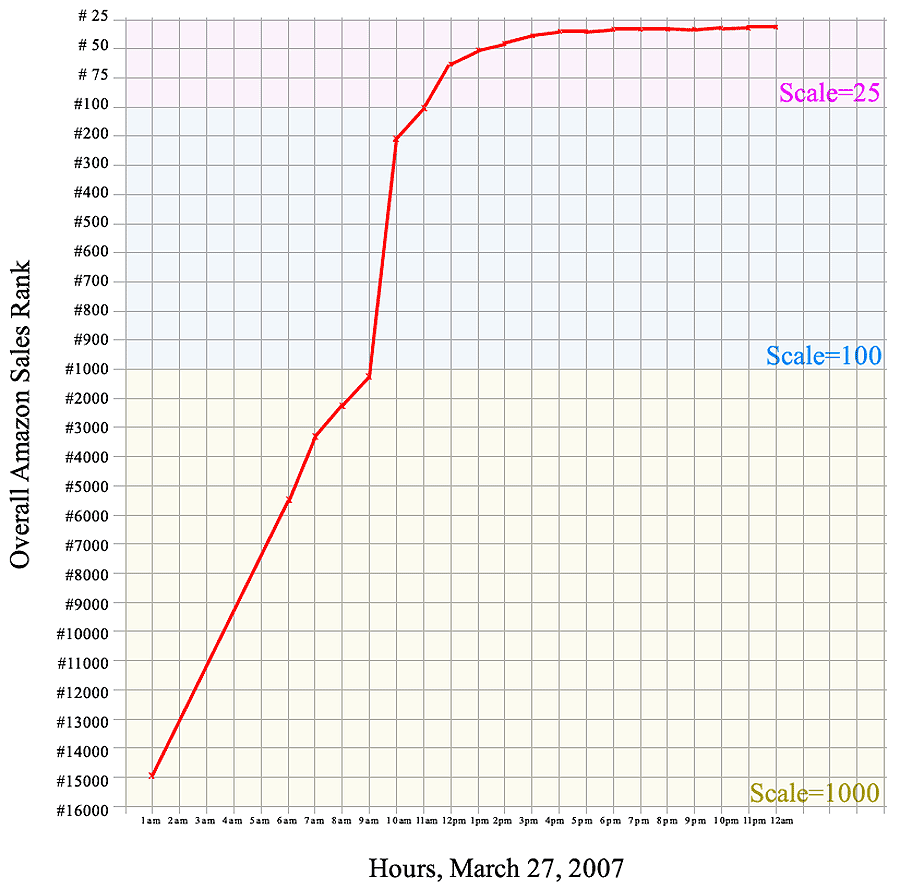
In a previous post I discussed my book SELL YOUR BOOK ON AMAZON’s climb up the Amazon Sales Chart as a result of specific marketing tactics. I included the following graph, which we charted on the day of the campaign:

There are some interesting things to notice about this cart.  For instance, you will notice how rapidly the ranking climbs from 15,000 to 3,000.  And then, again, you will notice how quickly it climbs from 1000 to 200 (the difference in scale notwithstanding, of course).  But also notice how slowly it climbs from 50 to 29.  This is probably obvious, but I’ll say it anyway: The closer you get to a #1 ranking, the more books you need to sell. 

One section of my book discusses the Amazon Sales Rank in detail, and the information may be helpful when looking at the above chart, so I’ll include it below:

First, the disclaimers: Since the algorithm Amazon uses to generate its sales ranking is proprietary, the details contained herein are extrapolated from research and field tests. The resulting consensus finds Amazon’s system to provide marginal sales data at best.

To whit, read Amazon’s own definition of its system, slightly paraphrased from their FAQ: “The Sales Ranking system exhibits how books are selling. The lower the number, the higher the sales. The calculation is based on sales and is updated each hour to reflect recent and historical sales of every item sold. We hope you find the Amazon.com Sales Rank interesting!” This last sentence seems to indicate Amazon’s own perspective on the importance with which the sales rankings should be viewed.

You’re not supposed to find the sales rankings informative or helpful. You’re supposed to find them interesting.

In actuality, the process is somewhat more convoluted than they let on. The ranking does not depend solely upon the actual number of books sold, but rather, on a comparison against the sales figures of the other books in their database (all 5 million+ of them) within that same hour. Simultaneously, a trending calculation is applied to arrive at a sales trajectory. So, hypothetically, a book that held a ranking of 2,000 at 2pm and 3,000 at 3pm, might hold a 4,000 ranking at 4pm, even if it actually sold MORE books between 3-4 than it did between 2-3.

Current projections and historic sales information also play a key role in these calculations. In fact, the predictive nature of the Amazon ranking system is what makes it possible for a newly-released book to outrank an older established title, even though the actual sales figures for the latter far exceed the former.

That said, sales history takes a back seat to current sales rankings. Sales projections and trending take an active role here, which is why a book’s ranking can leap from 900,000 to 200,000 in the span of 24 hours or less. Does this mean the book has sold 700,000 copies in 24 hours? Absolutely not! What it does mean is that recent activity (i.e. purchases) for that book is trending higher than those 700,000 books it just surpassed. But, don’t get excited just yet; since the activity of those 700,000 other books range from slow to stagnant, one or two orders are sufficient to catapult a ranking.

If a book’s ranking breaks into the top 100,000, the sales history calculation starts to rear its head, which is why a “phenomenon” book has a hard time maintaining a high, legitimate ranking. A phenomenon is defined by a book that leaps from the high hundred-thousands into the lower thousands (or better) in the span of 24 hours or less, usually due to some concentrated marketing initiatives. Since Amazon’s sales history for that title doesn’t support the leap, the spike occurs and then quickly drops again.

HOW DOES ALL THIS TRANSLATE TO ACTUAL SALES FIGURES?

Since the data is recalculated all the time, it’s impossible to arrive at accurate, cumulative sales figures, although those figures are applied to the algorithm during the calculation. No, to get a very rough idea of the actual number of books being sold, the sales ranking has to be dissected dynamically, with the same immediacy as the ranking being calculated. In other words, chart the ranking of the book at the same time every hour for 24 hours and then divide by 24 to arrive at its average daily ranking. Do that for seven straight days to arrive at its average weekly ranking.  You can do it all month long to arrive at its average monthly ranking. The longer your average timeframe, the more accurately your sales ranking will reflect “reality” (as opposed to a spike or dip in sales).

Are you a best-selling author? Part 2

A common question is, “How many books do you have to sell to become  a best seller?”

Well, it depends upon the list.  Another way of saying that is, it depends upon what you’re “comparing” your sales against.  While my Sell Your Book on Amazon is “officially” an “Amazon Best Seller” I will say that Outskirts Press has published many books that have sold more copies than Sell Your Book on Amazon in any given month, and many of them don’t refer to themselves as “best sellers.”   In fact, today on our Self Publishing News blog, our top 10 best sellers from 2009 are announced.

I will also say that a “best-selling” book doesn’t always translate to high revenue or high sales. In fact, those two criteria do not have to be connected at all.  We have other “official” Amazon Best Sellers who sold enough books to reach #1 in their category on Amazon for a period of time, but didn’t sell enough books to become one of our top 10 best-selling authors in that month.   We have other books where authors earn $20, $30, $50 or more for each copy of their books that Amazon sells, but the content is very niche.  As a result, their quantity of sales are never statistically “high” enough for them to be considered “best sellers” but we still send them impressive royalty checks. If their goal was to receive impressive royalty checks, mission accomplished. And then we have other authors who receive impressive royalty checks AND are best sellers in their category.

Authors have different goals when publishing a book. Some want to be famous; others want to make a lot of money; others want to share a message with the world; and still others want to attract the attention of an agent or New York publisher and get “picked up.”  We have helped authors reach all these goals, and that is part of our goal at Outskirts Press. Most authors’ goals fall into one of these four major categories, and being a “best selling” author is simply a by-product of, or a catalyst to, reaching one of those other goals.

Am I a best-selling author? Part 3

I’ve said in the past that I use my own books as “guinea pigs” for the self publishing services we offer to authors.  If I am successful doing something, it is reasonable to think that someone else can be successful, also. If something I do doesn’t have the positive impact I was hoping for, I adjust and try again.  And if something fails, well then we know to either avoid suggesting it or to make an effort to advise our authors against it.

Such was one of the blog postings I made in 2005 on my old blog about Kirkus Discoveries, and it was one of the blog postings that led to an interview with the New York Times.   At the time I believe Kirkus Discoveries was charging $350 for a “review” of self-published books. Recently they charged $400 or more, and very recently, I hear the future of Kirkus Discoveries seems to be in jeopardy entirely.

However, at the time in 2005,  I had seen several of these Kirkus Discoveries reviews, courtesy of our authors, and came away with the feeling that this was not serving the best interests of self-publishing authors, in general.  So I said in my blog this was something I wouldn’t recommend to our authors. And our Marketing COACH suggested our authors think twice about doing it.

Anyway, back to the story — another experiment I tried with one of my books was the so-called “Amazon Bestseller Campaign.” There are people out there charging thousands of dollars for this concept, but here it is for free: Contact as many people as you can (suggestions range from 500,000 to one million people) via email.  Get as many people as you can to buy your book on Amazon all on the same day. Provide them with incentive to buy your book by offering them other products or services that have a value much greater than the cost of your book itself. 

Conducting this campaign has its pros and cons. It also has its share of people firmly entrenched in the “this is good” camp and others firmly entrenched in the “this is evil” camp.   All the “downsides” to this campaign contribute to the reasons we don’t currently offer it as a “service” for our authors — because a lot of our authors inquire about it.

Furthermore, pulling this off is easier said than done. Who knows 500,000 people they can email? Nowadays there are companies that charge thousands of dollars to implement this sort of campaign on behalf of the author. 

Personally, I didn’t need to pay anyone to do it for me because I had access to lists, and I knew other industry professionals who would support my campaign. But it did take a lot of my time orchestrating, and in retrospect, it may have actually been more cost-effective and efficient — and perhaps even effective — for me to just buy it as a “package” from someone else.  But, nevertheless, when Sell Your Book on Amazon was published, I conducted by own “bestseller” campaign as a test.

And it worked.  My book reached #29 on the overall Amazon Sales Rank on March 27th, 2007. Below is a chart of my book’s Amazon sales rank that day. Notice that I have to change the SCALE of the chart 3 times in order to keep the chart from being 10 feet tall. Also notice that the ranking starts at 15,000.  It would have done the same exact thing if it had started at 150,000 or 1,500,000.  The initial ranking is important though, because it implies Amazon’s “true” valuation of the book. Which means after the “campaign” is over, your book will mostly likely return to roughly the level it started at. But in the meantime, you may have acquired a few more reviews, a few more tags, and a little more activity around your book — and that helps support your longer term marketing tactics on Amazon.

Click for a larger view (opens in a new window)

Was that an exciting day? You bet. Did I become a millionaire overnight? Of course not. I didn’t even reach #1. In fact, I didn’t even reach #1 in my category, which is the whole point of the campaign. I reached #2 in my category, because some HUGE best seller was #1, and I couldn’t knock it off.

As I mentioned in a previous post, best sellers are more a product of marketing than sales, just like Oscar winners are often more a product of marketing than quality.

Am I a best-selling author? Part 2

Let’s all conduct an experiment together. Go find a copy of Stephanie Meyer’s Eclipse paperback and look at the back cover. If you cannot find at least one copy lying around the house you either a) are not a woman or b) don’t know any women. This book is amazingly pervasive. Every woman I know has either read the Twilight Saga or is reading it (again).

On the back of the paperback edition of Eclipse it says:

The #1 New York Times Bestseller
The #1 USA Today Bestseller
The #1 Wall Street Journal Bestseller

Hmm, I guess Little, Brown — the publisher of Eclipse — prefers the single-word lexicon “bestseller” rather than the two-worded version preferred by Webster. But that’s not the point. The point is that there are multiple “best seller” lists. Eclipse promotes being the #1 best seller on 3 different lists from 3 different newspapers. Granted, in this case, these are highly respected lists.

But the fact is, nearly every major metropolitan newspaper has a “best seller” list, and most major booksellers or chains have their own best seller lists, too. The cynic inside me assumes that when a book promotes itself as being the “#1 bestseller” without specifying a list, it is because the best-selling list on which the book appeared #1 is NOT the New York Times, USA Today, or the Wall St. Journal.   But book marketing is book marketing and those publicists and marketers are doing whatever they can to draw attention to that book and that author in a very competitive environment. And the fact is, that book DID appear on some best-selling list, somewhere.

“Best-selling” status becomes even more questionable when you realize how the lists are compiled.  Are booksellers really pouring over weeks and months of data, comparing sales receipts against sales returns, and arriving upon a list of books that truly reflect higher sales compared against all other books?  Or, is a sales manager hastily completing a survey every week/month that rewards top-of-mind recall more than actual data?  This would make marketing and promotion the true factor involved, rather than actual sales, just as marketing and promotion is the true factor involved in the Oscar race, rather than performance/quality.

Am I questioning whether Eclipse is a #1 bestseller? Absolutely not!  I’m sure it is. As I mentioned, every woman I know owns a copy (and bought two more as gifts for other people last Christmas).   But I am saying that acquiring “best-selling” status is easier than it might appear and in many cases, might not even relate to actual sales volume.   And, there’s the rub; the moment something becomes “easier” to do, it receives less respect.  That’s one of the issues we face today with self-publishing.

But everything has a range of difficulty.  It’s easier to not write a book than it is to write one. So, right there, people who write a book deserve some level of respect.  Of course it’s easier to self-publish a book than it is to get a book traditionally accepted and published. But it’s even easier to not publish a book at all. Doing nothing is always easier than doing something.

And so it goes: writing a bad book is easier than writing a good one.  Writing a book that does not appear on any best seller lists is easier than writing a book that does appear on one or more best selling lists. Writing a book that does not earn a million dollar advance is easier than writing a book that does.   But are these black and white classifications?  Is a book only respectable IF it earns a million dollar advance, earns best seller status on the New York Times, and is published traditionally?

Certainly those accomplishments are worthy of admiration, but so are other accomplishments. Does someone choose not to respect Eli Manning because he’s not Peyton Manning? Even though publishing a book is becoming “easier” and becoming a “best selling” author is becoming “easier,” accomplishing these feats is still “hard” in the overall scheme of things. Any published book and any bestselling status is worthy of some level of kudos. 

If you are thinking about writing a book, don’t let anyone stop you. And if you are thinking about publishing a book, don’t let anyone stop you.

And with that prelude, the question remains: Am I a best-selling — or is it bestselling, or best selling– author?  Let’s examine that question further in an upcoming post…

Outskirts Press, Colorado Humanities, and TIE

I’ve been trying to avoid blogging about the “day-to-day” details because, frankly, that’s not very interesting. Strategic topics are great to discuss here, but when I find myself composing a blog about the minutiae of running a company, I usually end up erasing it. Why? Because the minutiae here is probably the same as the minutiae everywhere else.   Once companies reach a certain size, there’s a certain similarity to what is involved, and while the “big picture” might be different, many of the steps are often the same. 

But last week had a few exceptions. I met with the nice folks at Colorado Humanities to discuss what they were going to do with the donation Outskirts Press made to their non-profit organization last year.  We are sponsoring their Colorado Book Awards and Student Literary Awards and also discussed some other potential collaborations.

Last Thursday evening I also attended a TIE Association meeting. TIE stands for The Internet Entrepreneur and Thursday’s speaker was Steve Knopper, who was discussing his book, Appetite for Self-Destruction: The Spectacular Crash of the Record Industry in the Digital Age.

I don’t think I’m saying anything surprising when I say it has some similarities with what is happening now with the traditional publishing industry…

The trouble with blogging – part five

I think I already mentioned that as a writer, the disorganization of the “typical” blog bothers me, and that may be why, instinctively, I start doing things that “force” organization to blogs, like naming them “parts 1, 2, 3, 4, and 5,” for instance.  But that very philosophy is somewhat contrary to blogs in general.  The disorganziation and immedicacy is what appeals to many people… and then “twitter” took that one step even further…

For example, blogs appear in reverse-chronological order, so writing a “series” requires new readers who come upon the blog in the middle to either miss the beginning or “scroll down” to the start.  But do they scroll down?  I would, because I like organization.  But that very requirement of having to scroll down just to get to the “start” of something troubles me. Perhaps it’s the writer in me… I know that novels begin on page one.  But blogs begin on the date they started, and that first blog isn’t at the top of the blog; it’s at the bottom.

It’s even more problematic since I’m writing many of these blogs in advance, and usually writing multiple blogs on the same day, and then scheduling them to appear on different days in the future. For example, I started this “Trouble With Blogging” series on January 3, but am scheduling them to appear throughout January, with the last posting in the series scheduled for the end of the month.   But if I keep having to worry about writing a “series” in order to force a particular organization, I am probably missing the point of blogs…

Speaking of which, I just saw a link in the WordPress help section called “Write a book” and of course, being president of Outskirts Press, that phrase intrigued me, so I read the tip in which WordPress outlined a process for organizing a blog in a more traditional, book-like manner.  Judging from the amount of blogs I’ve seen that offer any sort of organization like that (namely, none), I’d say that doesn’t seem to be too popular of a topic on WordPress.

Perhaps what people are expecting to see when they click on a “Write a book” link is a procedure by which they can take the content of their blog and publish a book out of it, and to that, all I have to say is… “We can help you with that.”

FREE self-publishing e-book

This week we’re trying something new.   We’re giving away the e-book edition of Adventures in Publishing without first requiring an email address.  Giving away the e-book of Adventures in Publishing and Self-Publishing Simplified has been one of the successful ways we have acquired a pretty extensive email database.  But I’m sure an equal (or greater) number of writers don’t feel compelled enough to part with their email address just to read a free e-book. And, as a result, we are missing an opportunity to share the benefit and value of our services with them.

Yes, offering something for “free” in exchange for an email address, or some other contact information, is an effective and persuasive tool in the Internet age.  But if the “free product” is compelling in its own right, you may want to consider providing it even WITHOUT the email requirement.  Perhaps more people will read it as a result, and perhaps more people will find it a valuable solution to their particular situation, which may lead them to contacting you and volunteering their email address on their own.  And wouldn’t that be better for everyone?

That’s the logic of this little experiment, at any rate… So, without further ado, here is the free e-book edition of Adventures in Publishing