Start marketing your book as you are writing it

For the last month and a half, my posts have focused on my participation in National Novel Writing Month, which tasks writers to compose 50,000 words to a book within the 30 days of November.  During the month, as WriMo’s (as they are called) write their books, they also converse with “buddies” online, commiserate in forums,  and some even attend local “Write-Ins” in person, where they can write alongside other NaNoWriMo participants. And all of this helps them do something that ALL writers should do — market their book AS they are writing it.

This is good advice regardless of whether you are writing a book in a month, or in a year; and Outskirts Press has recently published a book by one of the best social media marketing authors, Mirtha Michelle Castro Marmol, who uses multiple social media platforms to engage her audience for both her acting career and her writing career.

Author and actress Mirtha Michelle Castro Marmol is perhaps best known for her roles in the “Fast & Furious” franchise and the upcoming film, “AWOL-72.” Her first book of poetry, Letters, To The Men I Have Loved, was released by Outskirts Press in June of 2014 and quickly climbed through the bestseller ranks. In a recent interview with us, Mirtha Michelle credits much of her success to a quality relationship with what she calls her “social media family.” In her own words, here are four simple tips she offers to the newly published author:

  1. Diversify your platform. Mirtha Michelle keeps readers up-to-date on her activities and poetry through Facebook, Twitter, Tumblr, and Instagram-a rigorous and diverse digital platform that ensures her words reach as many people as possible. “Social media has helped me get to know my readers and my audience,” she says, and it is important that she reach her readers wherever they are to be found.
  2. Create original content, and regularly. “Two years ago,” Mirtha Michelle tells us, “I just posted about my life a little bit-my outfits, if I went out somewhere exciting, and so on. But after a while, I started posting quotes I liked, and I started to see that social media was an outlet to express myself and show what I was working on.” She began posting more intentionally about her ongoing projects, with the intent of bringing her followers alongside as her work continues to evolve: “I see it as a job, to be honest. I pay close attention to my social media.” She makes a point of posting new and original content several times a week, including artistically and professionally shot photographs of her poetry.
  3. Positivity helps. Mirtha Michelle’s initials make up a personalized hashtag, #MMCM. This hashtag helps her readers connect across social media platforms, and has become a bastion for positivity and healthy relationships. In their comments on her blog, fans often cite her work as instrumental in helping them through difficult times. “I wish I could reply to every single person who writes a comment,” she says, “and I wish I could thank every person.” It can be challenging to keep up with every follower, but Mirtha Michelle goes to great lengths to ensure they know she’s listening: “I try to respond to everyone on Tumblr, because I really, really care.” Readers return to Mirtha Michelle’s blog, and her poetry, again and again-in large part because of her optimism and her genuine interest in their lives.
  4. Be authentic. “Write your heart,” Mirtha Michelle advises. “Imagine you’re meditating with your computer, with words. Really listen to your soul, so you can express what it wants to say.” Even on social media, she tells us, “I don’t try to be anything I’m not.”

Mirtha Michelle’s book, Letters, To The Men I Have Loved, is available through iTunes, Amazon, Barnes & Noble, and the Outskirts Press Direct bookstore.

My NaNoWriMo stats for yesterday, November 5, 2014:

Average Per Day 1833
Words Written Today 2371
Target Word Count 50,000
Target ~ Words/Day 1,667
Total Words Written 9165
Words Remaining 40,835
Current Day 5
Days Remaining 26
At this rate, you’ll finish November 28
Words/Day to finish on time 1,571

Writing a book requires the “writing” part

That headline is a head-scratcher, isn’t it? I mean, of COURSE writing a book requires the “writing” part, but that must be little-kn0wn fact if you’re to read many of the emails and “words of encouragement” being distributed by NaNoWriMo; and they’ve been doing this long enough to have some meaningful statistics.  They must know that the percentage of people who participate in NaNoWriMo each year is drastically different from the number of participants who win NaNoWriMo each year (and by “win” they mean writing 50,000 words in 30 days).

We experience the same phenomenon at Outskirts Press. We offer a free “Author’s Center“, which includes three free e-books, to whomever wants to sign-up without obligation.  Of course, since we are a business, we do that in the hopes that someday, those writers will be ready to publish a book and they will value all the free information and encouragement we have sent them over the months (or years), and choose Outskirts Press for their publishing and marketing needs.  But just like NaNoWriMo, we have more sign-ups than publishing authors.  I think almost everyone likes the idea of writing a book, but actually doing it requires commitment and discipline — something NaNoWriMo makes no secret of tackling head-on.

In order to write 50,000 words in 30 days, I’ve encouraged all the participants to at least write “something” every day. In fact, I’ve been more specific and encouraged everyone to write at least 1,000 words.

Well, yesterday, I was unable to do that.  I knew it was going to be a hard day to write (because it was election day), and I was only able to produce 827 new words to my novel, Idle Hands.   So I thought it would be interesting to compare my Day 3 Stats with my Day 4 Stats in order to see the exact affect it has on daily averages when you don’t produce at least 1000 words a day.

First, these Day 3 stats again, which are a repeat from yesterday.

Average Per Day 1989
Words Written Today 1459
Target Word Count 50,000
Target ~ Words/Day 1,667
Total Words Written 5967
Words Remaining 44,033
Current Day 3
Days Remaining 28
At this rate, you’ll finish November 26
Words/Day to finish on time 1,573

And now the new Day 4 Stats, incorporating 827 new words (by the way, am I the only one that experiences 404 Not Found “crashing” errors on the NaNoWriMo site when updating my word count from the top menu bar?)

Average Per Day 1698
Words Written Today 827
Target Word Count 50,000
Target ~ Words/Day 1,667
Total Words Written 6794
Words Remaining 43,206
Current Day 4
Days Remaining 27
At this rate, you’ll finish November 30
Words/Day to finish on time 1,601

The most telling statistics are the last two. The “At this rate, you’ll finish” date changed from November 26th to November 30th (from 4 days early to just-in-the-nick-of-time), and the word requirement per day also increased by 28 words. Now I have to write more each day AND I’m still scheduled to finish 4 days later than I was! Ouch!  Talk about a double-whammy!

THAT’s the danger of writing a low word count in a day. Imagine skipping a day entirely!

I know I was going to write about one of our recent Outskirts Press authors who has done an amazing job leveraging social media for success, but this low word count day offered a good opportunity to do a comparison, so I’ll do that other posting tomorrow (and hopefully I’ll write way more tomorrow, too!).


Knowing other writers can motivate you

I’m writing this blog posting on November 3, and then I will schedule it to post on the morning of November 4th. I often do this so that my blog postings can appear early in the day, and I’m never quite sure what my actual schedule will be each morning.

I mention that I’m a day early because this post involves my NaNoWriMo buddies, and specifically, just how many words THEY have written in only two full days of NaNoWriMo.  It’s humbling, but also inspiring.

My first “buddy” on NaNoWriMo was one of the local community administrators, which is probably a volunteer position, and is held by a long-time participant of NaNoWriMo. I can see from looking through her past history on NaNoWriMo that she joined in 2007 and in that year, she wrote over 100,000 words (twice as much as required)!  Now THAT is impressive.  Even more impressive is the fact that she has participated every year since then, and has written 50,000 words EACH AND EVERY TIME!  And she’s already up to 22,000 words in 2014, after just 2 days.  Makes my 2-day word count of 4,500 seem like nothing.  Okay, so it’s humbling, inspiring, and just a tad bit annoying, too.  I wish I were at 22,000 words already. Ahh, what a feeling that must be.

My other buddies aren’t quite as “annoying”, but still inspiring. After two days, a member from 2008 has 6,300 words; our Exec VP from Outskirts Press (who joined NaNoWriMo in 2012) has almost 10,000; and two new WriMos, both from 2014, have 2700 and 9100, respectively.  On the other side of the equation, I have a number of NaNoWriMo buddies, new this year, who haven’t registered any word counts at all yet… Hopefully they’re reading this blog, as I have invited them to, and finding the inspiration they need to upload their first word count totals and get “some skin in the game.”  As I’ve mentioned previously, falling even one day behind can start to make the “hole” insurmountable.

But the point of this posting is that knowing other writers and following other writers can offer inspiration and motivation to you as a writer, and this holds true even outside of the small (and short) NaNoWriMo universe.  If you have a favorite author who is currently still putting out work, odds are that he or she is “on the Internet” in some form or another, either on Facebook, or Twitter, or Instagram, or Tumblr.  Today’s market savvy authors know how to leverage different social media sites to grow their market, engage their audience, and build their platform as writers.  If you haven’t yet done that, today is a good time to start, and the first step is by finding a writer you admire and “following” them on one or more of their social media outlets. Perhaps they will do the same, and all of a sudden, you’ll find yourself using social media to broaden your reach as a writer.

At Outskirts Press, we have many authors who are taking great advantage of the Internet to market and sell their books, and tomorrow I’ll talk about one in particular…

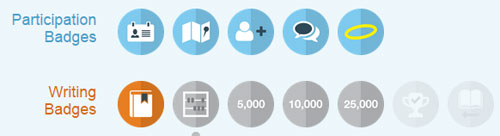
On a final note, after three days, I finally earned my 5,000 Word Count Badge by passing the 5,000 word milestone.  Woo hoo!   And my daily input is very close to my personal goal of 2,000 words each day. Hopefully I can keep that up.

My Daily Stats for November 3 were:

Average Per Day 1989
Words Written Today 1459
Target Word Count 50,000
Target ~ Words/Day 1,667
Total Words Written 5967
Words Remaining 44,033
Current Day 3
Days Remaining 28
At this rate, you’ll finish November 26
Words/Day to finish on time 1,573

5 things I’ve learned after 2 Days of NaNoWriMo

We’re on Day 3 of National Novel Writing Month.  How are my Mentorees holding up?  Have you received your third “Writing Badge” yet (for passing 5,000 words)?  I haven’t.  After two days I’m about 500 words short of that first 5,000 word milestone. But, I did earn my 2nd “Writing Badge” on Day 1 after entering my first day’s total.  And presuming I write an acceptable amount of words today, I’ll earn that third Writing Badge today (for reaching 5,000 words).  Hopefully a lot of my buddies join me.  In fact, if you want to be my “Buddy” on NaNoWriMo, just find my Forum Posting under “Mentors Looking for Newbies” and click on my username Outskirts_Press_Brent and then add me as a buddy. I’ll add you, as well, and that way, you’ll be able to see my Novel Stats through the month.  Hopefully the goal of writing more than I do inspires and motivates you toward great success this November.

And that brings me to the 5 things I have learned so far, after just 2 days of participating in National Novel Writing Month:

1) Publicize your goals and your efforts — It’s much harder to “quit” if other people know what you’re trying to do.  If you’re writing in a vacuum and you are the only person aware of your NaNoWriMo participation, it’s going to be easy to call it quits when those word count totals just aren’t what they should be. But by adding “Buddies” to your NaNoWriMo profile, or by posting your goals on Facebook or Twitter or your own website, you increase the chances of your success because your buddies, friends, followers, or visitors will be watching.  Even if they’re strangers, allow them to hold you accountable for your success.

2) Waking up early in the morning with the idea of “getting some writing done” isn’t going to work for me.  With the sun still far below the horizon, and unable to fall back to sleep with thoughts of NaNoWriMo swirling in my head, I decided it would be time best spent to crawl out of bed early and hit the book running.  So that’s what I did on November 1. But two paragraphs in, my lovely son interrupted me, and I always choose him over the computer, so I had to save my progress and plan to come back to it later.  That was probably harder than waiting until I KNEW I had some uninterrupted time available.

3)  This is closely related to the previous paragraph.  Being interrupted in the middle of writing and then being tasked with the idea of having to return back to it later in the day is much harder (at least for me) than just plowing through.  On November 1 I had to return back to my book a few hours later, and it took precious time to get the gears grinding again.  I knocked out the numbers on Day 2 all in one fell swoop and not only did I write MORE, but I wrote more confidently, and more quickly. All good things when the clock is constantly ticking.

4) Save each day’s work as its own file.  This holds two advantages. A) You don’t run the risk of losing your ENTIRE book if your file corrupts unexpectedly.  B) You don’t run the risk of reading your previous day’s work over and over, which takes time away from what you SHOULD be doing (writing).  On the other hand, there are two downsides: A) Each day you need to add up your own word count before entering it into NaNoWriMo, because their “stat machine” simply wants a cumulative total. B) During the “confirmation” stage when you apparently need to upload your book to the NaNoWriMo website for word-count verification you will need to combine your documents in one single file. But that 30-part cut-n-paste exercise seems like a small price to pay to keep me from re-reading my first page over and over again (which is something I’m apt to do otherwise).

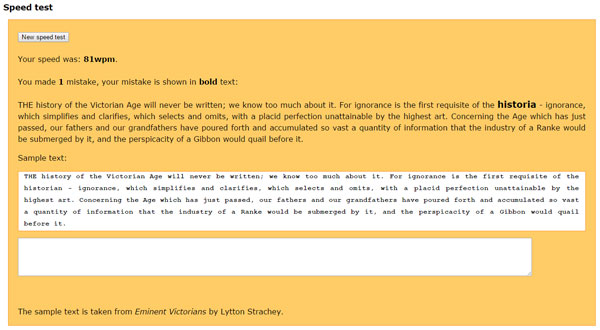
5) Being a fast typist helps.  A few days ago I posted a link to an online touch typing webpage which taxed you with copying a written paragraph into a box as quickly as you could.  I registered a words-per-minute rating of 81, with 1 mistake (including the time it took for me to move my hand to the mouse to click the “Start” button).   When I posted those results on my Facebook page with a challenge to my Facebook friends to beat me, of course my wonderful (and competitive) Outskirts Press EVP, Kelly, raised the bar to 83 words per minute with 2 mistakes at http://fastfingers.com — So naturally I had to give that different website a try. The good news was, it didn’t require me to take time away from typing to click the “Start” button. So my first attempt rated a 95 words-per-minute rating, but with 5 mistakes. Too many in my book, so I tried it again and earned a 94 WPM time with 3 mistakes, which the site makes easy to post to your Facebook page.   Logistically speaking, typing quicker makes it easier to get the required words on the paper. But more importantly, having a writing buddy (Kelly is participating in NaNoWriMo, also), especially an equally competitive one, increases the chances that BOTH writers will succeed, simply because neither writer wants to fail.  If you don’t have a writing buddy on NaNoWriMo, find one.

Or review my stats and compete against me. Here are my DAILY STATS for November 2, 2014:

Average Per Day 2254
Words Written Today 2316
Target Word Count 50,000
Target ~ Words/Day 1,667
Total Words Written 4508
Words Remaining 45,492
Current Day 2
Days Remaining 29
At this rate, you’ll finish November 23
Words/Day to finish on time 1,569

Movies about writing and writers

A few posts ago, I discussed the amount of actual time it might take to write a book in 30 days, which is what all the WriMos started doing yesterday, presumably with a stack of candy (it WAS just after Halloween, after all).  In that posting, I suggested that if you forgo ALL personal time (or, more accurately, squeeze ALL personal time into 5 hours/day, including eating), you still have 5 hours a day to devote to writing your book if you work 8 hours a day and sleep 6 hours a day.   If you actually spent 100% of those 5 hours each day for 30 days doing nothing but writing constantly and consistently, you would only need to type 7 words a minute to write 50,000 in 30 days.

But no one writes that way.  You’ll need to take some breaks to recharge. It’s a good thing you type faster than 7 words a minute, isn’t it?  So what can you do for relaxation that doesn’t take you TOO far from the laptop (just in case inspiration strikes)?

You can watch movies about writing and writers.  There are a lot of them.  Not surprisingly, many movies are about screenwriters (hmm, I wonder why), but there are also quite a few movies (some better than others) about book writers, poets, playwrights, etc.  So, in no particular order (well, except for the first one, which seems appropriate since we’re all about to artistically “suffer” writing 50,000 words in 30 days, AND since NaNoWriMo kicked-off on Halloween at midnight), are 25 movies about writers that you can watch when your fingers need a break during National Novel Writing Month. Add them to your NetFlix queue today.

1. Misery

2. Chinese Coffee

3. House by the River

4. Prick Up Your Ears

5. The Player

6. Barton Fink

7. Midnight in Paris

8. Deconstructing Harry

9. Wonder Boys

10. Another Woman

11. The Squid and the Whale

12. Capote

13. Numb

14. Starting Out in the Evening

15. Shadows in the Sun

16. The Ghost Writer

17. Beautiful Kate

18. The World According to Garp

19. Zorba the Greek

20. Listen Up Philip

21. The Tenants

22. Stuck in Love

23. Finding Forester

24. Sideways

25. Adaptation

Okay, okay…. you didn’t think I was going to forget one more, did you?   The Shining

I’m sure there are many others, but as they say,  “All work, and no play, makes Jack a dull boy.”  So have fun while you’re writing! Who knows? Some of the movies above may just inspire you (or at least explain why some writers are cra-azy!)

DAILY STATS UPDATE for November 1, 2014

Yesterday was fun! It was the first time I got to actually work on the book I’ve been blogging about for nearly a month, and the first time I got to put some words to paper, and then enter my word count into the NaNoWriMo site.  Contrary to my own advice, I didn’t quite reach 3000 words the first day out, but that’s okay. And, it’s even BETTER for the WriMo’s I’m mentoring because it offers up an opportunity:  I challenge you to stay AHEAD of me.  Each day I will post my previous daily stats on this blog and as long as you write MORE words than I do, you’ll be pacing yourself well (assuming, of course, that I will be pacing myself well, so the pressure is on!).

Average Per Day 2192
Words Written Today 2192
Target Word Count 50,000
Target ~ Words/Day 1,667
Total Words Written 2192
Words Remaining 47,808
Current Day 1
Days Remaining 30
At this rate, you’ll finish Nov 23
Words/Day to finish on time 1,594

I’m assuming the “Days Remaining” stat still says 30 because I updated my word count at noon, mountain time, on November 1.  That last stat is the benefit to writing MORE words than the required 1666 per day. Every time you write MORE than the required average, your NEW required daily average decreases.  Talk about a psychological boost!

National Novel Writing Month kicks off today

My last several posts have all been leading to this day, when the 2014 National Novel Writing Month (NaNoWriMo) officially kicks off.  For the next 30 days, approximately 500,000 participants from around the globe will be striving to accomplish the same thing: To write 50,000 words of a book before the stroke of midnight on November 30th.  That’s 1,666.6 words each day. We’ll be cheering each other on in local “Write-ins” around the country and world; we will be helping and commiserating online through the NaNoWriMo website and its forums; and we will be updating our daily word counts through their website as we each try to complete this amazing accomplishment.

For each “book” that you submit to NaNoWriMo (although it’s not really a book yet, since you haven’t written it — it’s a book idea), NaNoWriMo provides you with a “Stat” page on its website. Right now, before I’ve written a word, it looks like this:

stats

As you update your daily word counts, the table on the left will recalculate your averages while the line and bar graphs on the right will (I’m assuming) show you where you (and perhaps your local community) are compared with other NaNoWriMo participants.

Okay, it’s time to start writing. Each day I will post my own personal table stats as they are updated, so right now it looks like this:

Average Per Day Not started yet
Words Written Today Not started yet
Target Word Count 50,000
Target ~ Words/Day 1,667
Total Words Written Not started yet
Words Remaining 50,000
Current Day Not started yet
Days Remaining Not started yet
At this rate, you’ll finish
Words/Day to finish on time 1,666

Tomorrow I’ll update with new stats, along with my daily “Mentor” postings for other WriMos.


Beginning National Novel Writing Month with a BANG

Happy Halloween.

Tonight at midnight marks the beginning of National Novel Writing Month, when approximately half a million people from around the world will attempt to compose 50,000 words of their books before the end of November. I am joining them, as I write my dark comedy/thriller, Idle Hands.

And today I’m going to offer 3 suggestions about a way to not only survive, but thrive, as you cope with the next 30 days, which promises to tax your mind as well as your body.

TIP #1 Begin strong

And by that I mean,  take advantage of this first day, when you are going to be the most vigorous, the most pepped-up, the most anxious and excited, to tackle this adventure.  For those of you I’m “virtually” mentoring through the NaNoWriMo site on this blog, and for others who have stumbled across this blog as you prepare for this journey, here is my suggestion for day #1:  Write AT LEAST 3,200 words.

Why? Because if you begin with 3200 words on November 1, you can begin a countdown that allows you to write LESS words on each day that follows.  There is a psychological advantage to approaching each day of writing knowing that you are allowed to write fewer words than you did the day before.  So if you start with 3200 words on November 1, and write at least 3100 words on November 2, and 3000 words on November 3, and 29o0 words on November 4… and so on and so forth… you can “reward” yourself each day by writing 100 words fewer than the day before, and cross the finish line on November 30th with the word count total you seek.  Are you allowed to write more each day? Of course, and you should! There’s nothing wrong with crossing the 50,000 word finish line early. In fact, NaNoWriMo allows you to “declare” your 50,000 word count and begin the confirmation process as early as November 20th.

TIP #2 Write every day

When you are feeling inspired and motivated, it’s “easy” to write.  It’s more difficult when you approach your keyboard with trepidation or even fear.  But my suggestion is to combat that fear or trepidation head-on and be sure to write AT LEAST 1000 words EACH AND EVERY DAY, even if you really, really don’t want to.

Why?  Because skipping even one day puts you in a hole.  On the next day, not only do you have to write THAT day’s word count, but yesterday’s, as well.  It’s easy to see how completely skipping even ONE day can start to build an astronomical hole from which you cannot escape.  Don’t fall into that hole.  Write at least 1,000 words each and every day (unless, of course, you’re religiously following my advice in TIP #1 above and have earned the right to write less in the latter half of the month due to your impressive diligence in the first half).    Some days you might write 2,000, and some days, hopefully, even more.  But there may come a day or two in the course of the next 30 days when you absolutely, positively, don’t want to write one single word.  And on THOSE days,  be sure to write anyway.  You don’t want to find yourself too far “behind.” It’s very, VERY, difficult to catch up.

TIP #3 Write a treatment for your whole book on November 1

Since Day 1 is the day I have taxed you with writing at least 3200 words (of course MORE would be better!), and since Day 1 is the day you should feel the MOST inspired, and the most excited, Day 1 is the day to take advantage of your reckless muse and push “her” for all she’s worth.  Leverage this by writing a treatment or short story, that condenses your entire book into 3500-5000 words.

Why? By doing this, not only do you get all the important elements on paper (you know, the beginning, the middle, and the end), but you make your entire book seem more “real” since it is written down.  You suddenly have a beginning, a middle, and an ending, and, more importantly, you’ve harnessed your muse to bust through the 3,000-5,000 word count barrier in a single day, which gives you some latitude for the rest of the month.  And, with your whole book condensed into a short story, you have an outline for the rest of the month…

Start your engines everyone.  National Novel Writing Month is almost under way!

Pacing yourself to write a book in 30 days

Yesterday I posted the 9-block pacing/plotting device I’m using to write my novel, Idle Hands, in 30 days during National Novel Writing Month between November 1 – November 30.  Here it is again as a reminder:

plot

Today I’m going to discuss the notes on the outside of the box, and in many of the corners of the boxes. For instances, you will notice above the top-left box it says 3.5 Days, 7000 words, 10 pages (if you can read my handwriting).  I wrote that same thing over all three top boxes. And then in the remaining boxes I wrote simply 7,000 words.

My goal is for each “block” to have approximately 7,000 words.  By writing this word-goal on each block of my visual outline, I am constantly reminded of (and motivated by) this word count goal.  For me, writing 7,000 words seems much more achievable than writing 50,000, so by dividing my novel into 9 “bite-size” chunks, the task of writing an entire book in 30 days doesn’t seem so astronomical.  It will also help keep me focused, and on pace, to complete all 9 blocks in 30 days.

That is why I also wrote “3.5 Days” in every box (where I had room).  This tells me that I should spend no more than 4 days on the characters and plot within each block.  I am well aware that writing a novel in 30 days will (if I’m lucky) only present me with a first draft, and one which will require a fair amount of revision and editing.  But, why not make that first draft as complete, compelling, and well-paced as possible?  If I’m 4-5 days in and still on Block #1, this “calendar” will remind me to skip to Block #2. Sure, I may have to go back and fill in some blanks (so to speak) during my 2nd draft, but that’s okay. The goal of NaNoWriMo is to get 50,000 words of a book down on paper, so you have a huge first step toward a complete 1st draft of a book. Sounds easy, right?

So all I have to do is write 10 pages (at 8.5 x 11) every 3.5 days, which is approximately 7000 words. And if I do that consistently, in 31.5 days I’ll have a 90 page book of about 60,000-65,000 words.

That’s good news!  That’s 10,000-15,000 MORE words than I need to write to “win” NaNoWriMo. It’s especially good news since November only has 30 days, not 31.5.  I’ll need to be sure I’m a little ahead of the average.

The “STATS” screen on the NaNoWriMo site suggests a daily goal of 1,667 words (more on that tomorrow).  I’m shooting for a daily goal of 2,000 words.  I’m doing this for two reasons. 1) 50,000 words is short for an adult novel so I want my first draft to be longer, and 2) If I start with a higher word count average at the beginning, I’ll have a little more latitude toward the end of the month when I might be burned out (and when Thanksgiving happens; I doubt I’ll want to write when I’m full of tryptophan).

So if I have to write 2,000 words a day, how much time do I need to devote to this adventure?  Well, I have a job and a family, and I will need to eat and sleep, so let’s begin by removing time from each of those requirements in a day to find out how much time I have left.  For most of us, we work 8-10 hours a day.  If there are 24 hours to begin with, removing 8 leaves us with 16 hours. Let’s say during the course of November we’re going to sleep only 6 hours a day (might be less than the national average, but those average people aren’t writing a book in a month, now, are they?).

So that leaves us with 10 hours in a day.  Does 5 hours sound fair for rush hour, eating, family, exercise, and all the daily minutiae we all take part in?  For November, it’ll have to be.  And that leaves 5 hours to write.  Each day.

Composing 2000 words in 5 hours equates to an average words/per hour typing rate of 400.  That equates to a words/minute average typing rate of 6.6, rounded to 7.

ANYBODY can type 7 words a minute, even if you’re a glutton for punishment and planning on texting your novel into a mobile phone or using one of those virtual keyboards on your iPad.

By determining your words-per-minute typing speed, you can see how close you are to this 7 words-per-minute requirement to spend 5 hours a day typing your book.  This link takes you to a words-per-minute typing test: http://www.typeonline.co.uk/typingspeed.php

I just found that link on the internet, and I just took the test myself:

speed-test

So by determining your typing speed, and the amount of time it will take you to write your daily goal of 1667-2000 (or more if you’re inclined), that tells you how many hours each day on average you need to commit to working on your book during NaNoWriMo in order to complete 50,000 words in 30 days.

And that’s what those “November 1, November 2, November 3….” words are all about in each box of my 9-block outline.  That gives me something to check-off, or scratch out… It gives me a daily exercise to complete so I can feel as if I have accomplished a milestone for that day.  Once I reach my word count milestone on November 1, you can bet I will be scratching that “Nov 1” line from my outline… Call it catharsis. Call it motivational. Call it what you will. Find what works for you, and incorporate it into your daily routine during November…

Start your engines… it’s about to begin…

How to Plot a Novel

award

In 2007 I attended the annual Florida Writer’s Association conference to accept the “Book of the Year” award from the Royal Palms Literary Awards for my book, Sell Your Book on Amazon.

While I was there, I gave a seminar titled “How to Plot a Novel” and it proved to be so popular that I’ve since given that same presentation many times to writing groups and conferences around the country. And I am using the basis of that presentation to plot the novel I will be writing in 30 days during National Novel Writing Month.

So, for those of you that I am mentoring from NaNoWriMo, or those of you in general who are writing a novel (that means you’re writing a fiction book since non-fiction books are not called novels, although, confusingly enough, you ARE allowed to write non-fiction even during National Novel Writing Month), I’ve condensed the content of that hour-long presentation into one easily digestible blog posting.

I will use my novel, Idle Hands, as the example for this posting and you will get an inside, behind-the-scenes glimpse of how I’m preparing my book. Sorry for the horrible penmanship.  Then, tomorrow we will discuss the mathematical logistics required to actually, physically WRITE 50,000 words within 30 days.  Don’t worry, it’s not as boring (or as scary) as it sounds. But first, the plot!

The basic concept of my How To Plot a Novel presentation is creating a visual outline comprised of 9 “blocks” which is my own personal continuation of a standard “three-act structure.”  So if you wish to play along, get an 8.5 x 11 piece of paper and fill it with a Tic-Tac-Toe grid (or pound sign symbol, if you prefer).  Then enclose the lines with an outside box and you are left with 9 blank squares (see below if you want to see the boxes, although in my example, there’s lots of notes).

For the purposes of sharing this information in an orderly fashion, number the boxes from 1 – to 9 starting at the top left corner and going from left-to-right on each row.

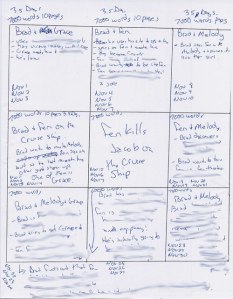
Here’s mine, along with copious (barely legible) notes, some of which have been obscured and all of which are difficult to read, since I don’t want to reveal too much of the twists and turns of my plot. But for the purposes of this blog/presentation, I’ve left in the important elements to discuss below:
plot

The easiest box to read is right smack in the middle in box #5: Fen kills Jacob on the cruise ship

Novels are about characters and relationships, but plots are about something that happens. When using my 9-block visual plotting device, you put the single major incident that happens in the center square, box number 5.  And since everything that occurs in a novel should somehow be connected to that one major event, this blocking scheme will help you place (and pace) appropriate characters, events, and twists in the appropriate parts of the story.  Boxes 1 -4 (the beginning portions of the novel) all must lead up to that major event.  Boxes 6-9 (the ending portions of the novel) involve the fall-0ut, climax, and resolution from that event.

Box #1 in the upper left hand corner is titled “Brad & Grace” for my book, Idle Hands.  This is where the protagonist (Brad) is introduced, along with auxiliary characters.  Each box doesn’t necessarily HAVE to involve a separate chapter, but it could.   Above Box #1 I have written “3 Days, 7000 words, 10 pages” and in the bottom of box #1 I have written “November 1, November 2, November 3.”  Those involve my personal milestone goals for WRITING the story in 30 days, and I will discuss those logistic notes in tomorrow’s blog posting, so ignore them for the time being.

Box #2 in the middle of the top row is titled “Brad & Fen”. This is were the antagonist (Fenderson, aka Fender or Fen) is introduced, along with other auxiliary characters.  You will also notice that since Block #2 is directly touching Block #5 directly below it (in the center, where the major plot event takes place), that Fenderson takes a lead role in both Blocks 2 and Blocks 5. In fact, he also takes a lead role in Block 8, directly below 5, although I neglected to title that block and should have. It would have also been titled “Brad & Fen”.

Box # 3 in the upper right is titled “Brad & Melody”. This is where the third major character and major love interest in this love triangle is introduced.  And speaking of plot connections, you will notice that Melody is also a key character in Blocks #6 and 9 directly below Block 3 in a column.

In fact, let’s discuss the columns and rows as a whole for a moment before moving on to the second row.

Idle Hands is a character study disguised as a dark comedy/thriller within the conventions of a love triangle.   The three major characters are Brad, Fenderson, and Melody, and you will notice, not coincidentally, that each major character “owns” their own column.  Brad owns the left-most column (Blocks 1, 4, and 7) with squares titled “Brad & Grace”, “Brad & Fen”, and “Brad & Melody & Grace”, respectively.  Fenderson “owns” the middle column (Blocks 2, 5, and 8) with squares titled “Brad & Fen”, “Fen kills Jacob” (the major event), and “Brad & Fen”, respectively.  And finally, Melody “owns” the right-most column (Blocks 3, 6, and 9) with squares titled “Brad & Melody”, “Fen & Melody”, and “Brad & Melody” respectively. Block 3 is also where the first major turning point of a novel should take place. For Idle Hands, this is where Brad meets Melody.

Okay, okay, Brad plays major roles in the majority of all these blocks, but that stands to reason since he is the protagonist.

It could be argued that the center column (Fen’s column) is actually the most important, because that is the column where the major event takes place in Block #5.  Part of the point of this 9-block device is to ensure a book is properly paced, with sufficient build-up (ie, motivation), and sufficient fall-out, and all the emotional highs and lows that result.   But it would be a mistake to assume that just because the major event is in Block 5 that nothing happens until half way through the book.  The opposite is true.  Something notable must happen in EVERY single square (otherwise, why write about it?).  I’ve happened to title my squares around characters, but you could just as easily title your squares around events that occur, all of them connected to their adjacent squares, and all leading toward (or coming from) the Major Event in Block 5.  In fact, more traditional, plot-oriented novels would probably do exactly that.

Now let’s discuss the rows. The top row involves the beginning of the novel, and if you’re a 3-act structure traditionalist, you would say Row 1 is Act 1 (and Row 2 is Act 2 and Row 3 is Act 3). In row 1 you introduce your characters (Brad, Fen, and Melody, in my case), and lay the ground work and emotional motivations for everything that takes place in Row 2.  The plot-outline-blocks of this 9-Block device can help you determine where in the story each character should be introduced based upon that specific character’s involvement with the plot.  The middle row is arguably the most important (for the same reason column 2 is the most important) because it involves the major event of the story.  This is different from a turning point or “twist” (which I will discuss below).  Block 5 is really the answer to the question, “What happens in your book?”  You wouldn’t reveal the plot twists or turns when answering that question would you?  And finally, the bottom row (Act 3) involves the character’s lowest point, the turning point, and the dénouement (the final resolution), respectively.

Now back to the individual blocks…

Block #4 in the middle-left square is titled “Brad & Fen on the cruise ship”.  Since Block #5 tells us that “Fen kills Jacob on the cruise ship”, we can see that Block 4 involves specific build-up and motivations to that Major plot event.

Block #5 is the centerpiece of your plot. For Idle Hands, that is when the antagonist, Fenderson Quinn kills Jacob Hardy.  Block 5 is also the one square among all of them that is connected to the most adjacent squares, so important characters or events leading up to this plot must be present in Block #2 and Block #4, while important consequences must be present in Blocks #6 and #8.

Block #6 in the middle-right is titled “Fen & Melody”. This is where another major turning point of your novel should take place, which is further complicated (and motivated/caused) by the major event that just took place in Block 5. In the case of Idle Hands, this major turning point is when Brad discovers that Melody and Fen are actually husband & wife.

That turning point in Block 6 should lead to the “emotional low” of your novel, when everything is at their darkest in Block #7, which I have titled “Brad & Melody & Grace” for Idle Hands. A character driven to his (or her) lowest point is sometimes driven to drastic measures and this is where events and characters introduced in Blocks 1 and Blocks 4 make another appearance, thus fulfilling requirements of foreshadowing, and demonstrating you are well in control of your craft as a novelist.

Typically a major twist leads to an epiphany and is what motivates the final climax (often some sort of emotional or physical confrontation), and this all occurs in Block 8. Given its direct proximity below Block 5, it’s probably no surprise that the epiphany or twist, as well as the climax, are all directly related to the event that takes place in Block 5.

The final block #9  in the lower right hand corner is where the dénouement begins and all the plot points are resolved, not out of the blue, but by connecting dots left in adjoining Blocks 6 (the second major turning point) and 8 (the results of the climax). Characters and/or events introduced in Block 3 must also play a major role in this resolution as well.  Resolutions cannot occur without the proper foundation.

Now that we’ve discussed pacing and plotting a novel, tomorrow we will discuss the pacing of writing a novel… in 30 days.

Donate to NaNoWriMo

The last and final Participation Badge for 2014 NaNoWriMo is the “Donation Badge” and in order to earn it you need to make a charitable donation to NaNoWriMo, which is a worthwhile cause.  According to the NaNoWriMo website…

…when you donate to National Novel Writing Month, you help bring free creative writing programs to nearly 500,000 kids and adults in approximately 200 countries, 2,000 classrooms, 650 libraries, and 600 NaNoWriMo regions every year.

You not only support people’s novel writing dreams, you help transform people into creators who see new possibilities in the world—and act on them. You spark a creative revolution.

“Storytelling is a powerful act. Stories have the mysterious power to widen hearts and change minds. The psyche is never quite the same after receiving a story,” says author Mitali Perkins in NaNo’s 2013 Annual Report.

Your donation spawns NaNoWriMo’s unique brand of transformative magic.

NaNoWriMo relies on individual donations to pay for things such as web hosting costs, pep talks, Come Write In resources, and classroom kits to help turn people into writing wizards.

Nearly half of our income comes from individual donations. We need to raise approximately $1.3 million in 2014 to put on NaNoWriMo and our other programs. Please donate and help us today.

 support2

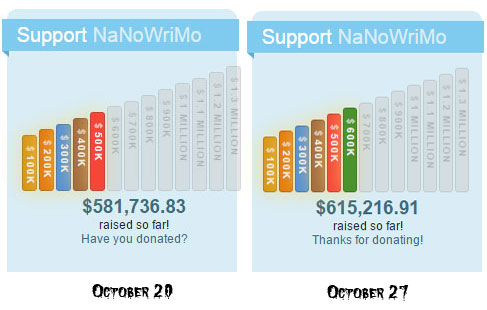
On October 20th, NaNoWriMo had secured $581,736 in donations.  A week later they had $615, 215.  So leading into November 1, they earned $33,479 in one week. I wonder if their donations speed up or slow down after November 1… I guess we’ll find out.  Yesterday I donated to the cause, and here’s a list of all the “stuff” I get as a result:


  • The 2013 NaNoWriMo Webinar Double Pack including both donor-only webinars from earlier this year, the Book Doctors’ “Make Editing Fun: How to Enjoy Revision” and Guy Kawasaki’s “The Art of Artisanal Publishing”
  • A coupon good for pie with NaNoWriMo Director of Programs Chris Angotti and Executive Director Grant Faulkner. You have to come to Berkeley to redeem it, but come on—this is good pie. Also, the coupon is fully transferable!
  • An option to have your novel featured online in NaNoWriMo’s Mighty Catalyst Bookstore.
  • A year-long print and digital subscription to The Sun, a unique monthly magazine of essays, interviews, short stories, poems, and photographs. Writing from The Sun has won the Pushcart Prize, been featured on National Public Radio, and appeared in Best American Essays and Best American Short Stories!
  • The 2014 “Boundless Novel” poster designed by Elizabeth Doyle
  • A starry “Halo for Your Wrist”!
  • A “Novelist’s Little Helpers” sticker set, which includes three (3) 3” by 3” round stickers each instilled with a bit of writer-ly magic to help you reach 50K.
  • Your very own magical NaNo Wizard bookmark signed with thanks by our Director of Programs Chris Angotti and Executive Director Grant Faulkner
  • A donor halo on your NaNoWriMo author profile
  • A listing on the NaNoWriMo Brought To You By page
  • A coupon code for 30% off plus free shipping from our friends at Chronicle Books
  • A coupon for a free Structure class from StoryWonk ($10 retail value)

badges2

So now that I’ve collected all the Participation Badges, it’s on to the Writing Badges, which I can start to earn starting on November 1…

MENTORSHIP ADVICE:

As a NaNoWriMo mentor, I recommend to all participants of NaNoWriMo that you spend the days leading up to November 1 earning all YOUR Participation Badges, one right after the other, as I did.  You’ll feel more committed to the cause, and that can only help as you begin taxing your mind and your fingers to churn out 50,000 words in 30 days.