7th funniest self-publishing contract clause

All this week I’ve been examining the top ten funniest self-publishing contractual clauses from competitors and dissecting what the legalese means and why it’s “funny.” I did the 10th, 9th, and 8th last week. And of course, it goes without saying that this topic of contractual clauses around Christmas is very punny. Here’s #7:

7th Funniest Clause from the Competitor’s Contract – All statements and other accountings will be conclusive, final and binding, unless you give us written notice stating the specific basis for objection within one year after the date the payment was rendered. You will not maintain any action or proceeding against us or our affiliates in respect of any disputed statement unless you commence that action or suit against us within 6 months following the date that you provide us with the written notice referred to in the immediately preceding sentence.

What it means: The amount they pay you is final, and unless you officially object to the amount within 1 year of payment, you can’t do anything about it.

Why it’s funny: Many companies have accounting clauses like this, because accounting processes require some period of time during which potential liabilities (royalties and objections) have to be carried on the books.  So I understand the reasoning for this, and drawing attention to this particular clause isn’t necessarily a “slam” on this publisher. It’s just funny because, here in America, customers can object to things any time they want, and rarely do contractual clauses prevent them from doing so (since we’ve already established that almost no one reads this particular competitor’s contracts anyway).   

Next time, #6…

8th funniest self-publishing contractual clause

All this week I’ve been examining the top ten funniest self-publishing contractual clauses from competitors and dissecting what the legalese means and why it’s “funny.” I’ve already done #10 and #9…

#8 Funniest Clause from the Competitor’s Contract – We may, in our sole discretion, at any time, and without notice to you remove, or refuse to list or distribute any Content on or from any sales channel, but you will remain liable for all fees and other amounts that you may owe under this Agreement in connection with any Title or Promotional Clip we remove because of a violation of this Agreement or our Content Guidelines.

What it means: They can remove your book from their store or from distribution at any time (or elect never to sell it in the first place) but you still have to pay them.

Why it’s funny: This clause is funny for two different reasons. For one, it’s kind of absurd to ask customers/clients/authors to pay for something that isn’t delivered. But, this clause is funny for another reason, too, since it recognizes that this particular publisher does not review books before publishing them — therefore, this clause allows them to terminate books after-the-fact when a self-published book’s subject matter causes their customers to want to boycott their company entirely.

Next time, #7…

9th funniest self-publishing contractual clause

Over the next few weeks I’ll examine the top ten funniest contractual clauses from our competitors and dissect what the legalese means and why it’s “funny.” I looked at #10 yesterday.

#9 Funniest Clause from the Competitor’s Contract – We will determine how to handle Customer returns of Units, which may include, without limitation (a) in the case of physical Units, placing the returned copy of the Unit into inventory and reselling it to another Customer, in which case we will have no obligation to pay you any Content License Royalty for the resale of such Unit (because we paid, or will pay, you for the original sale of such Unit);

What it means: This publisher is allowed to sell your book multiple times from its e-retail store, but only pay you for it once.

Why it’s funny: Authors have two major frustrations with the book publishing industry:  Book returns and the secondary market.   The secondary market is when a book is sold “used” over and over again without any compensation coming to the author.  Logistically this occurs because most bookstores don’t have a way of tracking secondary sales.  But even though this particular publisher does have a means of tracking secondary sales (and in fact, it’s e-retail store is huge)  it actively chooses not to recognize secondary sales nor compensate its authors for secondary sales.

Next time, #8…

10th funniest self-publishing contractual clause

Over the next few weeks I’ll examine the top ten funniest contractual clauses from a competitor’s self-publishing contract and dissect what the legalese means and why it’s “funny.”

#10 Funniest Clause from the Competitor’s Contract – You will provide a List Price for each Title which will be at or below (a) the price at which you list or offer that title via any other sales channel; and (b) the price at which you sell such title in physical form to customers through any distribution method.

What it means:  If you’re going to publish your book with this publisher, you have to allow them to sell it for the same price, or less, than you sell your own book anywhere else.

Why it’s funny: This clause even prevents you from selling the book yourself (from your website or in person) for less than what your publisher sells it for, and in essence, mandates the price you must sell YOUR book for everywhere. 

Would you rather set your own retail price and keep 100% of the net profits? Publish a book with Outskirts Press.

Next time, #9…

Top 10 Funniest Self-Publishing Contractual Clauses

We do a lot of competitive analysis at Outskirts Press to constantly make sure Outskirts Press remains the best self-publishing company.  There are a lot of other reviews and comparisons of self-publishers that can be found on the Internet, too, and I wrote about those, and how we rank among them, in series of blog posts cumulating with this one here.  During my own recent review of our competitors I stumbled across some entertaining  (at least to me) clauses in self-publishing contracts and had to ask myself, “Do authors actually read these agreements before they pay some of these companies?”  I think in many cases, the answer is no, because would YOU sign something containing clauses like these?

The Top 10 Funniest Self-Publishing Clauses Found in Our Competitor’s Contracts

10. You will provide a List Price for each Title which will be at or below (a) the price at which you list or offer that title via any other sales channel; and (b) the price at which you sell such title in physical form to customers through any distribution method.

9. We will determine how to handle Customer returns of Units, which may include, without limitation (a) in the case of physical Units, placing the returned copy of the Unit into inventory and reselling it to another Customer, in which case we will have no obligation to pay you any Content License Royalty for the resale of such Unit (because we paid, or will pay, you for the original sale of such Unit);

8. We may, in our sole discretion, at any time, and without notice to you remove, or refuse to list or distribute any Content on or from any sales channel, but you will remain liable for all fees and other amounts that you may owe under this Agreement in connection with any Title or Promotional Clip we remove because of a violation of this Agreement or our Content Guidelines.

7. All statements and other accountings will be conclusive, final and binding, unless you give us written notice stating the specific basis for objection within one year after the date the payment was rendered. You will not maintain any action or proceeding against us or our affiliates in respect of any disputed statement unless you commence that action or suit against us within 6 months following the date that you provide us with the written notice referred to in the immediately preceding sentence.

6. Our use of the Descriptive Materials may become integral to us throughout the term of this Agreement and will continue beyond the term of this Agreement even though we will no longer produce or sell new Units after the term of this Agreement. Therefore, notwithstanding anything to the contrary herein, for Descriptive Materials and Promotional Clips, the license you grant us will be perpetual and royalty-free.

5. Accordingly, for each of your written Titles you hereby grant us permission, on a nonexclusive, perpetual basis, to (x) reproduce and store the entirety of each Title in digital form on one or more computer facilities of or under the control of us or our affiliates or our independent contractors;

4. We may disclose or use Feedback for any purposes whatsoever without any obligation (including any financial obligation) to you. In addition, if you are participating in a beta program, you agree to provide us with any reports we request and to promptly respond to any and all reasonable inquiries, questionnaires, surveys and other test documents we submit to you.

3. We may terminate this Agreement at any time by sending you an e-mail notice at the e-mail address associated with your account. Our notice of such termination will be effective at the time we send you the notice. Upon termination, you will pay us whatever fees were incurred prior to the date of the termination.

2. We will have sole discretion to determine the production, appearance and format of each Unit (for example, bar code placement).

1. You acknowledge that you have no input or control over the price at which your Titles are sold. 

Next we’ll examine each clause one by one and I’ll explain what each of these clauses actually means for an author, and why they’re kind of funny (and a little scary that people are agreeing to them). Stay tuned…

Sell Your Book on Amazon*

Here is a recent review I received for my latest book:

Sell Your Book on Amazon: The Book Marketing COACH Reveals Top-Secret “How-to” Tips Guaranteed to Increase Sales for Print-on-Demand and Self-Publishing Writers

Brent Sampson’s “Sell Your Book on Amazon” is the book I have been waiting for so I can understand how Amazon ranks my books and how I can better promote my books on Amazon. As an author myself, my books have been listed on Amazon, but I had no idea I had any control over how popular they could become.

While I had already been doing a couple things Brent Sampson suggests, primarily writing book reviews, I learned there is a great deal more I can and should do. Brent Sampson takes us step-by-step through the jungle of Amazon. He explains to us about creating an Amazon-Connect account, which includes a profile to show up on your book-detail pages. He explains in detail all the aspects of the Book-Detail page for a book. And he provides instructions for all those features on Amazon such as writing book reviews, participating in listmania, creating tags, and “So You’d Like To” guides. Throughout the book, he gives excellent advice. Not being the most computer-savvy individual, I never would have figured out on my own the many features he discusses. I guarantee “How to Sell Your Book on Amazon” will sit by my computer for a long time and be frequently referred to as I learn to use Amazon to my advantage.

My greatest revelation from reading “Sell Your Book on Amazon” is that Amazon is not only a bookstore but a networking site for authors. I have already been promoting my book at other sites like Myspace, Facebook and Shelfari, but I now realize Amazon is a fantastic networking site to meet readers, and to group and associate my book with other similar and more popular books in my subject area. I am guessing it is far more effective and lucrative than those other sites as well.

I would say “Sell Your Book on Amazon” is 95% user-friendly. I actually sat at my computer and followed the steps on Amazon as I read the book, so although the book is only 164-pages long, it took me a good week to read through it, spending a few hours each night working on my author profile and creating tags and lists on Amazon. I did get a bit confused at times, but I think that’s because Amazon may have changed the placement of a few things on its website. I hope Mr. Sampson is diligent about keeping the book updated because I think it is already a bit out-of-date in one or two places because of Amazon’s website changes. The only addition I wish the book had was a chart listing all the different addresses for Amazon programs—Amazon-connect, a seller-account (part of Amazon-connect), an associates account, and the different email addresses to contact Amazon depending on the section you need help with. My head rather swam as I grew to realize you don’t just have one Amazon account, but probably several different ones depending on whether you’re selling or directing traffic from your website to Amazon, or simply purchasing from Amazon. I did greatly appreciate the several pages in the back of the book designated for notes. I now have several pages of notes for quick reference when I need to perform a task on Amazon.

Brent Sampson also recommends authors tell people to go to Amazon and write 5 star reviews for their books. He even asks the reader to write a five star review for “Sell Your Book on Amazon.” I am happy to comply with his request, and at the same time, follow his advice that I sign my review with a plug for my own book.

– Tyler R. Tichelaar, author of “Iron Pioneers” available on Amazon.

Sell Your Book on Amazon: The Book Marketing COACH Reveals Top-Secret “How-to” Tips Guaranteed to Increase Sales for Print-on-Demand and Self-Publishing Writers
Brent Sampson
Outskirts Press (2007)
ISBN 9781432701963
Reviewed by Tyler R. Tichelaar for Reader Views (9/07)

2011 Update: Since this review was written in 2007, it obviously refers to the first edition of Sell Your Book on Amazon. Last year I released the long-awaited second edition, which updated some of the changes and new offerings at Amazon, most specifically the replacement of Amazon-Connect with Author Central and the introduction of the Kindle and its publishing platform.  The latter, of course, allowed us to introduce another new service-of-convenience for all self-publishing authors: The Amazon Kindle edition.

* Originally posted on self-publishing.blogspot.com on September 9, 2007. To see why, click here.

Should Amazon have bought Borders.com?

On September 26, 2011 the federal bankruptcy court approved the sale of Borders’ brand trademarks, domain names, and customer lists to Barnes & Noble for approximately $14 million, sold through an action involving 50 rounds of bidding.

Where was Amazon?

Should Amazon have bought Borders’ assets, including its trademarks, domain names (including Waldenbooks), and its customer information, including mailing addresses and emails? What do you think?

Why didn’t Amazon buy Borders.com?

On September 26, 2011 the federal bankruptcy court approved the sale of  Borders’ brand trademarks, domain names, and customer lists to Barnes & Noble for approximately $14 million. The true value of the sale was just shy of $16 million but a bookseller — in Malaysia! — bought the remaining assets totaling approximately $2 million.  As a result, Barnes & Noble received customer information, mailing lists, and all the traffic resulting from www.borders.com – it now forwards directly to barnesandnoble.com.

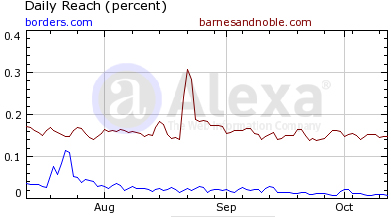
These assets were offered in an auction. So one has to ask, why didn’t Amazon buy them?   Here are some thoughts:  Amazon probably already has all the customer information Borders.com was offering.  But wouldn’t the domain names redirecting to Amazon.com be something Jeff Bezos & Co. would value?  Perhaps. Perhaps not.  Here’s a comparison of the website traffic for borders.com, barnesandnoble.com, and amazon.com, courtesy of our friends at Alexa:

Perhaps Amazon felt the Borders.com domain name was not very valuable. And this chart below can demonstrate perhaps why Barnes & Noble did … their traffic is at least in the same ball park, once you remove Amazon from the scale:

What do you think? Should Amazon have bought Borders’ assests rather than allowing Barnes & Noble to take ownership of them? I’ll open up a public poll tomorrow…

Book publishing on Amazon

Over the past several posts we have been examining a screen shot showing the 7,300 books published by Outskirts Press for our authors that currently appear on Amazon.com, and we’ve been looking closer at the breadth of subject matter and quality.  Well, so far we covered the breadth of subject matter, including the statistic that approximately 40% of the books we publish are fiction and approximately 20% are religious or spiritual in nature.

So now let’s cover the quality.  Here’s the screen shot again, so we can look at the Average Customer Reviews of Outskirts Press books:

Of the 7,302 books appearing on Amazon, 4,052 have at least a one-star rating. Notice that this doesn’t mean 4,052 books ONLY have a one-star rating, since the number of books with 4 or 5 stars is included in this 4,052 number.  Instead, it means that of the 7,302 Outskirts Press books appearing on Amazon, 55% of them have received a rating of some kind.  Compare that with our 5 largest competitors, where that percentage is 42%, 30%, 25%, 21%, and 15% respectively.  Ouch.  By the way, I’ve mentioned in the past I don’t mention our competitors by name, even when I want to — like now.

Of course, simply receiving a rating doesn’t necessarily equate to “quality,” particularly as it involves the one-star ratings. But receiving a rating does relate to is ENGAGEMENT by the author in marketing effort.   Let’s look at those figures above again.  Only FIFTEEN PERCENT of one of the major online publisher’s authors have managed (or bothered) to even get 1 review of the book they worked so hard to write and then threw into a machine to publish.  That’s kind of … sad. Perhaps that is because once their book is published, their publisher forgets about them.  They probably don’t receive years of ongoing marketing support via email like our authors do with the exclusive Outskirts Press Marketing COACH.

So now let’s look at the quality of books, which relates to the number of reviews that are 4 stars or higher.  For Outskirts Press, that number is 3,791, which is 52% of all the books we have published.  That IS a demonstration of quality.

So, let’s compare the quality of Outskirts Press with the quality of those 5 other publishers, at least as determined by Amazon readers:

Publishing Firm Percentage of 4 or 5 star ratings
Outskirts Press 52%
Company A 24%
Company U 37%
Company X 19%
Company C 27%
Company L 13%

Hmm, I guess on second thought, if I published with Company L, I wouldn’t go out of my way to get any reviews either – since I’d have the highest possibility among these 6 publishers of getting a lousy review.  Better yet, I think I’d consider publishing with Outskirts Press, where our books are reviewed more often and receive statistically more 4 & 5 star reviews among all the major self-publishing companies.  If you’re looking for a way to compare self publishing companies, this is one way. There are other ways, too, and I’ve blogged about one way here.

Amazon publishing

To continue the post from yesterday, we’re looking at this Amazon screen shot of the 7,302 books Outskirts Press currently has published and listed available for sale on Amazon for our authors:

We discussed the New Releases and Department sections yesterday. That brings us to Format, where you can see Paperback books are far and away the favorite, although Kindle Editions are catching up fast, considering the Paperback count starts in the year 2002 and the Kindle editions began in 2010 with the release of our Amazon Kindle Edition.

Since we also provide the Kindle Edition service for authors with books from other publishers, our Kindle numbers are actually much higher, but we often perform that service for authors “behind the scenes.”

We do a lot of these because authors from many of our competitors would rather pay us a small one-time fee to perform this service independently so they keep 100% of their profits as opposed to letting their current publisher do it and take up to 50% of their Kindle profits.  Hmm, you’d think that same reasoning would translate to moving their books to Outskirts Press where we pay 100% profits on paperbacks and hardbacks, too.  And you know what? It often does.

But I digress.  “Binding” comes next and seems to be fairly redundant.  Then comes mentions of specific authors and then Series, followed by “Shipping Option” and “Promotion.”

The “Average Customer Review” is interesting though, and I’ll cover that next time…