
Best of December promotion

Last December Outskirts Press ran a promotion looking for the “Best Manuscript of December” where the winning author will receive not only a full credit of their publishing package cost, but an additional 10% as well.

According to our manuscript evaluation department and author services team (the front-end folks), it was very successful and resulted in a LOT of manuscript submissions. I always say a discount or a promotion is never the ONLY reason to use a company, but it can sometimes help those “on the fence” take action. The idea, of course, is to combine the benefits of your business or company, overall, with the urgency of the promotion.

Our manuscript evaluation team then narrowed down ALL the manuscripts we received in December from authors who began their publishing package during the promotion dates and from that list provided me with 12 very high-quality manuscripts to review.  Yes, from ALL the manuscripts that were submitted, 12 made it to the second round, and let me tell you, these were 12 excellent manuscripts!

The idea of this process was not only to identify and reward a very talented author, but to also imitate the selection process of traditional publishers, as harsh as it is.  These 12 manuscripts from among all the submissions represents a much larger “statistical likelihood” than an unsolicited manuscript finding success with being sent to a traditional publisher or agent.

The next step was very closely reviewing these 12 manuscripts to narrow them down even further.  The 12 “second round” manuscripts literally came from all four corners of America — ranging from California to Connecticut, New York to Texas — and the globe.

It was challenging narrowing down the 12 to a more manageable 6.  They were all very, very good.  Now we have arrived at 6 “finalists.” 

3 fiction and 3 non-fiction.

Since they were all submitted in December, some of them are already published, but until all 6 finalists are published, we cannot move forward with the judging. Here’s why…  While there’s no doubt the strength of the writing is very important, other factors contribute to an overall successful book — not the least of which is being a professional author who has a “platform” on which to jump-start marketing efforts after publication.   But we also want to view the published book “as a whole” including its cover, the back copy text, the author’s webpage, marketing tactics being put forth, etc.

This also imitates the process of a conventional publishing process, where the publisher or agent is almost always as equally interested in the author as the manuscript. “How easy is this author going to be to work with? How professional is she?  How much marketing muscle can he bring to the table?”  Etc.

Once all 6 books are published, I’ll touch upon this again.
Find the pot of gold

One of the promises I made to myself when I started this blog at the first of the year was that I was going to try to “reveal” some inside stuff since that is probably an expectation when reading a blog from a CEO.  When I discussed this topic in a previous posting, I mentioned the dilemma such a goal produces: revealing interesting enough stuff without jeopardizing either  the interests of our company or our authors.  It’s a hard line to walk.

But today presents me with a perfect opportunity!  On St. Patrick’s Day we’re offering a 1-day promotion and I’m announcing it here first.  Authors who order their book publishing package during St. Patrick’s Day and include the following promotion code at the time of check-out, will receive a 20% instant discount on either the Diamond or Pearl full-color  publishing packages.

PROMO CODE:  PADDY2010

 Talk about finding the pot of gold at the end of the rainbow! An instant discount worth either $199 if you publish with the Diamond, or $219 if you publish with the Pearl.

Click here to publish your book

Press Release Happy

Speaking of press releases, Outskirts Press was recently complimented when it was referred to as “press release happy.”  That’s true!  We are press release happy, and we are happy with the results of press releases.  In fact, we have a systemized “Press Release System” to try to make the process of creating and distributing press releases as effective and efficient for both us as a company and all our authors as possible.

We send out three different types of press releases:

1. Standard Publication Announcement Press Releases

These press releases follow a very standardized formula of composition to ensure they contain all the necessary elements to announce the publication of a book, be optimized with keywords, and contain enough content to serve the author’s purpose. When you release as many of these types of press releases as we do (between 50-100 each month), it becomes necessary to standardize them both for consistency and quality control. Each of our Diamond authors  receive one of these standard press releases included with the package; and therefore, the majority of the standard press releases we distribute are for our Diamond authors. Press releases help these authors draw attention to the publication of their book and also get their feet wet with the process of promotion by starting with a common initial tactic.

2. Custom Press Releases

These press releases are also exclusively for our authors and can be used either to announce the publication of the book itself, or any other special occurrence the author wishes to promote. They are custom drafted by one of our press release writers according to the wishes of the author.  Unlike our standard press releases, the sole purpose of which are to announce the publication of the book, the custom press release can be used multiple times by the same author, to highlight author events, the winning of an award, or any number of other accomplishments. 

I am always looking for ways we can improve our services for our authors and I feel one of those ways is in further educating authors that press releases are not ONLY for the publication of a book. Yes, the publication of a book is a good “excuse” to send out a custom press release, but the goal of any good press release should be to make the release news worthy; and in this day and age, the simple publication of a book is rarely news worthy on its own.  The responsibility lies with the author and press release writer to come up with something more news worthy. On the other hand, when a book wins an award, or multiple awards, that makes better content for a compelling release, particularly at the local level.  I am of the opinion that a Standard Press Release should be used to annouce the publication of a book and a Custom Press Release should be used multiple times to announce the accomplishments of the book.

The quantity of Custom Press Releases for authors that we send out every month varies, but is almost always less than the number of standard press releases we distribute (not surprising, really, since one is free with the Diamond package and the other has a cost to it).

3. Company Press Releases

The third type of press release Outskirts Press distributes are custom-drafted press releases focused on a new service or product or feature of Outskirts Press.  We try to distribute one of these every Tuesday.  Like all of our press releases, we have made efforts to systemize this PR schedule for the sake of efficiency, so there is a method to the madness. The first Tuesday of every month we will typically distribute a press release about our monthly promotion. The last Tuesday of every month we will typically distribute a press release about our bestselling books of the previous month. That leaves two or three remaining press releases that require a topic for each month. 

This requirement, in turn, compels us to meet website enhancement milestones or introduce a number of new products and/or services each month. In other words, our press release schedule prevents us from becoming complacent and motivates us to constantly improve and grow. Plus, as I’ve mentioned before, press releases that are distributed throughout the Internet are good for optimization purposes.  SEO and consistent service improvements? Who says you can’t kill two birds with one stone?

So, whether you’re an author or a business owner, if you’re not press release happy, maybe you should be….

Seek awards and/or recognition for your book or company

Another tactic both the book promoter and company marketer can do is seek awards. “Contests and Awards” are an industry onto itself, and there are awards and contests for just about everything under the sun, like “happiest employees,” “best places to work,” “best benefits,” “most profitable,” “minority-owned,” “largest headcount increase,” “best website design,” “CEO of the year,” “entrepreneur of the year,” “best invention,” “best product,” etc., etc… The list goes on and on.

The options are just as endless for published writers seeking book awards.  From widely recognized and established contests like the Writer’s Digest International Self-Published Book Awards to local contests being held for members of small writing groups, published authors have a daunting list of contests and awards to consider pursuing.

Adding insult to injury, most of the contests have entry fees, so not only is it a matter of time, there is also a financial investment one is making when choosing to pursue these recognition programs.  For companies, the fee is often nominal, but for an author faced with thousands of contests each costing between $10 – $400 each, it becomes important to separate the wheat from the chaff.  

For example, in an effort to help our authors successfully and conveniently pursue valuable awards and contests, Outskirts Press offers an optional Book Award Submission Marketing package that includes all the details associated with submitting books to 6 widely recognized and established book awards, including the Writer’s Digest award mentioned above, the ForeWord Magazine Book of the Year award, and 4 more.   As I often say, this isn’t something an author can’t do himself — double negative alert! — but it matters not whether published authors take advantage of marketing services offered by their respective publishers, or seek award entry independently; the important point is that authors do it, one way or the other.

For a convenient way to search for awards or contests to enter, visit www.awardsync.com

Winning an award gives you “something to say” and when it comes to marketing a book or a company, having “something to say” is worth its weight in gold, as we’ll discuss next time…

Give incentive for people to buy your product or service

Whether you are promoting a book or promoting a company, you need to give people incentive to buy.  Just making it easy isn’t quite enough (although it is an important component).  Not only must the purchase process be easy, it must be urgent.  You create urgency through the use of promotions, discounts, or other incentives.

One of our competitors does this very well. They inflate their prices to $13,000 so they can offer a $7000 discount.  Do authors fall for this? Of course.  It looks great on a Flash banner; and it is a savvy person who can look past the flash — pun intended — and identify the true value, or lack thereof.

Books sell better with incentive, too. The most typical incentive is a discount or a “sales price” and in the majority of the cases, this type of promotion is handled by the retailer rather than the author herself.  Amazon does discounting very well.  They discount books in a variety of ways.   Not only will they often discount a single book by eating into their own margin, but they also pair similar books together and then offer discounts if the customer orders BOTH books.   My book Sell Your Book on Amazon discusses how authors can use this functionality of Amazon to their advantage.

Make it easy for people to buy your product or service

In continuing our current discussion about how book promotion is similar to company marketing we arrive upon a step that can oftentimes single-handedly mean the difference between success and failure.  It’s a proven fact. If something is too hard, most people won’t do it.

Amazon.com is a perfect example of this. They have “perfected” the process of online product sales. It is almost TOO easy to buy things on Amazon. How many of us have gone to Amazon to make a single purchase and by the time we’re “checking out” we’ve added one or two additional items?  Amazon is the ultimate product sales “person.”   This is actually the cornerstone to my book Sell Your Book on Amazon, but you can see examples of “good” selling processes and “bad” selling processes all over the Internet.

I recently saw an article in Entrepreneur discussing a new technology/service company. I recognized the potential it might hold for published authors and so, to experiment with it on our author’s behalf — I have said in the past that I often use myself as a guinea pig for tactics I feel our authors should pursue — I signed myself up to the tune of $29 each month.

Sure, giving them that initial $29 was relatively smooth, but the instant the “credit card cleared” their site seemed to break and I couldn’t log-in to their customer center.  A day later I received an email that I could log-in. Apparently they were handling payments manually.  Not ideal, but okay.  Once I logged-in, however, I was confronted with a non-intuitive “dashboard” that, I’m sorry to say, gave me WAY more credit than I deserved.  It made assumptions about my depth of knowledge and asked me questions that I didn’t know the answers to regarding the service they were offering. What’s more, there wasn’t a “help button” or instruction manual or “contact us” link to be found.  

In short, they were not making it easy to buy their product or service… Almost impossible, I’d say.

As a company that conducts 100% of our business through our website, we have considerations like this all the time at Outskirts Press. We spend “scads of dough” on website design, optimization, usability, etc., in an effort to make the process as enjoyable as possible for our authors. We’ve come a long way. And we have a long way to go. Our site has tons of information but here’s an interesting fact — people don’t “read” websites, per se. They skim. They browse.  The trick is communicating information visually.  

Amazon does this very well nowadays. I recently saw a “running example” of what Amazon.com looked like in the 90s.  As they say: “You’ve come a long way, baby.”   

It’s a fine line between improving the customer experience, and constantly changing the website to improve the website, which, ironically, customers don’t like, either.  Very few people “like” change.

So how does this consideration translate to book promotion and book sales? It’s a changing world, and people are “using” books in different ways, now.  It used to be that there were just “paperbacks” and “hardbacks.” Then, “ebooks” became another format to consider. Nowadays, simply calling something an “ebook” isn’t specific enough, as there are multiple formats and multiple platforms to consider — Kindle books, Sony Reader books, Nook books, iPad books, Stanza books, Espresso Book machine books… the list goes on and on.

“Make it easy for people to buy your product or service.” At Outskirts Press, one of the ways we do that as a company is by making it easy for readers to buy our authors’ books, in as many different platform choices as possible. To that end, we offer options for paperbacks, hardbacks, general ebooks, Kindle editions, and Espresso Book machine editions.  Thanks to the Kindle app, our Kindle books are also available on the iPhone, iTouch, and iPad; and we’re working on optional methods for our authors to get their books  in front of the Sony, Stanza, and Nook crowds, too.  

When an author’s book is available in whatever manner a customer wants it, that is the definition of “making it easy for people to buy your product.”

Optimize your book or company for search

As we continue discussing how book marketing is similar in many ways to marketing a company, one consideration to always keep in mind is “search engine optimization.” This may seem a more appropriate topic when it comes to marketing a company, specifically as it relates to optimizing a company website, but the same considerations — and therefore the same tactics — hold true with regard to book promotion as well.

Optimizing your book for Internet sales starts with the title.  I discuss this subject in my book Sell Your Book on Amazon in regard to how Amazon’s search engine indexes books, but the same can be said for Internet search engines in general (Google, Yahoo, etc).  When “content” is indexed by computers, the “title” of that content is weighted quite heavily. For books, the title is… well, the title. For web pages, the title is the “title page” in the HTML.

This is so important for authors that Outskirts Press offers an optional service whereby we offer title suggestions to our authors.  This begins with seeing the author’s initial title and/or sub-title. We analyze that against the content of the book and against other books that may either share that title or be “too similar” to that title.   Next, we suggest 3 alternate titles and sub-titles that are geared toward maximizing the applicable “keywords” that define the book’s subject matter or content. 

Sub-titles for books are one of the most powerful, and one of the most overlooked, marketing opportunities for books in the Internet age.  One need look no further than five of the top 10 bestselling books published through Outskirts Press in 2009 for perfect examples. I’ll highlight the keywords that are helping these books get seen by more potential customers who conduct searches on the Internet.

  • The Complete Guide to Day Trading: A Practical Manual From a Professional Day Trading Coach, by Markus Heitkoetter
  • LEED AP Exam Guide: Study Materials, Sample Questions, Mock Exam, Building LEED Certification (LEED-NC) and Going Green, by Gang Chen
  • Meat Smoking and Smokehouse Design, by Stanley Marianski, Adam Marianski, Robert Marianski
  • Sell Your Book on Amazon: Top-Secret Tips Guaranteed to Increase Sales for Print-on-Demand and Self-Publishing Writers, by Brent Sampson
  • What To Do When You Become The Boss: How New Managers Become Successful Managers, by Bob Selden

If sub-titles are so successful for books, ask yourself…. should your company have one?  Are the names/titles for the products or services you launch optimized for search? These are important things to consider.

Navigating the Amazon Sales Ranking

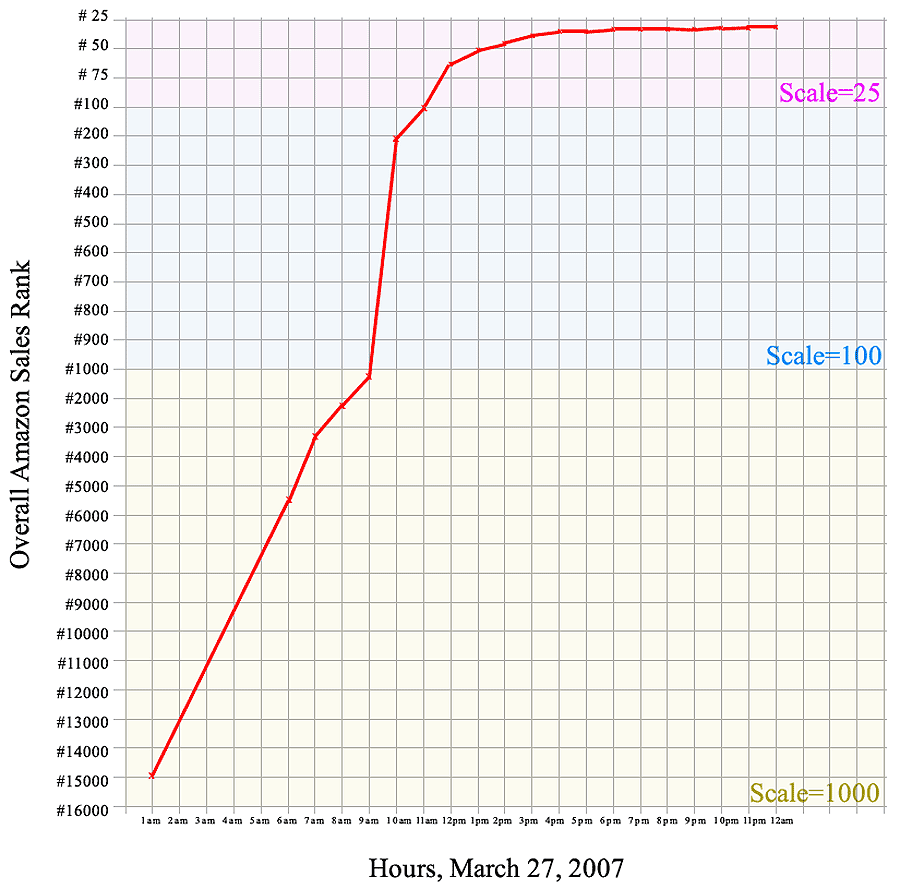
In a previous post I discussed my book SELL YOUR BOOK ON AMAZON’s climb up the Amazon Sales Chart as a result of specific marketing tactics. I included the following graph, which we charted on the day of the campaign:

There are some interesting things to notice about this cart.  For instance, you will notice how rapidly the ranking climbs from 15,000 to 3,000.  And then, again, you will notice how quickly it climbs from 1000 to 200 (the difference in scale notwithstanding, of course).  But also notice how slowly it climbs from 50 to 29.  This is probably obvious, but I’ll say it anyway: The closer you get to a #1 ranking, the more books you need to sell. 

One section of my book discusses the Amazon Sales Rank in detail, and the information may be helpful when looking at the above chart, so I’ll include it below:

First, the disclaimers: Since the algorithm Amazon uses to generate its sales ranking is proprietary, the details contained herein are extrapolated from research and field tests. The resulting consensus finds Amazon’s system to provide marginal sales data at best.

To whit, read Amazon’s own definition of its system, slightly paraphrased from their FAQ: “The Sales Ranking system exhibits how books are selling. The lower the number, the higher the sales. The calculation is based on sales and is updated each hour to reflect recent and historical sales of every item sold. We hope you find the Amazon.com Sales Rank interesting!” This last sentence seems to indicate Amazon’s own perspective on the importance with which the sales rankings should be viewed.

You’re not supposed to find the sales rankings informative or helpful. You’re supposed to find them interesting.

In actuality, the process is somewhat more convoluted than they let on. The ranking does not depend solely upon the actual number of books sold, but rather, on a comparison against the sales figures of the other books in their database (all 5 million+ of them) within that same hour. Simultaneously, a trending calculation is applied to arrive at a sales trajectory. So, hypothetically, a book that held a ranking of 2,000 at 2pm and 3,000 at 3pm, might hold a 4,000 ranking at 4pm, even if it actually sold MORE books between 3-4 than it did between 2-3.

Current projections and historic sales information also play a key role in these calculations. In fact, the predictive nature of the Amazon ranking system is what makes it possible for a newly-released book to outrank an older established title, even though the actual sales figures for the latter far exceed the former.

That said, sales history takes a back seat to current sales rankings. Sales projections and trending take an active role here, which is why a book’s ranking can leap from 900,000 to 200,000 in the span of 24 hours or less. Does this mean the book has sold 700,000 copies in 24 hours? Absolutely not! What it does mean is that recent activity (i.e. purchases) for that book is trending higher than those 700,000 books it just surpassed. But, don’t get excited just yet; since the activity of those 700,000 other books range from slow to stagnant, one or two orders are sufficient to catapult a ranking.

If a book’s ranking breaks into the top 100,000, the sales history calculation starts to rear its head, which is why a “phenomenon” book has a hard time maintaining a high, legitimate ranking. A phenomenon is defined by a book that leaps from the high hundred-thousands into the lower thousands (or better) in the span of 24 hours or less, usually due to some concentrated marketing initiatives. Since Amazon’s sales history for that title doesn’t support the leap, the spike occurs and then quickly drops again.

HOW DOES ALL THIS TRANSLATE TO ACTUAL SALES FIGURES?

Since the data is recalculated all the time, it’s impossible to arrive at accurate, cumulative sales figures, although those figures are applied to the algorithm during the calculation. No, to get a very rough idea of the actual number of books being sold, the sales ranking has to be dissected dynamically, with the same immediacy as the ranking being calculated. In other words, chart the ranking of the book at the same time every hour for 24 hours and then divide by 24 to arrive at its average daily ranking. Do that for seven straight days to arrive at its average weekly ranking.  You can do it all month long to arrive at its average monthly ranking. The longer your average timeframe, the more accurately your sales ranking will reflect “reality” (as opposed to a spike or dip in sales).

Are you a best-selling author? Part 1

Some of my previous posts have already touched upon the caveat that should exist with the term “best-selling author” since different lists from different retailers have different values and different processes for creating the list.  An argument could be made that the only true way to define a “best-selling” book is based upon the number of copies it has sold.

As both the president of a self-publishing company and an author, I am in a fairly unique position of being able to see my own book sales, compare it with my Amazon Sales Rank, and then do the same for the 5,000+ other books that have been published through Outskirts Press.   I talk about this a little bit in Sell Your Book on Amazon, because I feel it’s a unique perspective.   And since I have an opportunity to share a unique perspective, I feel obligated to do so.

And here’s my perspective: If you have an “Amazon Best-Selling” book, you should be proud.  All things taken into consideration, that’s an amazingly hard feat to accomplish.   With the proliferation of books being published nowadays (500,000+ a year), it’s been said that publishing a book isn’t all that impressive anymore. Excuse me? There are over 6 billion people on the planet.  If you’ve written and published a book, no matter how you’ve done it, you’re in the minority. 

With the “best-selling Amazon campaign” it’s been said that being an “Amazon best seller” isn’t all that impressive anymore. Excuse me?  There are 500,000+ books published every year.  If your book was/is an Amazon best seller, no matter how you’ve done it, you’re in the minority.  And books that are Amazon best sellers still attract attention and kudos from publishing traditionalists like editors, agents, and conventional publishers.  These people are scanning the self-publishing ranks looking for their next authors/clients, but maybe no longer due to the strength of the book and the promise of its sales potential. Now I believe it is because an author that can “become an Amazon best seller” themselves has successfully demonstrated his or her ability to leverage/monetize their platform.  And that’s what is valuable to all publishers and agents — an author who not only has a platform, but can turn that platform into book exposure and book sales. Just having a list of 500,000 to million people to conduct the “campaign”  is impressive to publishers and agents, not to mention composing a “pitch” compelling enough to get a large number of those people (most of them strangers) to purchase something.  Like I said before, it’s all easier said than done, and that’s why being an Amazon best seller is a hard-earned, noteworthy status. We have many authors at Outskirts Press who have accomplished this, and it is a milestone in their continuing book promotion efforts.

Changing the name of your blog

At some point during my previous blog postings I was discussing the process of picking a template for this blog and placing some of the widgets along the side.  In doing so, I think I’ve arrived upon the WordPress blog template that I like the most, although the one element I don’t like so much about it is the “Leave a comment” link at the top. It wouldn’t be so bad if you could actually leave a comment, but as I referred to in a previous post, I’m not positive I have time to do comments justice, so they are turned “off.” My Board of Directors keeps telling me I don’t even have time to do a blog justice, and they’re probably right.

 As a result, the “Leave a comment” link that is so inviting up there at the top but doesn’t actually do anything is kind of annoying.  As George Castanza said on Seinfeld, “Why must there always be a problem?”

I also referred to the fact that, when “naming” my blog, WordPress advised me I could change it any time I wanted. Of course, I further detailed my inability to find the procedure by which one changes the name and came to the conclusion that I was simply stuck with my original blog name, which, when I registered this blog with WordPress was: CEO Self Publishing Start-Up OutskirtsPress.com

Lots of keywords? Yes. Grammatically correct? No.

Well, by browsing the “help” and forums of WordPress (hence my stumbling upon that “Write a Book” link” which I mentioned in a previous post), I was able to learn about the General>Settings page, although I’m embarrassed to admit how long it took me to find it on the screen even when I knew precisely what I was looking for.

But I digress. The short story is that I simply added the word “of” to the name and now the name of my blog, at least today as I’m writing this,  is a more grammatically-correct, and still keyword-filled: CEO of Self Publishing Start-Up OutskirtsPress.com.

What does “keyword-filled” mean? It means those are the keywords I envision the intended target audience of this blog typing into a search engine and then finding my blog as a result.

For instance: CEOs and executives may be interested in some of the things I write because I’ll touch upon things like social media confidentiality, trade secrets, M&As, recession-proofing your business, and the like.

And people searching for “self publishing” may be interested in some of the things I write because there is a lot of confusion and misunderstandings about the term; savvy authors exploring all their publishing options are wise to get as many different perspectives as possible to make an informed decision.

And people searching for the phrase “start-up” may be interested in some of the things I write about because I’ll talk about running a company with a 3-year growth percentages of 1000%+, balancing work and a personal life – what personal life? – and managing the obstacles that presents themselves – and the solutions that are required – when you outgrow your credit card processor and your website hosting company all in the same quarter, for example.  

Although, on one hand, Outskirts Press was never in “start-up” mode, per se, because that implies angel investors, securing VC rounds, losing control and board seats, etc – and none of that applied to us, which makes us relatively unique and is also something, perhaps, people searching for “CEO” and “start-up” might find interesting. On the other hand, EVERY company should always view themselves in “start-up” mode to some extent — because every day should be an agressive struggle to improve and thrive.  On the first hand again, it may be selling ourselves “short” to refer to Outskirts Press as a “start-up,” because… well, for all those reasons I mentioned above.   I think maybe I will replace it with a reference to our Inc. 500 placement, which has the potential to attract the same keyword searches– and therefore the same audience– as “start-up” anyway, and is more accurate. And cooler, too.

Now that I think of it, I may want to add “Best-selling author” to the name of my blog, too, but that presents a whole host of considerations, which I’ll get into later…